
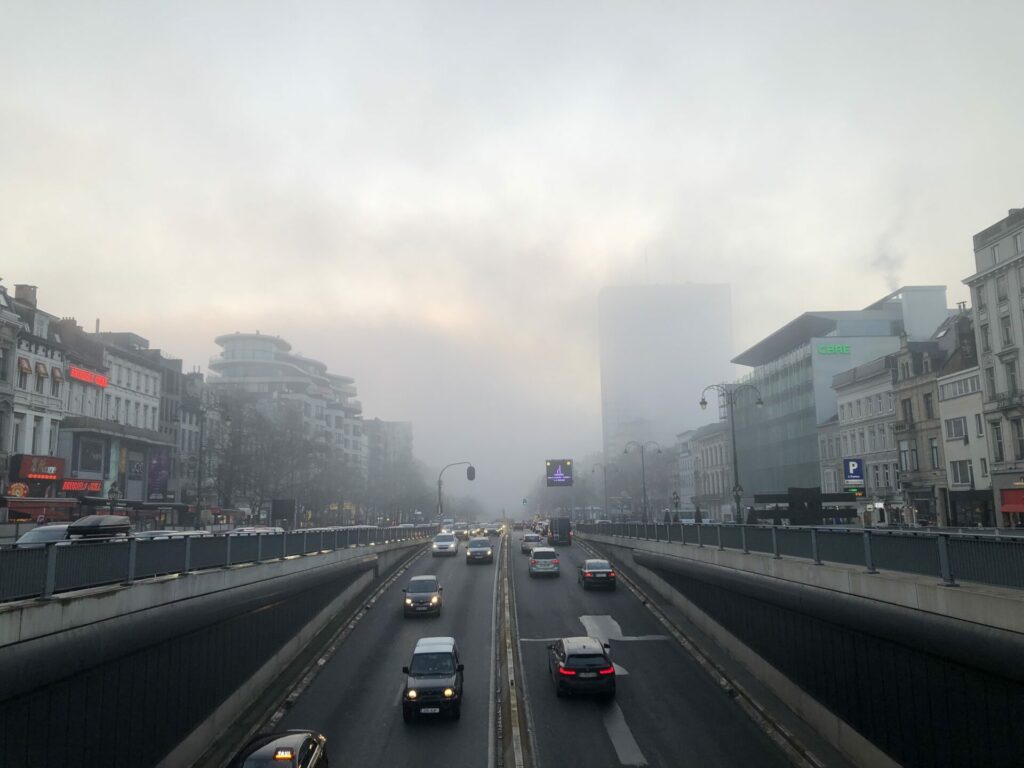
Noise pollution is one of the most felt environmental impacts for people living in Brussels. While its health consequences are well documented, proper measurements are needed before action can be taken. To this end, Brussels is launching a new 'Noisemonitoring' website.
Noise is much more than just a nuisance: it is a genuine public health problem, stressed the office of Brussels Environment Minister Alain Maron (Ecolo). Excessive exposure can lead to stress, sleep disturbances, chronic fatigue, and even cardiovascular disease.
"Noise is not inevitable," Maron said. But to effectively address the problem, objective, accurate, and consistent measurements are essential.
"With Noisemonitoring, we give every Brussels resident the opportunity to view and understand their noise environment," he said. "It is also an indispensable tool for taking fair and effective action to protect everyone's health and well-being."
New, more accessible website
While noise is a nuisance that disappears once it is over, mapping it allows residents and the authorities to visualise the issue and make it more tangible.
The new website shows the noise levels measured by the measuring points in real time. This allows for comparing measurements over time, distinguishing between different noise sources, monitoring compliance with existing standards, and providing reliable data to guide government policy.
The example of aircraft flying over the Brussels-Capital Region demonstrates this: measurements can be used to identify violations of the decree on combating noise pollution caused by air traffic and provide irrefutable evidence.
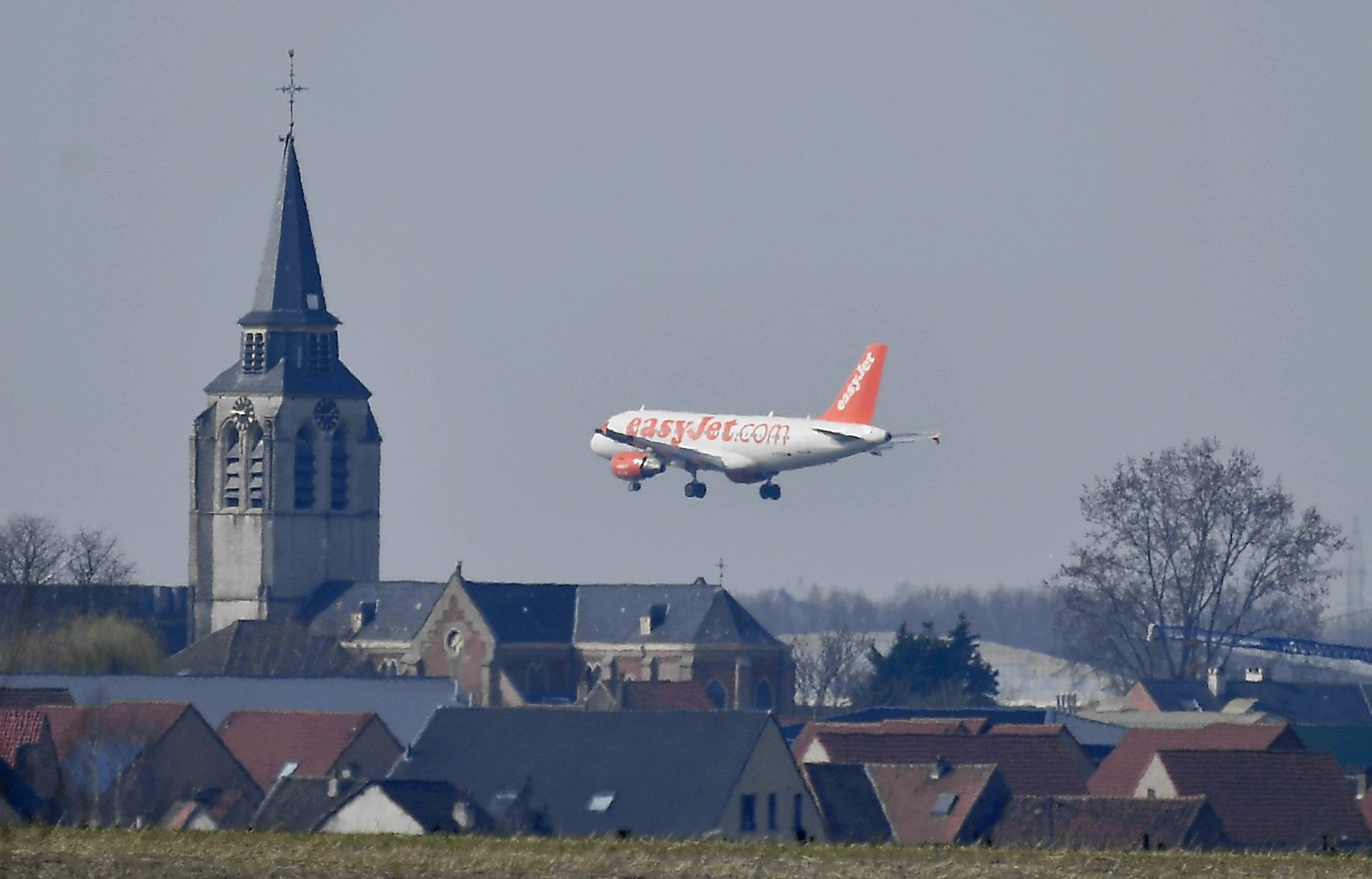
An airplane flying near Brussels Airport in Zaventem, Monday 13 March 2017. Credit: Belga/Eric Lalmand
Managed by Brussels Environment, the new website allows for real-time monitoring of noise levels measured by a network of 22 measuring stations across the Capital Region. These stations continuously measure ambient noise and specific noise pollution from air, rail, and road traffic, 24/7.
The results are accessible to everyone in the form of graphs and clear analyses, which can be consulted immediately or downloaded for more in-depth studies.
This means that every citizen can easily consult the noise level per measuring station and per period (day, week, month, year), better understand aircraft noise thanks to information directly related to regional regulations, and quickly access the data, which is also made available to municipalities and associations.
When does noise become a nuisance?
Nearly all (90%) of the Capital Region's surface area is affected by traffic noise, and almost half of it experiences noise levels that could seriously disturb the population, according to the World Health Organisation (WHO).
The north and southwest of the Region, where road, air, and rail traffic are cumulative, are particularly at risk with high noise levels exceeding 60 decibels (dB) over large areas, according to Brussels Environment. Only the southeastern part appears to be relatively unaffected: aircraft fly over less frequently. And although nighttime noise levels are much lower, traffic noise still affects half of the territory.
Noise levels are "alarming" in approximately half of Brussels: 45% of the territory is exposed to levels exceeding 55 dB (the threshold for "severe disturbance"), 28% to high noise levels exceeding 60 dB, and 7% is likely to exceed the 68 dB regional intervention level.
Very high values (between 65 dB and 75 dB) are mainly observed around motorways and metropolitan arteries leading to the A12 Antwerp, A3/E40 Liège, and A4/E411 Namur; as well as around the Western Ring Road near Anderlecht and Forest, and around the Eastern Ring Road in Auderghem and Neder-Over-Heembeek. The same applies to the city's access roads.
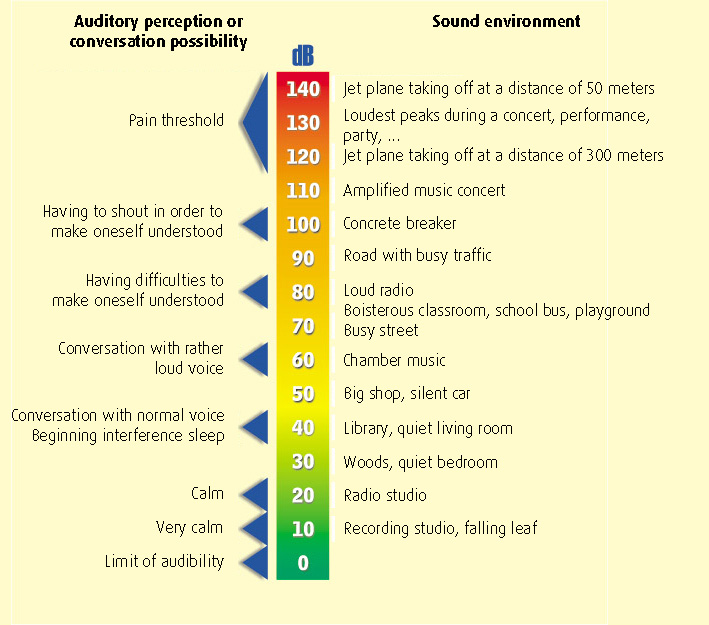
Decibel scale. Credit: Belgian Health Ministry
But given the density of the road network in Brussels, road traffic noise is everywhere. On most major roads and their surroundings, the level exceeds 55 dB – which affects about a third of the regional territory (33%). "This is particularly concerning for the health of local residents, as the WHO strongly recommends that road traffic noise levels should not exceed 53 dB."
Remote, quieter areas within residential areas or in the heart of sparsely urbanised areas (parks, fallow land, forests) also still exist, but the noise levels can still be quite high: between 55-60 dB in large city parks such as the Bois de la Cambre and the Cinquantenaire Park, or around the Sonian Forest and large green spaces.
However, there is light (or silence) at the end of the tunnel: noise nuisance related to traffic has decreased everywhere in Brussels compared to 2016. The levels have gone down across the entire Brussels Region (except around the Ring Road, in the west and northwest), at all hours of the day and even more so at night.
