
Brussels needs “major efforts” to ensure its air quality complies with international health standards, warned the Brussels-Capital Region’s environment administration, Brussels Environment.
Poor air quality is a significant health hazard. The exposure to polluted air can cause issues ranging from bronchitis, to asthma, to lung cancer in severe cases.
The pollutant nitrogen dioxide (NO₂) and PM2.5 have the greatest impact on human health, with estimates that over 4,000 premature deaths in Belgium in 2022 were caused by the exposure to PM2.5, according to the European Environment Agency.
Ahead of the International Day of Clean Air for Blue Skies, Brussels Environment noted on Tuesday that while the Region's air has steadily improved in the last decade, not all its air quality measurements comply with requirements, as outlined in its latest annual report.
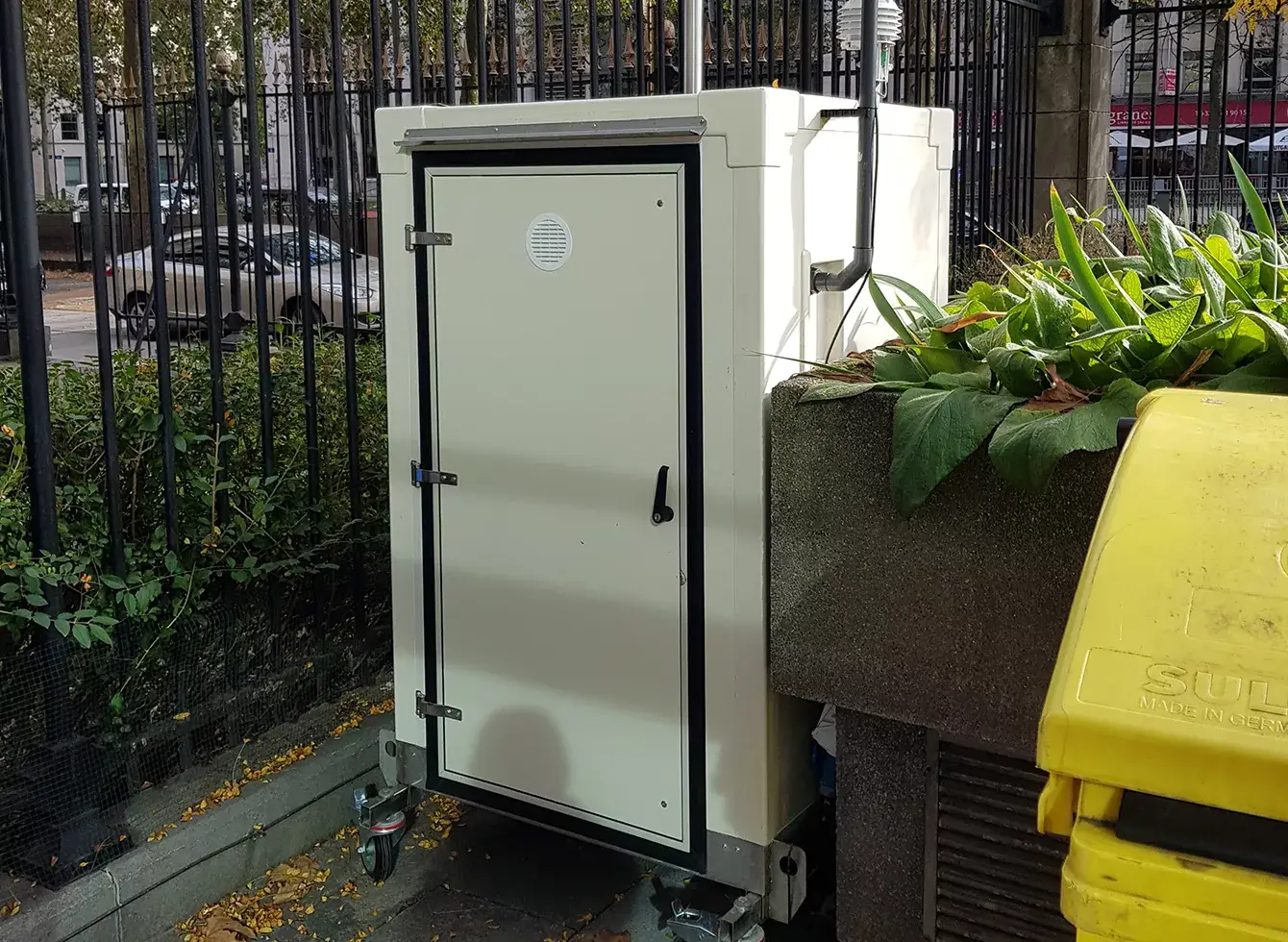
One of the 13 measuring stations in Brussels. Credit: Brussels Environment.
The Region has a network of 13 fixed monitoring stations to keep track of pollutants in the air. This is supplemented by the "secondary network", consisting of simpler, less accurate, and cheaper, measuring devices in 29 sites of heavily polluted areas.
One of the “biggest challenges” for the capital remains the concentration of NO₂. While all official measuring stations met the 2024 European standards, this was not the case for the secondary monitoring network.
Additionally, the stricter WHO standards, which the 2023 air-climate-energy plan (PACE) sets out to achieve by 2035, are yet to be met for this pollutant. This is also the case for the pollutant PM2.5 and ozone.
Postponing climate measures?
While PACE already has a "coherent" plan set to improve Brussels' air, the progress could be jeopardised if authorities fail to commit to existing environmental goals and initiatives, according to Brussels Environment’s spokesperson, Pascale Hourman.
“Any reduction in ambition or postponement of a measure would destabilise this balance [in PACE],” she said. “[It] would considerably increase the risk of not achieving the pollutant reduction targets, compromising both public health and the regional commitment to better air quality.”
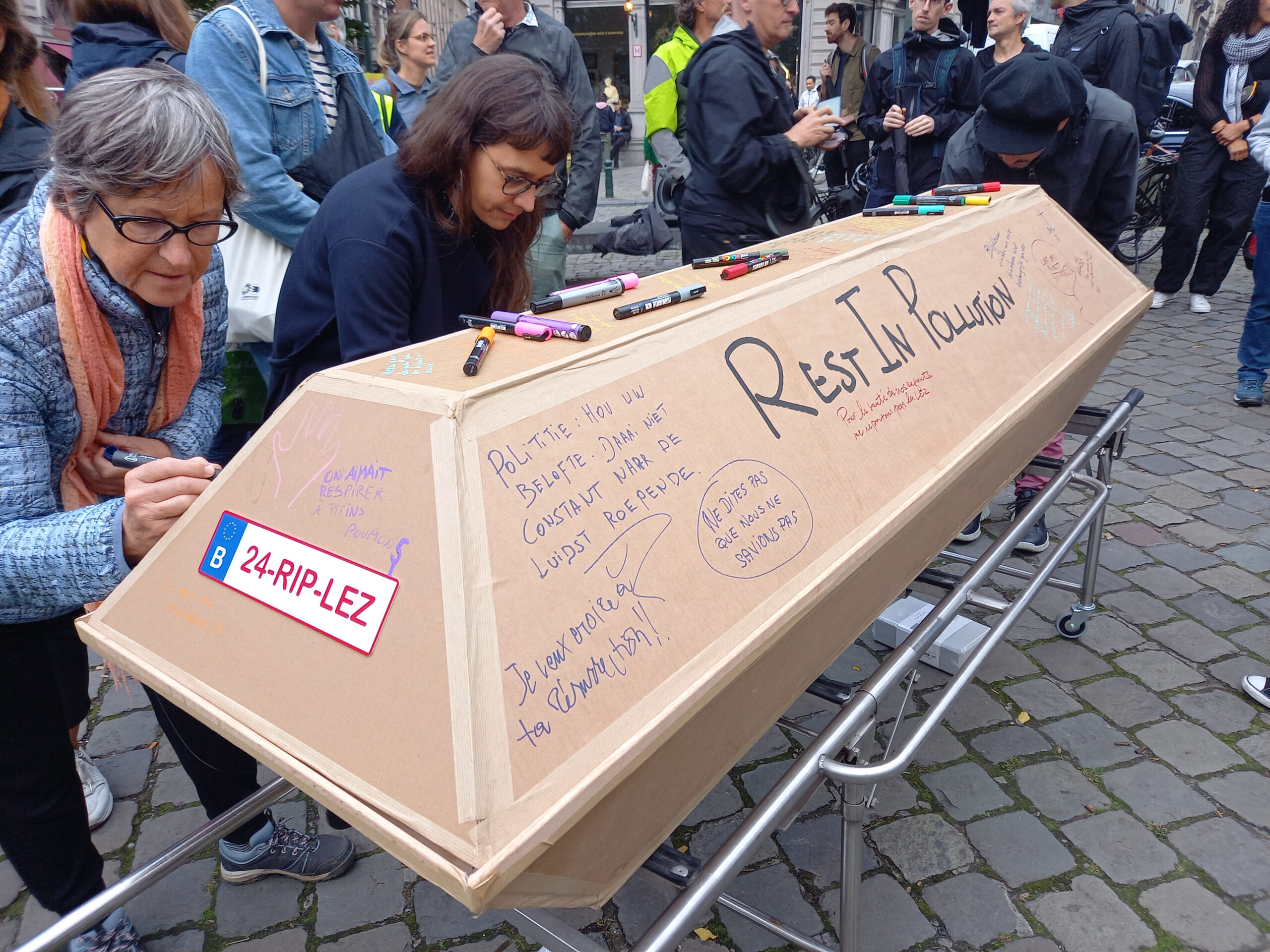
Fictional burial ceremony of the LEZ low emission zone by citizen's collective Bruxsel'AIR to denounce the proposal to postpone the next phase of the low-emission zone, on 23 September 2024. Credit: Belga/Jean Van Driessche
Last year, the Brussels Parliament voted to postpone the next phase of the LEZ to 2027. The decision was met with backlash, with several associations condemning the decision's impact on public health.
While Hourman says this is currently not expected to significantly hinder the ability to meet the upcoming air quality target, she warns that the impact of any major change to current efforts cannot be easily fixed.
“Such a decision would be difficult to offset by accelerating other actions planned in the PACE, as it would entail significant social, financial and operational costs,” she added.
Approaching targets
Although the capital still falls behind on certain pollutant standards, Brussels Environment still believes it can get a hold of NO2, one of the most dangerous pollutants, NO2.
“According to models developed by UCLouvain with funding from the Bloomberg Philanthropies Foundation, more than 98% of the Region's territory is expected to comply,” said Hourman.
While she noted that the model was developed before the revision to the LEZ schedule, she believes that air quality goals are still realistic:
“This change should not have a significant impact on air quality in 2030, provided that the schedule for the 2028 and 2030 milestones remains unchanged."
