
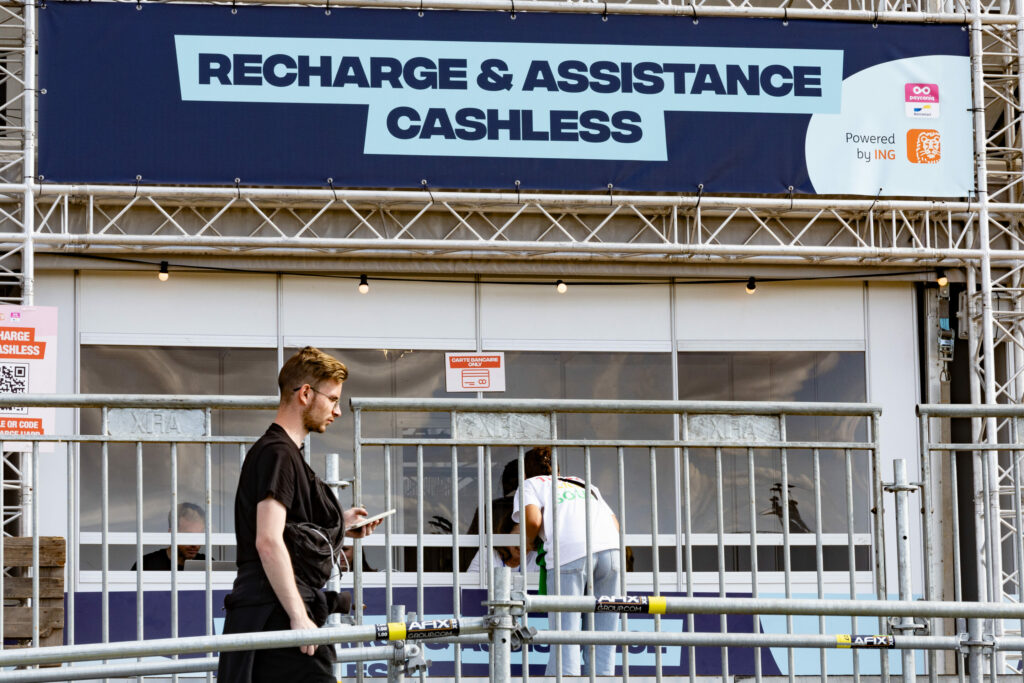
Despite government efforts to protect consumers from "unfriendly" at best and "illegal" at worst payment practices at Belgium's many music festivals, not much improvement was made compared to last year, found consumer protection organisation Testachats after a new analysis this summer.
Just like last year, Testachats investigated several festivals in Belgium to see how consumer rights are being enforced. Focusing on payment options, they found that festivals made "little improvement" compared to summer 2024. At the start of the summer, The Brussels Times decided to look at the practises, and published a special report about the issues of Belgium's cashless festival scene.
"Federal Consumer Protection Minister Rob Beenders (Vooruit) drafted a Charter that festivals can sign voluntarily. Despite this, the festival grounds are not the most consumer-friendly place," said Testachats in a press release. "What's more, the organisation even uncovered illegal practices."
Credit: Belga/Virginie Lefour
Anyone who has been to a festival recently knows that using a festival-specific payment method seems fashionable: festivalgoers receive virtual coins with names like coins, pearls, or douros on a bracelet or card, which they can use to pay at the festival.
However, to use this system at some festivals, you first have to pay: Les Ardentes charges a €1.25 activation fee, and Tomorrowland requires people to pay €13.50 to have their bracelet shipped. Dour takes a different approach: there, festivalgoers have to top up their bracelets with a minimum of €10 via the app, and they can only add €5 increments.
What's worse: anyone with any money left over at the end of the festival will then have to pay to get it back almost everywhere.
This costs €3.75 at Les Ardentes, €3.64 at Tomorrowland, and €3.50 at Rock Werchter, Graspop, and Dour. At Ronquières, revellers only get a refund if they have at least €3 left on their wristband (but they do get it all back). Other festivals offer this at a much more reasonable price, such as Paradise City or Esperanzah (€1).
Advanced festival maths
To complicate matters even further, the virtual currencies rarely correspond to euros. For example, 1 coin at Rock Werchter or 1 skully at Graspop is equivalent to €3.80 (unless you bought them in advance, in which case it was €3.50).
Tomorrowland takes the cake: 1 pearl is €1.8181, which the festival conveniently rounds up to €1.82. But Dour also knows how to play the game: 1 douro is €1.75 – so €10 (the minimum amount to top up) corresponds to 5.71 douros, making it impossible to get to 0.
Meanwhile, some festivals such as Paradise City, Ronquières, and Esperanzah demonstrate that it's also possible to use euros. This way, festivalgoers do not need a calculator to know how much money they have left on their bracelet or card.
Better enforcement neededFor Testachats, these proprietary payment methods with conversion tables are not a good development. They point to the Francofolies festival, which demonstrates that it is possible without coins, pearls, or skullies: you pay however you like, and there are no hidden fees. But for festivals that still prefer to use their own payment methods, clearer agreements are needed.

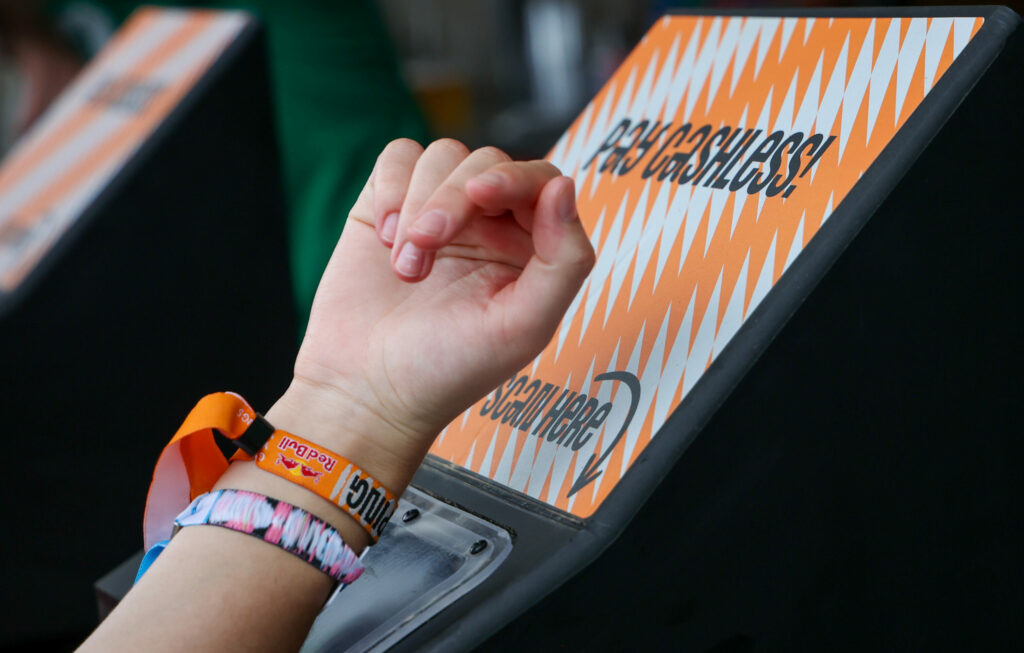
An example of a payment being made using a "cashless" wristband. Credit: Belga
This year, Beenders took the first step towards better regulations with a voluntary Charter for festivals. According to this Charter, festivals are allowed to offer their own payment method, but consumers should be able to purchae those with cash or electronically, and no minimum purchase. Additionally, festival-goers must have at least one month to recover their money.
"That is a good first step, but it still leaves the option for festivals to charge fees to activate the payment method and recover money. Festivals also choose for themselves whether to sign the Charter and comply with its rules," said Testachats spokesperson Laura Clays. "Hopefully, the Minister will work on a more comprehensive and stricter Charter in the coming years."
Now, Testachats is filing a complaint against several festivals that are still engaging in illegal practices:
- against Les Ardentes and Tomorrowland for illegal hidden fees that should be included in the ticket price,
- against Ronquières, Paradise City, Les Ardentes, Pukkelpop, Graspop, and Rock Werchter because parking and sometimes the ticket itself can only be paid electronically,
- against Brosella because not every stand accepts cash.
