
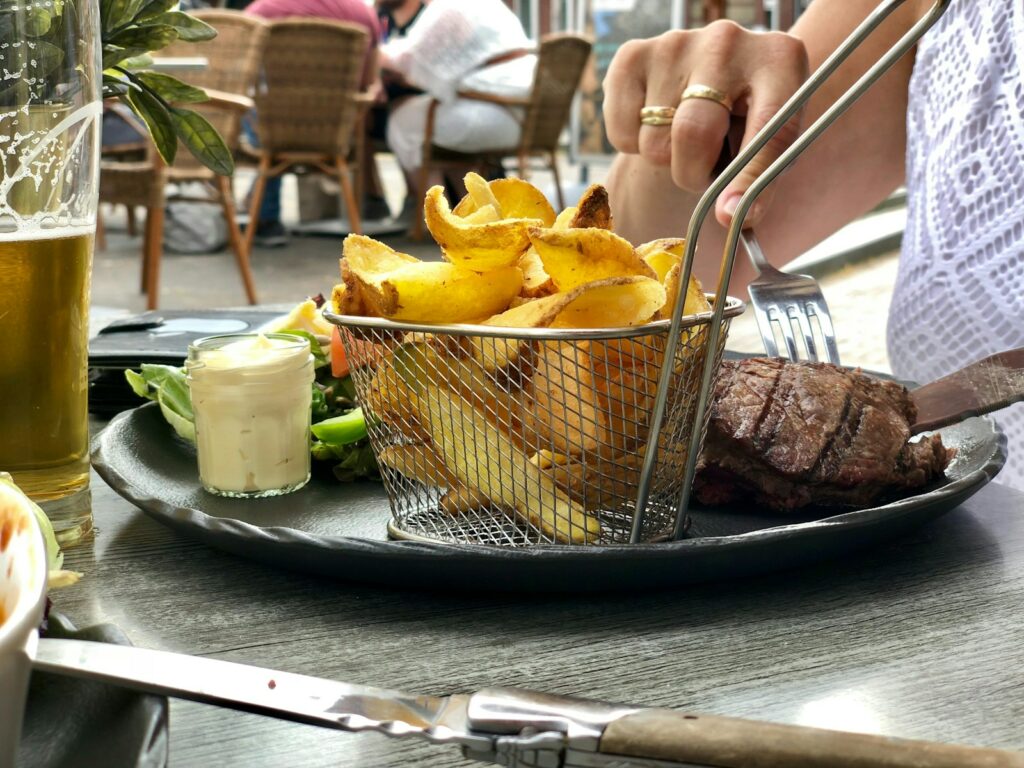
Belgium is a paradise for meat-lovers and home to a high number of carnivores. In many Belgian restaurants, you’ll be hard-pressed to find a meat-free option on the menu.
In Flanders, the government has been working on ways to reduce people’s meat consumption in a region where stoofvleessaus (carbonade) is king. They argue that eating less meat is not only better for our health, but also better for the planet.
Ten years ago, Flanders set itself an ambitious target. By 2030, the government wants to get Flemish people to eat a diet where 60% of their protein intake is plant-derived.
However, progress has been slow in meeting the target. So far, only around 40% of the average Flemish diet is derived from plants.
As part of a plan to encourage people to improve the balance, the Flemish government recently sent the hospitality industry a brochure listing ten tips to help people diversify their diets.
One of the tips says: "Avoid the terms 'vegetarian' and 'vegan': opt for neutral letters (v or ve) or use symbols like a green leaf."
The office of Environment and Agriculture Minister Jo Brouns (CD&V) explained the government's reasoning to Nieuswblad, arguing that "scientific studies have shown that the word 'plant-based' has a much more positive connotation than the terms 'vegetarian' and 'vegan'."
The spokesperson added: "They show that people associate the word 'vegetarian' with 'boring' or 'not good,' while the term 'vegan' evokes a 'hippie' and 'bland' side. This is why the Flemish minister is encouraging restaurants not to use these words, which are considered more ‘polarising’ or ‘moralising’."
