

Brussels residents are fairly satisfied with their lives, but less so than the overall Belgian population, a study conducted by the Brussels Institute for Statistics and Analysis (IBSA) and the Federal Planning Bureau (FPB) has shown.
People aged 16 and over living in the Belgian capital scored their life satisfaction 7.5 out of 10 in 2023, falling just short of the country's average of 7.7/10, according to the IBSA and the FPB.
Walloons rated their life satisfaction the same as that of people in Brussels. Residents of Flanders, meanwhile, were the most satisfied with their lives (7.8/10). This confirms a survey by Statistiek Vlaanderen earlier this month in which nearly 77% of participants gave themselves a score of 7 or higher, and half rated their satisfaction at 8 or more.
Age played a part in how satisfied residents were: those in the youngest and oldest age brackets said they were most satisfied with their lives, while middle-aged people (40-60 years old) expressed less satisfaction, particularly in the Brussels-Capital Region.
This is due to changing factors at different stages of life, such as health and employment status, disposable income, housing quality and social relationships.
Why is life satisfaction lower in Brussels?
Health, both physical and mental, appears to be the most decisive factor in the life satisfaction of Brussels residents, where one in four people say they are in poor health (24%, compared to 22% for Belgium as a whole). Living with a long-term health problem or not having access to the necessary care significantly reduces life satisfaction.
The ability to pay bills on time, cope with unexpected expenses, and cover basic needs, such as heating, also impacts life satisfaction. However, only 11% of Brussels residents say they fit into this category of living – more than double the Belgian level of 4% – explaining the lower level in the capital.
Unsurprisingly, being unemployed or unable to work also has a negative effect on life satisfaction. In Brussels, the proportion of people on long-term sick leave is 9% and in Belgium as a whole it is 11%.
Quality of housing is another contributing factor, and in Brussels, a staggering one in four people (24%) live in inadequate housing (with leaks or damp). This is considerably higher than the national percentage (14%). One in five people (20%) are also exposed to noise pollution in Brussels, compared with 14% for Belgium as a whole.
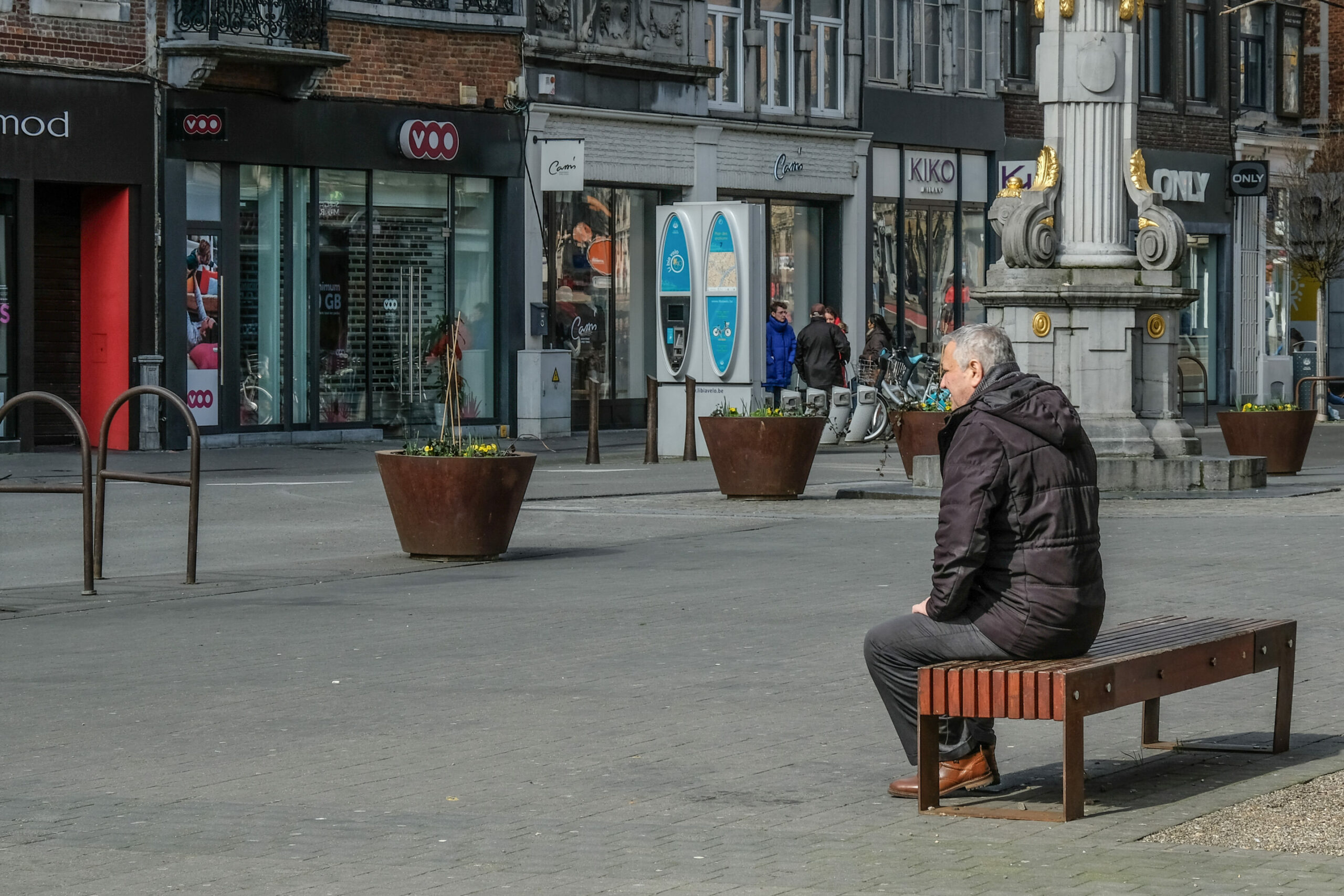
Illustration picture shows lonely man sitting on a bench in Namur, Saturday 14 March 2020. Credit: Belga
Social relationships also play a major role, and isolation is more of a challenge in Brussels, nearly a quarter of the population (22%) lives alone.
In addition, fewer Brussels residents see their family and friends regularly (78% compared to 83% for Belgium as a whole) and participate in leisure activities (53% compared to 73%).
Third in the EU
Across the European Union as a whole, Belgium has previously come in third place for life satisfaction with a score of 7.6/10, according to separate figures from the Eurostat statistics agency last year – despite previously named one of the most stressful countries in the world to live in. This was significantly higher than the EU average (7.1).
Austria scored the highest (7.9), followed by a shared second place for Finland, Poland and Romania (each 7.7).
While a reasonable income and a good safety net are usually the two elements that contribute the most, "people also get satisfaction from their relationships with others, and things like hobbies, for example," demographer Patrick Deboosere (VUB) told The Brussels Times at the time, adding that "life satisfaction in Belgium has always been very stable."
