
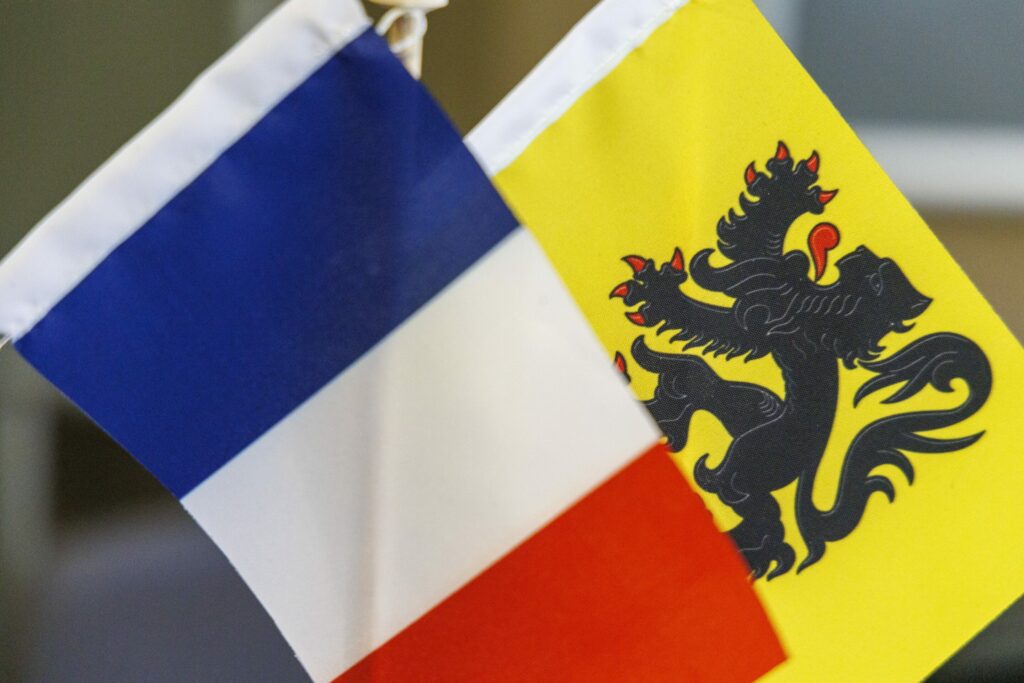
France's regional languages and dialects have long been marginalised, and even oppressed, with the national language having enjoyed precedence in all areas of public life for centuries.
The West-Flemish language in the far north of the country, which was spoken by over 150,000 French citizens at the start of the 19th century according to an 1806 census, is no exception.
There are still an estimated 40,000 speakers of Flamand français (West Flemish, or Vlaemsch, as it is known in the language itself). They are mostly concentrated in the arrondissement of Dunkirk within the Nord département.
This region, a thin strip of land along the border from Lille to the North Sea, is known as the Westhoek, a name which can also refer to a part of the Belgian province of West Flanders. On the French side, most towns and villages have maintained distinctly Dutch-sounding names, such as Steenvoorde and Godewaersvelde.
Recognition by the French state
The local dialect has been recognised by the French state as a regional language, under the name 'Flemish', since 2021. Based in the hilltop town of Cassel (Kassel in Dutch), the Regional Flemish Language Institute looks to promote the use of West-Flemish and secure a legal status on a par with the rest of the country’s regional languages (such as Basque, Breton, Corsican, and Occitan).
Among its initiatives, the ANVT (by its native initialism, from Akademie voor nuuze Vlaemsche Taele) publishes books, teaches the language to locals and installs bilingual road signs around the region. Cassel also hosts a bilingual radio station, Radio Uylenspiegel, which has been broadcasting to the area (and to the other side of the border) for the last 40 years.
The state's recognition of the language in 2021 has allowed local schools to launch language lessons. "There are about 20 schools teaching West-Flemish to around 500 students," the ANVT founder and co-president Jean-Paul Couché tells The Brussels Times.
"It's obviously still not enough, but we are seeing a revival of the language through schools. We want to expand the teaching of Flemish on the basis of a multi-year plan, by training enough teachers so that tens of thousands of children could be learning Flemish."
'It's very easy to revitalise a language'
One example of the enduring presence of West-Flemish is the expression À noste keer ('see you next time') when parting ways, in which the French À has, over time, replaced Tot (as in the standard Dutch, Tot ziens). "Children are now saying anosteké to each other, which just goes to show that it's very easy to revitalise a language. You just need to have the right methods," says Couché.
Somewhat paradoxically, it's a sliver of France that is leading efforts to revitalise the language, even though most speakers live in Flanders proper. Couché laments the lack of recognition and support for West Flemish as a distinct language on the other side of the border.
"It's funny, you have to come to France to find a dictionary for the language, when there are 1.5 million speakers in total," he says. "We sell a lot of Flemish publications to Belgian Flanders. In the last year, we've published two books, and there are three more on the way, including an update to the West Flemish dictionary."
"In Belgium, they always have the linguistic issue which hangs over everything, so people are still speaking West Flemish but it isn't being taught in schools and parents aren't passing it on. They're going through the same thing we did two generations ago."
In recent years, the regional authorities have been working towards setting up the Office public du flamand occidental (Public Office for West-Flemish) which will look to carry on the work of the ANVT with greater resources. "It will include Ministry of Culture, the Ministry of Education, the Hauts-de-France region, probably the Nord department, and around 100 communes", explains Couché.
A controversial banner sparks debate
How exactly the area’s Flemish identity can be expressed, beyond language, is a subject of debate. A banner unfurled by Lille football fans at their Ligue 1 match against Paris Saint-Germain a few weeks ago read “Rijsel is vlams” ('Lille is Flemish'), a reference to the city’s ties to the historic County of Flanders.
More controversially, the slogan was accompanied by a variant of the flag of Flanders in which the lion's red tongue and claws are painted black. This version is widely used by the far-right nationalist movement north of the border, and is not recognised by the region's government. The standard version of the flag, meanwhile, can be found on town halls all around French Flanders (and sometimes even just to the south, in the Artois region).
Williams Nuytens, a professor at the university of Artois in the north of France who studies the sociology of football fans in the region, explains that regional identity is commonly used by ultras groups as part of their visual identity. Speaking to The Brussels Times, he says: "These are independent groups, mostly made up of young men, who want to want to show that they exist. A match against Paris Saint-Germain is the chance to send a message to other supporters' groups."
While the supporters' group which occupies the stand claims to be apolitical, according to Nuytens, "within [the group] there's a small group of people who do have ties to the far-right. Lille is not a place where the far-right has a big presence, so they feel as though they have a hard time making themselves heard."
For the ANVT co-president, the Lille fans' display has "nothing to do" with West-Flemish language and identity: "Those are not the colours of concorde, they're the colours of discorde", he insists.
He gives another example of what he sees as a misguided representation of the French-Flemish cause. "A few years ago, there was a group putting up bilingual signs at night, taking pictures of them, and posting them on social media as though it was some kind of victory," says Couché.
"That gave a terrible impression and irritated mayors, because they would have to send people to take them down because they were put up illegally. That's not how we operate, we don't force anything.
"We created a charter for bilingual signage and started working with the mayors, that's why we get financial help from the regional authorities. We launched the bilingual signage project ten years ago, and now 55% of French-Flemish towns have it."
For Couché, the key is to foster an environment where both French and West-Flemish can coexist. "All of the regional languages should be spoken, whether that’s West-Flemish, Picard, Breton, Basque, or another one," he says. "They make us who we are, and it doesn’t stop us from being able to speak in French to each other."
