
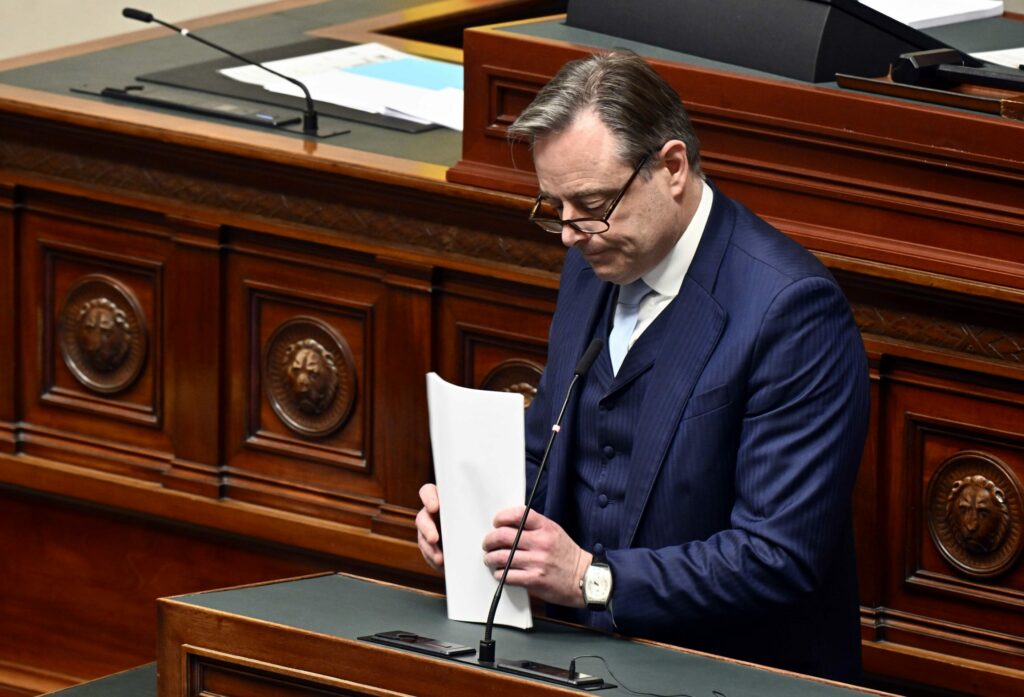
Belgium’s federal government once again failed to reach an agreement on the federal budget during Wednesday’s meeting of the 'kern' - the government’s select committee composed of key ministers.
This left Prime Minister Bart De Wever seeking new talks with his deputy prime ministers on Friday. But what happens if De Wever and his team still can’t reach an agreement?
To shed light on what might follow, we spoke with Caroline Sägesser of CRISP (the Centre for Socio-Political Research and Information), one of Belgium’s leading political commentators.
What happens if the deadlock persists?
“It is still possible that the deadlock cannot be broken and that, faced with his inability to reach an agreement, the prime minister decides to tender his resignation to the king, who accepts it, leading to the dissolution of the House and early elections. But frankly, at this stage, that is not a likely scenario,” Sägesser tells The Brussels Times.
What is more likely is the adoption of a provisional budget, known as a budget of 'provisional twelfths'. This is a temporary system allowing the state to keep functioning month by month. Under this rule, public authorities can only spend one-twelfth of the previous year’s budget each month, ensuring continuity for essential services like salaries, pensions, and healthcare, but preventing any new spending or investment.
Even so, Sägesser believes that such a situation would be extraordinary. “It would be unprecedented for a fully functioning majority government to be unable to table a budget - it is unlikely”.
Ripple effects beyond the federal level
Beyond federal consequences, the budget impasse could ripple through Belgium’s regional governments. There may be a decline in confidence between coalition partners - which, in both Flanders and Wallonia, mirror those at the federal level. As Sägesser points out, “Belgian politics is more interlinked than in other federal states.”
She also warns of more immediate, practical effects: “There is also a possible impact from the delay in certain budgetary measures, such as the finances of the CPAS (public social welfare centres), which will be affected by the arrival of large numbers of unemployed people who have exhausted their benefits.”
Crisis or just another Belgian standstill?
Belgium is no stranger to prolonged political crises. Could this be just another day at the office in Rue de la Loi?
For Sägesser, this time, things might be different - and the results could prove more volatile: “In a traditional budget exercise, each department tries to minimise the impact of potential spending cuts and find new sources of funding. Here, the aim is to slash spending across the board, with the exception of defence,” she explains.
“The difficulty of the exercise is compounded by the heterogeneous nature of the coalition, which includes two right-wing parties, two centre-right parties and one centre-left party. But even within the same political camp, there are very different approaches. The MR would like to achieve the necessary savings without increasing the tax burden, which would require painful spending cuts that its partners cannot accept.”
The road ahead
For Sägesser, the blockage over the federal budget is not just technical - it highlights deeper structural weaknesses. “The budget is the backbone of public policy,” she says. "By nature, it is a highly political instrument that requires agreement between parties.”
The current deadlock, she argues, is yet another sign that Belgium may need to rethink how its federal governments are composed. “Since at least the start of this century, Belgian governments have suffered from an inherent fragility due to the large number of political formations that make them up.”
Looking ahead, she expects negotiations to resume and eventually lead to “a compromise allowing the submission of a budget bill to Parliament,” possibly a limited one covering only 2026. “The alternative - the fall of the government and new elections - appears highly improbable,” she concludes.
Technically, there’s no immediate crisis. The budget can still be adopted before, or even shortly after, the new year. But politically, the cost is mounting. Each delay underscores the fragility of the Arizona coalition, already strained by months of negotiation and recurring stalemates. With every missed agreement, the government’s capacity to act, and to convince Belgians it still can, grows thinner.
Related News
- Foreign Minister warns of tense political climate, does not rule out Government collapse
- Belgium ranks fourth in the EU for the highest public debt-to-GDP ratio
- Belgium approves healthcare budget 2026
- Belgian PM De Wever to skip COP30 climate summit in Brazil
- Union demands dismissal of Employment Minister over 'xenophobic' statements
