
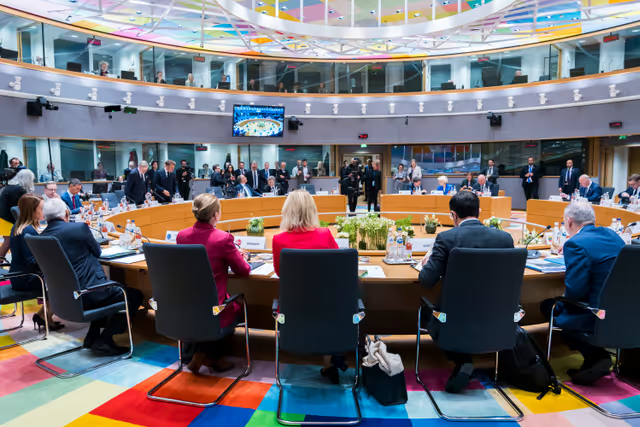
The European Council on Thursday in Brussels was described by EU leaders as a successful summit which delivered on all fronts, especially as regards agreements on supporting Ukraine against Russia’s war of aggression. It left also some unfinished business to next meeting and unclarity about EU’s support to the fragile ceasefire in Gaza and contribution to Trump’s peace plan.
As regards Ukraine, which dominated the meeting, the Council discussed the latest developments and exchanged views with President Zelenskyy. The conclusions were set out in a separate document which was “firmly supported by 26 Heads of State or Government”. The only non-supportive country, Hungary, was not mentioned. Prime Minister Orbán reportedly arrived too late to veto the conclusions.
The document says that Russia has increased the intensity of its missile and drone strikes on Ukraine, particularly targeting civilians and civilian infrastructure, “thus demonstrating its lack of real political will to end its war of aggression and to engage in meaningful peace negotiations”. The Council urged Russia to agree to a “full, unconditional and immediate ceasefire”, to which Ukraine already has agreed.
Alternative security guarantees
The issue of security guarantees is mentioned in the conclusions. A Ukraine capable of defending itself effectively is seen as an integral part of any future security guarantees. “The EU and Member States are ready to contribute to robust and credible security guarantees for Ukraine, in particular by supporting Ukraine’s ability to deter aggression and defend itself effectively.”
Security guarantees given by other countries is another matter and has been discussed since the start of Russia’s illegal and unprovoked invasion in February 2022. The most effective security guarantees would be NATO membership (article 5) but that option is blocked by the Trump administration.
A coalition of countries have still to show their willingness to send enough troops to Ukraine to deter Russia. In August, Commission President von der Leyen said that European capitals are working on “pretty precise plans” for potential military deployments to Ukraine as part of post-conflict security guarantees that will have the full backing of US capabilities.
EU membership with its own ‘mutual defence’ clause in the treaty (article 42(7)) could offer a form of security guarantee but membership is far away and the European Council encourages Ukraine, the Council and the Commission to take work forward on the accession process. The fundamentals cluster, which is the first to be opened and is ready according to the Commission, requires unanimity in the Council.
Since the start of Russia’s war of aggression, the EU and its Member States have provided €177.5 billion in support for Ukraine and its people but more support is needed to strengthen Ukraine in the battle field and at the negotiating table. The Council committed to address Ukraine’s pressing financial needs for 2026-2027, including for its military and defence efforts.
Russia’s immobilised assets
Therefore, the European Council invited the Commission to present, as soon as possible, “options for financial support based on an assessment of Ukraine’s financing needs and invites the Commission and the Council to take work forward, in order for the European Council to revert to this issue at its next meeting”. The wording on options refers to the use of Russia’s immobilised assets.
According to the conclusions, “subject to EU law, Russia’s assets should remain immobilised until Russia ceases its war of aggression against Ukraine and compensates it for the damage caused by its war”. The assets are estimated to ca €290 billion, thereof €180 billion placed in Belgium. Its Prime Minister, Bart De Wever, is reluctant to “confiscate” the assets to guarantee loans to Ukraine.
“I would prefer an alternative solution, but I’m just little Belgium, I can only point out the problems and ask nicely for solutions to the essential issues,” he said. Other debt options, that require unanimity from all 27 EU member states, seem to be blocked by Hungary.
Asked about the assets, Commission President von der Leyen replied at the concluding press conference at Friday midnight that the European Council had agreed on the “what” and now had to work on the “how”. Council President Costa said that nobody vetoed anything.
“Different leaders raised technical issues until next summit in December. The most important thing is the political decision and the clear message we are sending to Russia.”
The proposal on Russian assets respects international and EU law, according to Costa, and both the Eurogroup and the European Central Bank were supportive of it. President Zelenskyy said at his press conference that he believes that a decision is close in “one or another way”. Ukraine needs any Russian assets to run its defence industry to full capacity. The funding is needed in 2026, the earlier the better.
Zelenskyy’s simple peace plan
In a statement last week, before the European Council, Zelenskyy and other European leaders agreed that the current line of contact should be the starting point of negotiations. “We remain committed to the principle that international borders must not be changed by force. Therefore, we are clear that Ukraine must be in the strongest possible position - before, during, and after any ceasefire.”
Zelenskyy’s peace plan is simple and the same as before. First a ceasefire or rather the will stop the war and sit down and negotiate a ceasefire leading to a peace agreement. This requires more pressure on Russia. He rejected any talks about “land swaps” at the expense of Ukrainian territory occupied by Russia.
He was relatively satisfied with the outcome of his meeting with US President Trump last week. He did not get long-range cruise Tomahawk missiles but the planned Trump-Putin meeting in Budapest was cancelled. The US imposed new sanctions on Russia targeting its two largest oil companies. These companies are also targeted in EU’s 19th sanctions package which was adopted on Thursday morning.
More sanctions on Russia
A total ban on Russian Liquefied Natural Gas (LNG) as of 1 January 2027 for long-term contracts and a further clamp-down on the shadow fleet represent the strongest sanctions yet on Russia's crucial energy sector, according to the Commission. With 117 additional vessel listings, a total of 557 vessels in Russia's shadow fleet are now listed by the EU.
The vessels are subject to a port access ban and a ban on receiving services. But that is not enough. The European Council calls for further measures to disrupt the operation of Russia’s shadow fleet, particular for effectively addressing the significant environmental and security risks that the shadow fleet poses.
Hungary did not veto the 19th sanctions package as was feared and has in fact accepted all previous packages. “The question isn’t whether Hungary uses its veto or not,” commented Marc Loustau, Affiliated Fellow at the Institute for Advance Study, Central European University in Budapest, and author of the "At the Edges” newsletter on Substack. “The question is whether it’s in Putin’s interest for Hungary to vote against the packages.”
“We're still dealing with this problem because the EU hasn’t done enough to weaken economic and political ties between Russia and Hungary,” he says. He believes that Hungary’s provocations reached a breaking point with the invitation to Putin to a summit in Budapest. “It is necessary to put a time limit on the article 7 procedure against Hungary.”
At some point, EU leaders need to ask when Europe is going make Donald Trump irrelevant to Ukraine’s security, not to mention its own security, he added.
“Using frozen Russian assets to support Ukraine is a start. Committing enough military aid to replace the support Trump has withdrawn – that’s another good idea. But in the end, a Ukraine that is fully and completely – and legally – a part of EU and NATO. That’s the only thing that will eliminate Europe’s increasingly self-defeating dependency on the Trump administration.”
