
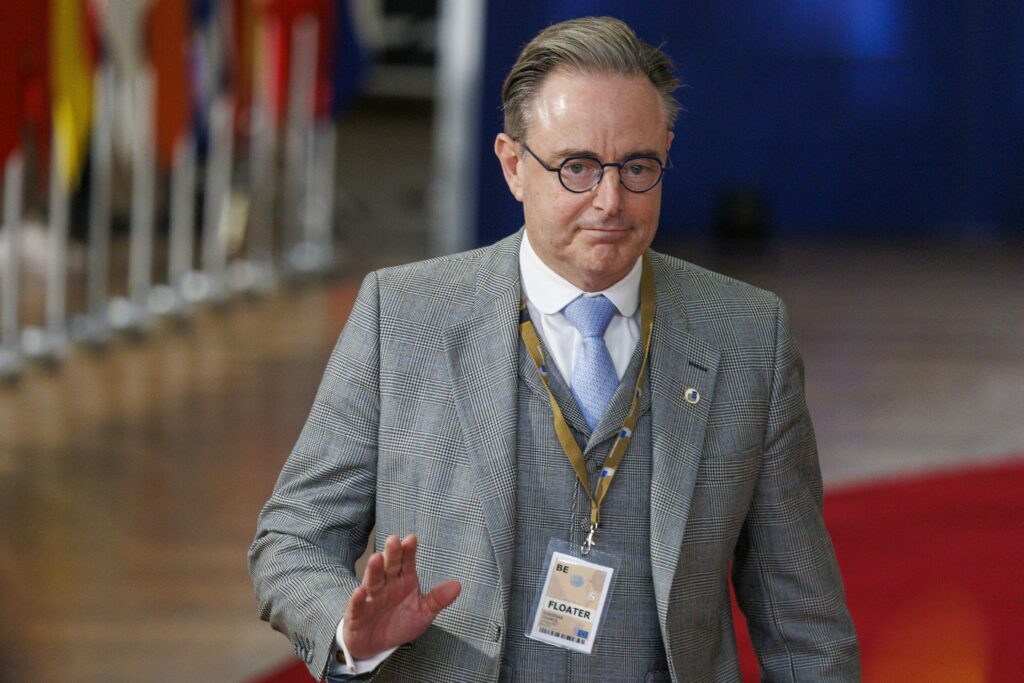
Belgium's Prime Minister Bart De Wever said on Thursday that he would prefer a new European loan for Ukraine rather than undertaking a “sort of confiscation” of Russian assets immobilised in Brussels.
De Wever was speaking at a press conference following yesterday's meeting of EU leaders in Brussels. The possibility of using Russian assets to guarantee a €140 billion loan to Ukraine was the subject of lengthy discussions at the summit.
Belgium, which fears the high risks of such an arrangement, ultimately obtained a significantly softened conclusion that did not mention Russian assets. The Commission must return with “options” to cover Ukraine’s financing needs for 2026 and 2027, according to the published conclusions.
De Wever argued that a European loan would allow Europe, or even the coalition of the willing, to “create money” quickly. The main advantage of debt, compared to using Russian assets, he said, is that it offers "certainty": on the amount to be repaid, on those responsible for repayment, and on the duration of the loan.
Conversely, according to De Wever, using Russian assets to guarantee the €140 billion loan to Ukraine opens up a wealth of problems linked to likely future disputes, the extent of which is difficult to assess.
Belgium has reiterated its readiness to help Ukraine continue to defend itself against Russia, but for several weeks has been highlighting the legal risks and the need to obtain guarantees from its European partners in the event of using immobilised Russian assets.
De Wever's loan proposal
“If tomorrow there were a proposal to take €45 billion in debt for the next two years and then integrate it into the EU ‘s multiannual budget, I would be 100% in favour,” the prime minister said. “These are enormous sums, but at the level of Europe and the European budget, it’s a detail.”
However, De Wever was clear-eyed about the chances of seeing such an option succeed. A debt solution would require unanimity from all 27 EU member states , which seems unrealistic given Hungary ‘s usual reluctance. “I would prefer an alternative solution, but I’m just little Belgium, I can only point out the problems and ask nicely for solutions to the essential issues,” he said.
The leaders will have to revisit the issue of the Russian asset-backed loan at the December European summit.
The prime minister added that it would be “brilliant” if, in the coming weeks, several conditions were met: first, a solid legal basis to protect the European Union against possible litigation or retaliation from Russia; second, the participation of countries outside the eurozone that also hold immobilised Russian assets, such as the United Kingdom, Canada, or the United States; and finally, guarantees ensuring that the liquidity can be mobilised immediately if needed .
