
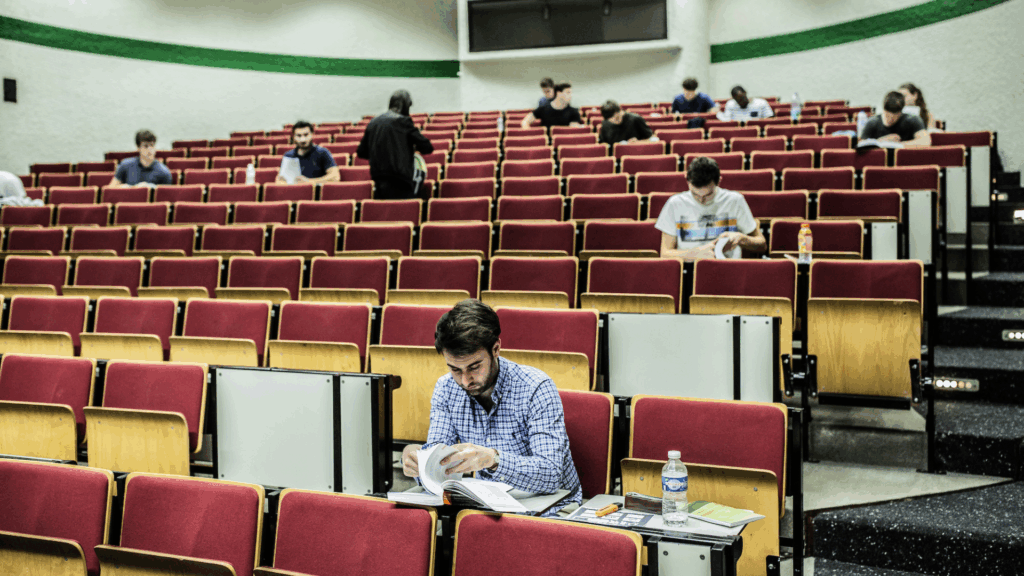
Students at Flemish universities are set to feel the impact of significant reforms in higher education starting next year, according to the Flemish Interuniversity Council (VLIR), which represents Dutch speaking universities in Flanders.
The warning comes following the approval of a decree accompanying the 2026 budget by the Flemish Government.
According to the VLIR, the higher education institutions will face a reduction of €46.3 million from the basic funding as of next year, leaving around 350 full time positions at risk in the long term.
The cuts include scrapping the funds supporting Dutch-speaking higher education in Brussels, reducing the funding for students from outside the EU, and scrapping agreements between the Institute for Development Policy in Antwerp and the Institute for European Studies in Brussels.
Students at risk?
Amid the cuts to university fundings, students are set to be directly impacted by a reform to student grants, aimed at saving the Flemish Government €33.8 million.
The VLIR highlighted that the reform threatens to deprive up to 20,000 students from receiving a grant, citing data by the Flemish Student Association (VVS).
“This will make it more difficult for them to access university education, at a time when all Flemish policymakers agree that we must remain internationally competitive and that knowledge is still the only resource we have in our region,” reads a statement by VLIR.
The group further stressed that students will need more social support due to the stricter conditions to apply for scholarships.
Rising tuition costs
The burden of the impact of the savings plan for 2026 has triggered the Flemish universities to consider increasing tuition fees by €150 per student from the 2026-2027 academic year.
However, this is a change that must be approved by the Flemish Education Minister, Zuhal Demir (N-VA).
According to VRT NWS, Demir is currently unwilling to raise tuition fees, although she remains open to discuss other plans with the higher education institutions.
Threatened jobs & economy
While the VLIR recognised that restoring public finances requires financial reforms, it underscored that the new plans are “structurally undermining” the knowledge economy.
"They are at odds with the innovation ambitions in the Flemish coalition agreement for 2024-2029 and make the 1% target for public investment in research and development increasingly unachievable,” said VLIR Secretary-General of VLIR, Koen Verlaeckt.
He added: “They are also inconsistent with the Flemish Government's justified emphasis on competitiveness and productivity…Investments in higher education are among the most productive forms of investment.”
The Brussels Times contacted the Flemish Minister of Education, Zuhal Demir, for comment but has yet to receive a response as of time of publication.
The Flemish Interuniversity Council (VLIR) is an autonomous body funded by the universities, that aims to promote dialogue and cooperation between the institutions, and represent their joint interest.
