
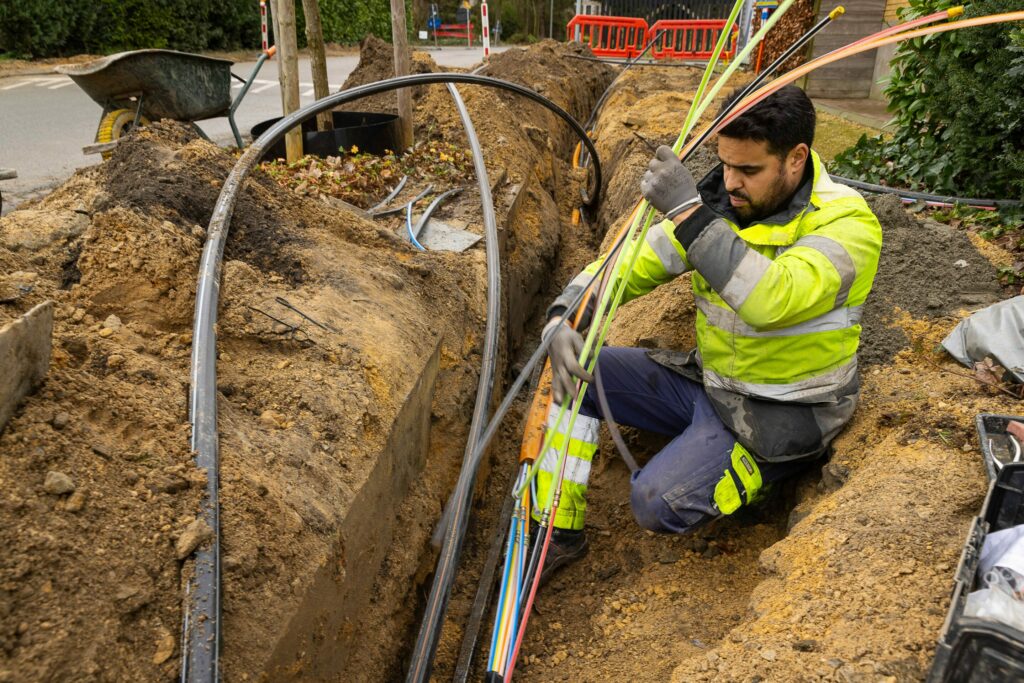
Upon arrival in Belgium, some newcomers from neighbouring European countries notice that the broadband here is slower in comparison to their home country. Why is that?
The short answer is that Belgium started deploying fibre later than its European neighbours.
For years, the country leaned heavily on cable and copper wire for its broadband network.
Instead of rushing into fibre, the country first focused on improving cable, which was upgraded so that almost every city could get a gigabit (a unit of information amounting to one million bits) download.
Copper was mainly used by Proximus, the country's biggest broadband provider, which also improved to the point that many lines reached 70-100 megabits per second (Mbps).
These networks are good, but they are not built for the way people use broadband today.
Belgium slips behind
"Belgium was not late on purpose. We simply upgraded the old networks very well, so fibre felt less urgent here than in other countries," Haroun Fenaux, Proximus' spokesperson, told The Brussels Times.
Fibre-to-the-home (FTTH), the modern gold standard, arrived late. By early 2025, only 43% of Belgian homes had full fibre, compared with much higher rates in France, Spain or the Netherlands.
Proximus, which is the main deployer, eyes a 50% coverage by end-2025, 70% by 2028 and 95% by 2032.
France and Spain, for instance, have already covered far beyond 80% of their territory.
"Belgium had very strong coax and VDSL (Very high-speed digital subscriber line); people were getting high speeds already, so the sense of urgency to deploy fibre everywhere was lower," Fenaux explained.
Downloads and uploads
But more Belgians and Internationals work from home or send huge files over the cloud, copper and coax reach their limits, especially on upload speeds.
Most Belgian broadband customers get respectable download speeds. The issue is upload performance, which has a direct impact on video calls and remote working.
Cable provides between 20 and 50 Mbps uploads, whereas VDSL often stays below 20 Mbps, and fibre delivers hundreds of Mbps and is symmetrical.
This gap explains why someone moving from Amsterdam, Paris or London, where fibre is widespread and cheap, often feels Belgian broadband is "slower" despite similar download figures.
"People don't realise how important upload is now. Fibre fixes that immediately," Fenaux explains.
'Brussels is moving extremely fast'
Brussels, although under strict radiation limits that slowed 5G at first, is leading on fibre rollout.
Today, 75% of Brussels homes can already get fibre broadband. Gigabit coverage is almost universal. New buildings increasingly come with fibre-only.
"Brussels is moving extremely fast," Fenaux says. "Every week, more municipalities reach critical mass on fibre coverage."
The capital is now ahead of many Flemish cities and dramatically ahead of rural Wallonia.
Belgium's geography and physical environment make fibre deployment far complex. Narrow historic streets, ageing buildings, protected façades and fragmented permitting rules all slow construction.
Unlike countries with extensive ducting systems, Belgian operators often need to negotiate access to private buildings and wait for municipal approval to run cables on street façades or underground.
"Deploying fibre in Belgium is simply more complex. You need access to buildings, you need permits, and every region does things differently," said Fenaux.
High prices solved the competition and early investment
For years, Belgium's broadband market was shaped by three major players: Proximus, Telenet and VOO (now part of Orange).
Cable networks offered fast downloads early, so there was less commercial pressure to push fibre at scale.
Due to the limited competition, prices remained high compared with neighbouring countries. Standalone broadband packages of €50/€70 per month became the norm.
However, according to Fenaux, a new player has helped shake things up in recent months.
"The landscape changed overnight with the arrival of Digi Belgium in late 2024," he explained. "Digi launched fibre at €10 for 500 Mbps, €15 for 1 Gbps and €20 for 10 Gbps, far cheaper than anything seen in the Belgian market."
The incumbents have since accelerated their deployments and adjusted offers in areas where Digi is expanding.
"You'll see a very different Belgium in five years. Fibre will be everywhere, and the experience will be completely different from today," Fenaux concludes.
