
In Woluwe-Saint-Lambert, the memory of two murdered French teachers will soon live on in a new public space.
The Brussels municipality is set to propose renaming an existing square, Place Samuel Paty et Dominique Bernard, paying tribute to the educators killed in terrorist attacks in France for defending freedom of expression and secular values.
Samuel Paty, a history and geography teacher in Conflans-Sainte-Honorine, was brutally murdered on October 16, 2020, after presenting his students with caricatures of the Prophet Muhammad as part of a classroom discussion.
Dominique Bernard, a teacher in Arras, was killed on October 13, 2023, by a terrorist who opposed freedom of expression, women’s right to abortion, and the rights of LGBTQ+ individuals. Both assassinations reverberated globally, highlighting the fragility of freedom of expression and the risks faced by educators.
The site selected includes municipal spaces like the cultural centre, the library and a dance school, a location chosen for its symbolic link to freedom and the transmission of knowledge.
According to Woluwe-Saint-Lambert Mayor Olivier Maingain, this naming intends to pay homage to teachers and the universal values they embody. He emphasised that the choice of this location is also a way to associate the memory of both educators with the civic role of schools in shaping open, critical societies.
Naming and renaming streets in Brussels
In Brussels, communes hold full authority when it comes to naming or renaming streets, squares, or public spaces.
After the First World War, Brussels changed all names referring to Germany or its allies. For example, Rue de la Turquie (Turkey) became Rue de Roumanie (Romania), and Rue de Munchen (Munich) became Rue d'Andenne.
The toponymy commission, which once gave its opinion on proposals, no longer plays a role. "The commission no longer exists," Mayor Maingain told The Brussels Times. "Today, these are decisions taken by the councillors. It’s up to the local authority to evaluate the relevance of a name, and to assume the responsibility that comes with it."
However, as Maingain points out, renaming existing spaces can be complex. "Changing a street name has consequences, for residents, for postal addresses, for local businesses. That’s why, when possible, we prefer to name new public spaces rather than modify existing ones. We have already named some new alleys after figures such as Christian de Duve, a Nobel Prize winner, and Louise Van den Plas, a pioneering feminist," he notes.
The process, he says, aims to balance symbolism with practicality: to honour memory without creating unnecessary disruptions for citizens.
Feminisation in Brussels’ street names
The issue of who gets remembered on Brussels’ street signs has also taken on new importance.
Across the capital, over 90% of streets still bear male names, as pointed out by the EqualStreetNames collective, a figure worse than in Paris or Madrid.
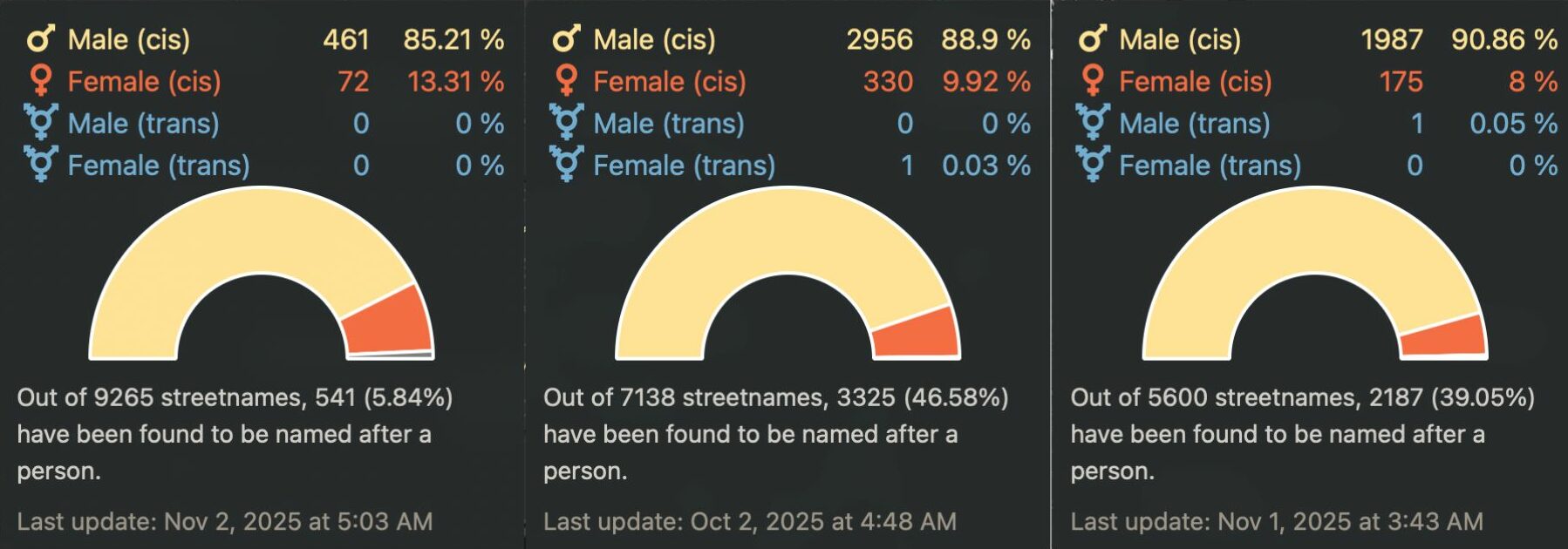
Repartition of street names for Brussels, Paris and Madrid. Credit: EqualStreetNames.org
"There is a deficit of streets named after women," the mayor acknowledges. "When new roads or alleys are created, the culture service proposes names from a predefined list of illustrious women." Examples include Adrienne Gommers and Lilly de Gerlache, resistance figures deported to Ravensbrück, and Louise Van den Plas, the first elected female councillor before the First World War.
The hierarchy of streets also matters: larger avenues, boulevards, or arterial roads in Brussels are overwhelmingly named after men, often historical or colonial figures, military leaders, or prominent city-builders.
Exceptions exist, such as Avenue Louise in Brussels, named after the king’s daughter, or streets recently renamed to honour women without affecting addresses, like Allée Rosa Luxembourg and Square Maurane. However, many streets named after women honour members of royalty or religious figures (saints…), which emphasises their status or mystique rather than their personal achievements.
Some streets commemorate both men and women, for example, Avenue Houba de Strooper in Laeken, named after Louis Houba and his wife Adèle Clémence de Strooper. In rare cases, gender is indeterminate, or the names reflect collective historical contributions.
Only one street in Brussels commemorates a transgender figure: Willy De Bruyne, who was born intersex and officially recognised as male in 1937. Since 2019, the street, unlisted on Google Street Map, has borne his name at the intersection of Allée Verte and Avenue de l’Héliport.
Controversial figures, historical reflection
The discussion also raises delicate questions about historical legacy. In Uccle, for example, the Rue Stanley, named after explorer Henry Morton Stanley, who played a key role in the brutal colonisation of the Congo, raises questions about whether certain figures should still be celebrated in the public space.
"Luckily, we have done the inventory; we do not have this type of situation in Woluwe-Saint-Lambert, probably because our municipality was urbanised more recently than others in Brussels," Maingain explains. "But if such a case arose, the debate would take place in agreement with the inhabitants. We would either provide contextual panels explaining the history or, if the residents agreed, consider changing the name."
This even brought bigger discussions on, notably on one specific event, recalled Florian Mariage, member of the Royal Commission on Toponymy and Dialectology for RTBF in 2022.
"We try to allow some distance from history, twenty years, for example, so that we can judge whether a person’s life and values deserve to be remembered by future generations. Emotional contexts can sometimes lead to unfortunate choices, as happened in Tournai when a quay was named after Stalin after liberation and later changed to Sakharov."
The creation of Place Samuel Paty et Dominique Bernard coincides with the tenth anniversary of the 2015 terrorist attacks in Paris, though Maingain stresses this was not deliberate.
"We did not plan it to match that period,” he says. However, the dedication is a reminder of the fragility of freedom of expression in society as a whole: "The tribute is about these two teachers, their work in education, and the principles they represent: citizenship, democracy, and respect for differences."
