
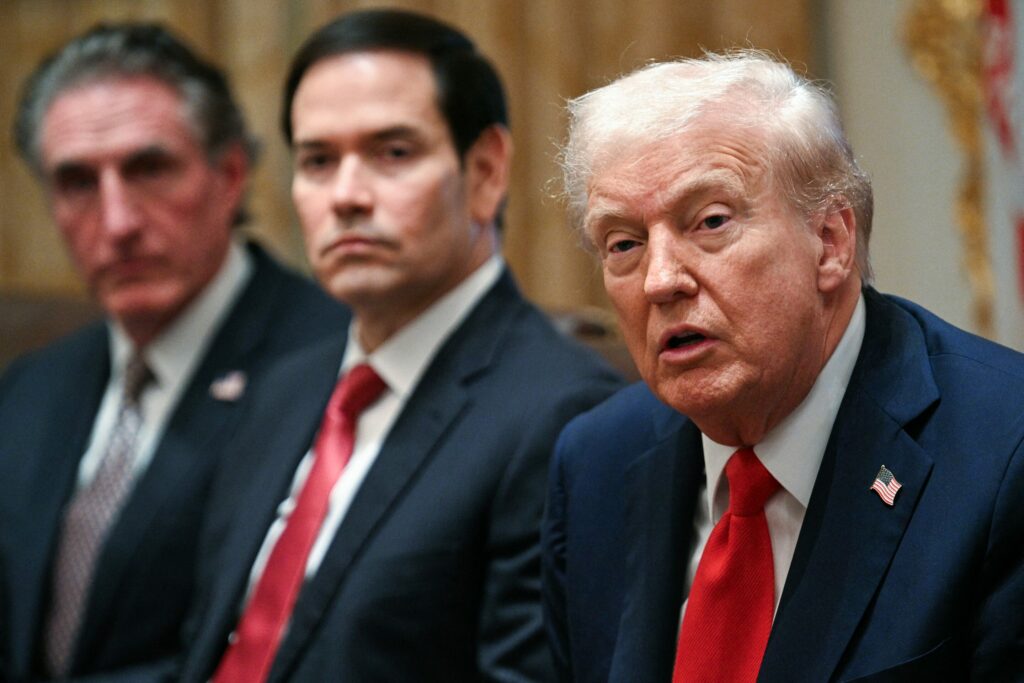
The United States’ new security strategy could cause the reversal of over 80 years of friendship with Europe. It has left "weak" EU leaders scrambling for a response. But what does the strategy actually say?
Released last Friday, the US new political document vows to fight against Europe’s "civilisational erasure" and to "cultivate resistance to Europe’s current trajectory" with the European Union.
This new direction lays bare the hostile and provocative tone the US has reserved for its European allies since Trump’s reelection, particularly on issues such as migration, tech regulation, and the war in Ukraine.
US President Donald Trump and Vice-President JD Vance have led eyebrow-raising attacks on Europe and its leaders, accusing them of freeloading on NATO and threatening tariffs on countries that "discriminate" against US tech.
Trump's rhetorical jabs have pushed European countries into action by increasing defence spending for NATO and rolling back on certain EU regulations that will benefit US tech companies. Yet, this is still not enough for the US President and his team.
"I think they’re weak," Trump said about Europe’s political leaders in an exclusive interview with Politico US on Tuesday. "I think they don’t know what to do. Europe doesn’t know what to do," he claimed.
His latest attack on European leaders comes as the continent is still scrambling to respond to the US’s new vision for the international order.
"Allies do not threaten to interfere in the domestic political choices of their allies," the President of the European Council, António Costa said on Monday during a conference in Paris. "The US cannot replace Europe in what its vision of free speech is … Europe must be sovereign."
For the EU leader, the US and Europe "do not share" the same view on the international order anymore.
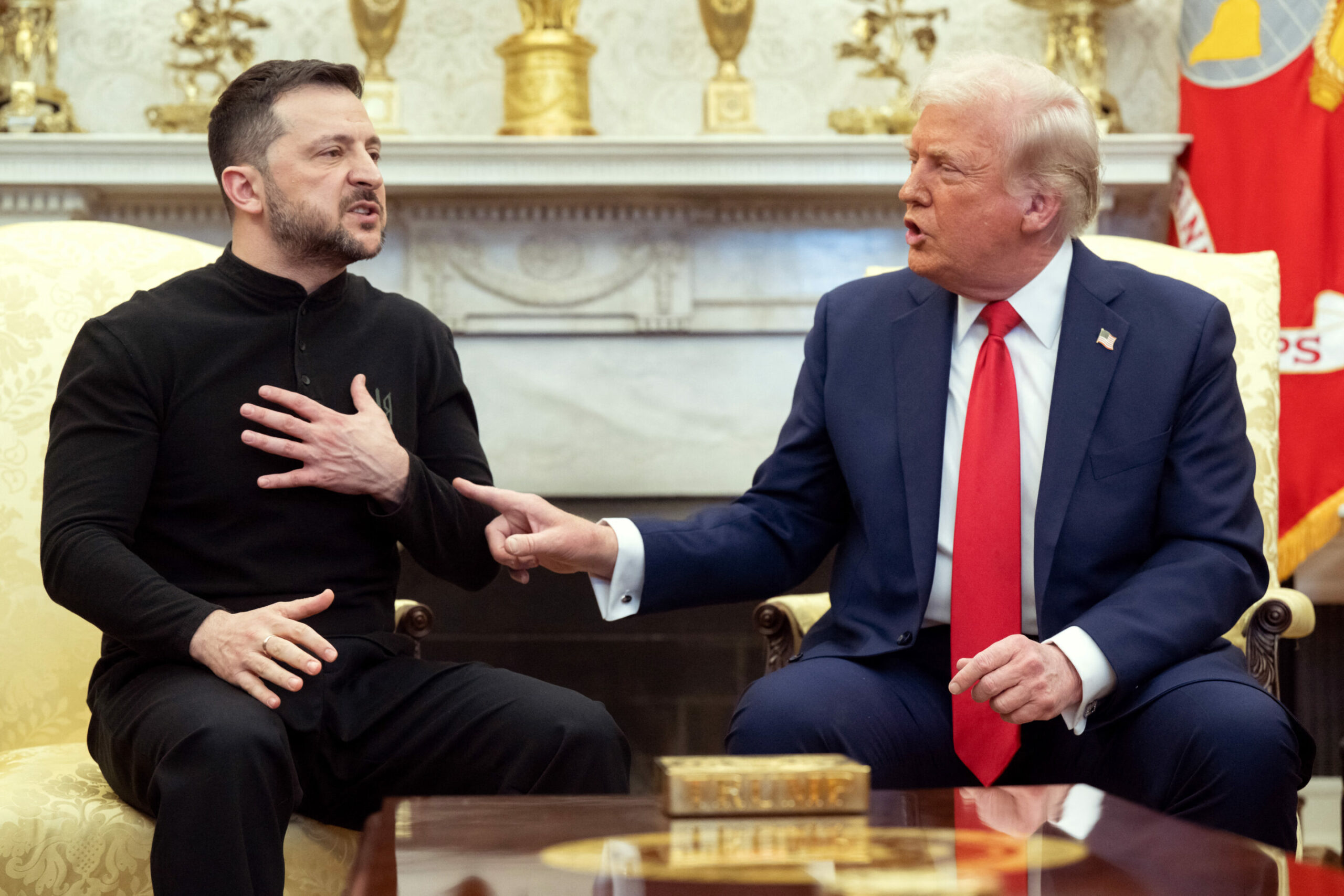
US President Donald Trump and Ukraine's President Volodymyr Zelensky meet in the Oval Office of the White House in Washington, DC, February 28, 2025. Credit: Belga / AFP
What is actually in it?
The US National Security Strategy 2025 has been widely seen as torching the international consensus in the West that has been unchanged since the end of the Cold War.
The US now wants strategic rapprochement with Russia and a rebalance of its economic relationship with China. It does not speak of a "great power competition" as in previous years, but rather opts for "global and regional balances of power."
To do this, the US will prioritise business-oriented diplomacy to strengthen its industries, using tariffs and reciprocal trade agreements as "powerful tools" for its economic benefit.
It calls for the US to maximise its interests to ensure it "remains the world’s strongest, richest, most powerful, and most successful country for decades to come."
Crucially, the new strategy pledges not to intervene in other countries’ affairs, saying that the United States will only get involved if their activities "directly threaten our interests".
Attack on Europe
However, given the strong attacks on the EU and liberal democratic values, some experts have pointed out that this strategy can be equivalent to "bully your friends, placate your adversaries".
Indeed, while the US argues for a strategy of non-interference in other countries' affairs, it vows to essentially support populist right-wing parties by "cultivating resistance to Europe’s current trajectory within European nations."
The policy document focuses on Europe changing "unrecognisably" via migration and "political correctness" – two notions which are frequent positions argued by the European populist right.
The US administration even claims that "it is more than plausible that within a few decades at the latest, certain NATO members will become majority non-European." It is worth noting that irregular migration into Europe has been going down in recent years.
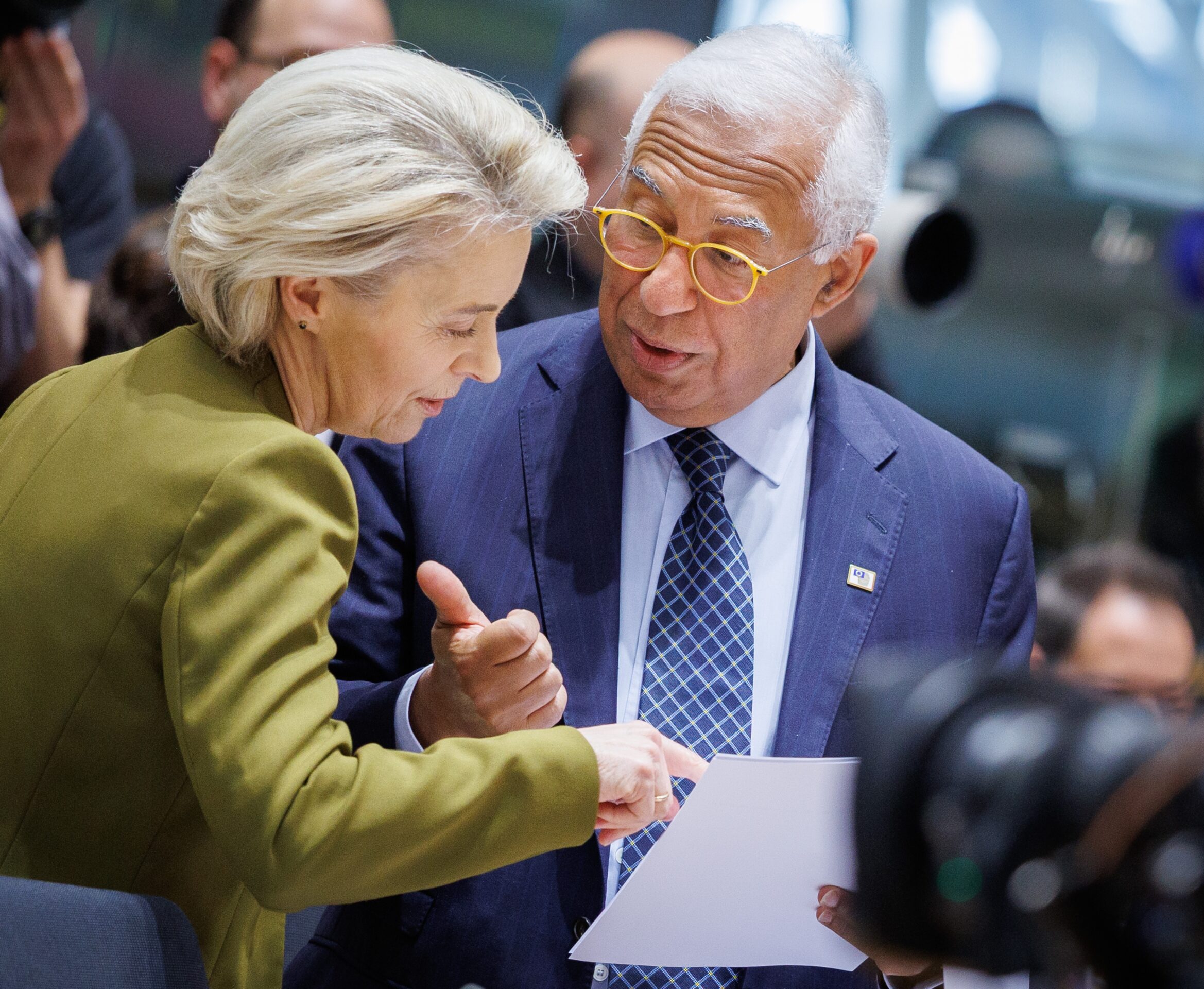
European Commission president Ursula Von der Leyen and European Council President Antonio Costa pictured during a European Council summit, in Brussels, Thursday 20 March 2025. Credit: Belga/Benoît Deppagne.
Europeans were left the most stunned by the accusations against the EU, claiming it "censors free speech" and "tramples on basic principles of democracy to suppress opposition."
It goes further by arguing that American diplomacy should stand up for "unapologetic celebrations of European nations' individual character and history" and "the growing influence of patriotic European parties indeed gives cause for great optimism."
In Trump’s interview with Politico on Tuesday, he pledged to continue backing those political candidates who share his ideology. "I’d endorse [again]…I’ve endorsed people that a lot of Europeans don’t like. I’ve endorsed Viktor Orbán."
Quo vadis, EU?
Yet, to avoid a further souring of relations, the responses from European leaders have been subdued.
Since Friday, European Commission President Ursula von der Leyen has not explicitly commented on the strategy, but Spanish European Commission Vice-President Teresa Ribera called the strategy "so weird and injustified [sic]… but so clearly said."
"I am sorry for so many great US citizens and their great commitment to a peaceful, better world," she added in her social media post.
The EU High Representative for Foreign Affairs, Kaja Kallas, reiterated that the US remains Europe’s main ally on Saturday, even admitting some of the allegations in the political document were true.
Yet on Tuesday, Europe's top diplomat clarified those remarks when speaking at the European Parliament (EP).
"The US National Security Strategy sends a clear message that we should be more self-confident. When it comes to Russia, yes, but also China. And sometimes, [towards] our allies, like the United States," Kallas told MEPs in the EP Foreign Affairs Committee.
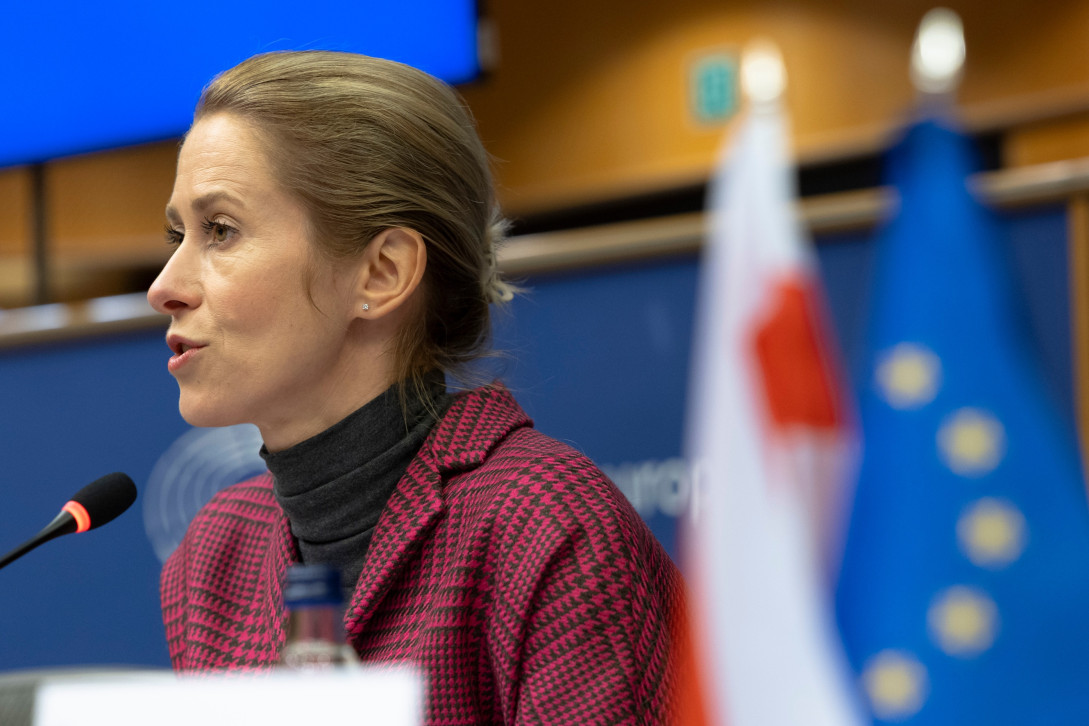
The EU High Representative for Foreign Affairs, Kaja Kallas, speaking in the European Parliament, Tuesday, 9 December 2025. Credit: EU
She pushed back on the claims about the EU censoring free speech, saying that the bloc is "the very essence of freedom."
"So any such criticism regarding liberties here should be aimed in a different direction – Russia, perhaps, where dissent is banned, where free media is banned, where political opposition is banned, where ‘X’ is in fact also banned," Kallas continued.
On Friday, the EU fined Elon Musk’s social media company €120 million under the Digital Services Act for X’s use of the ‘blue checkmark' for ‘verified accounts' – found to deceive users under EU law. In yet another sortie into European politics, Musk responded by saying, "Abolish the EU".
Despite these attacks, the EU has not backed down on sanctioning abuses by Big Tech companies.
In his speech on Monday, European Council President Costa said that "there will never be free speech if citizens' freedom of information is sacrificed for the aims of the tech oligarchs in the United States."
The following day, the European Commission announced another investigation into Google over alleged anticompetitive conduct in the use of online content for AI training purposes. This will come as a blow to the US administration’s efforts to fight against EU regulations.
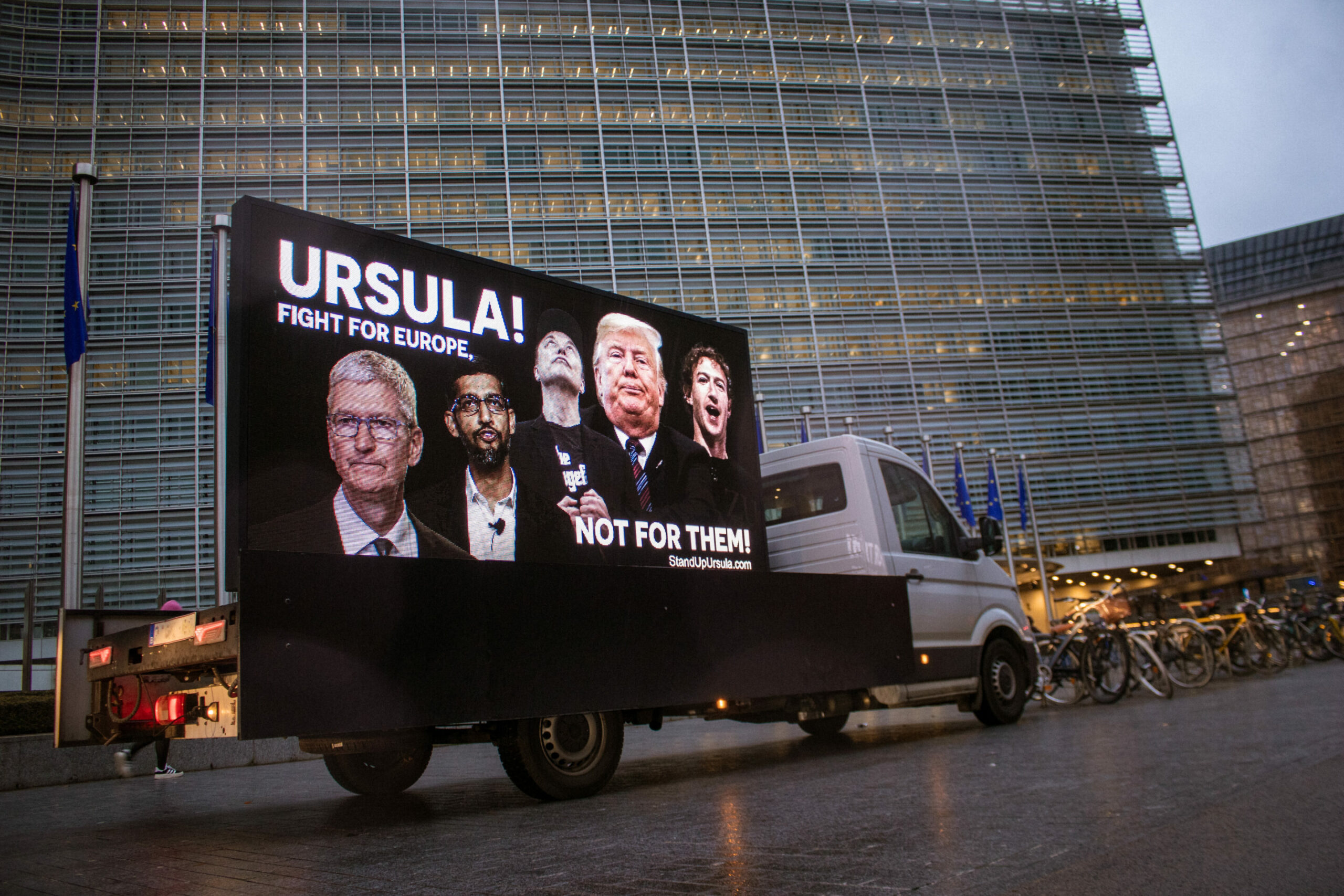
Campaigners from People vs Big Tech, WeMove Europe, and EDRi launched four mobile billboards driving across Brussels, calling on Ursula von der Leyen to stand up to Trump and Big Tech, and defend Europe’s digital laws, Wednesday 19 November 2025.
Indeed, the new US strategy outlines the "opening of European markets" to US goods and services while "ensuring fair treatment" of US workers and businesses, as one of its top goals.
"We want Europe to remain European, to regain its civilizational self-confidence, and to abandon its failed focus on regulatory suffocation," the strategy professes.
Experts in Europe are concerned that this strategy will lead to more US interference in European politics, particularly in support of "anti-democratic, extreme-right forces against the EU", as seen with the elections in Germany.
"Let us be clear: it is a hybrid attack as unwelcome, and as threatening, as any Russian or Chinese hybrid attack against us," said Sven Biscop, the Director-General of Egmont Institute, Belgium’s leading international affairs think tank, in a new analysis.
Future of Ukraine
Indeed, the new tension between Europe and the US has been most evident in the discussions about the Ukraine war, which in February will enter its fourth year since the full-scale Russian invasion.
The Trump administration finds itself "at odds" with European officials who "hold unrealistic expectations for the war perched in unstable minority governments," in what appears to be a jab at recent political instability in France and Germany.
Yet Trump’s peace plan for Ukraine has been widely discredited by Europeans and Ukraine, who were both sidelined by the US, which then floated peace proposals favouring Russian interests. Now, a new version is being prepared, according to Kyiv.
However, it is important to note that the US’ main priority when it comes to Europe is "reestablishing conditions of stability within Europe and strategic stability with Russia." This move was welcomed by the Kremlin as "consistent with their vision".
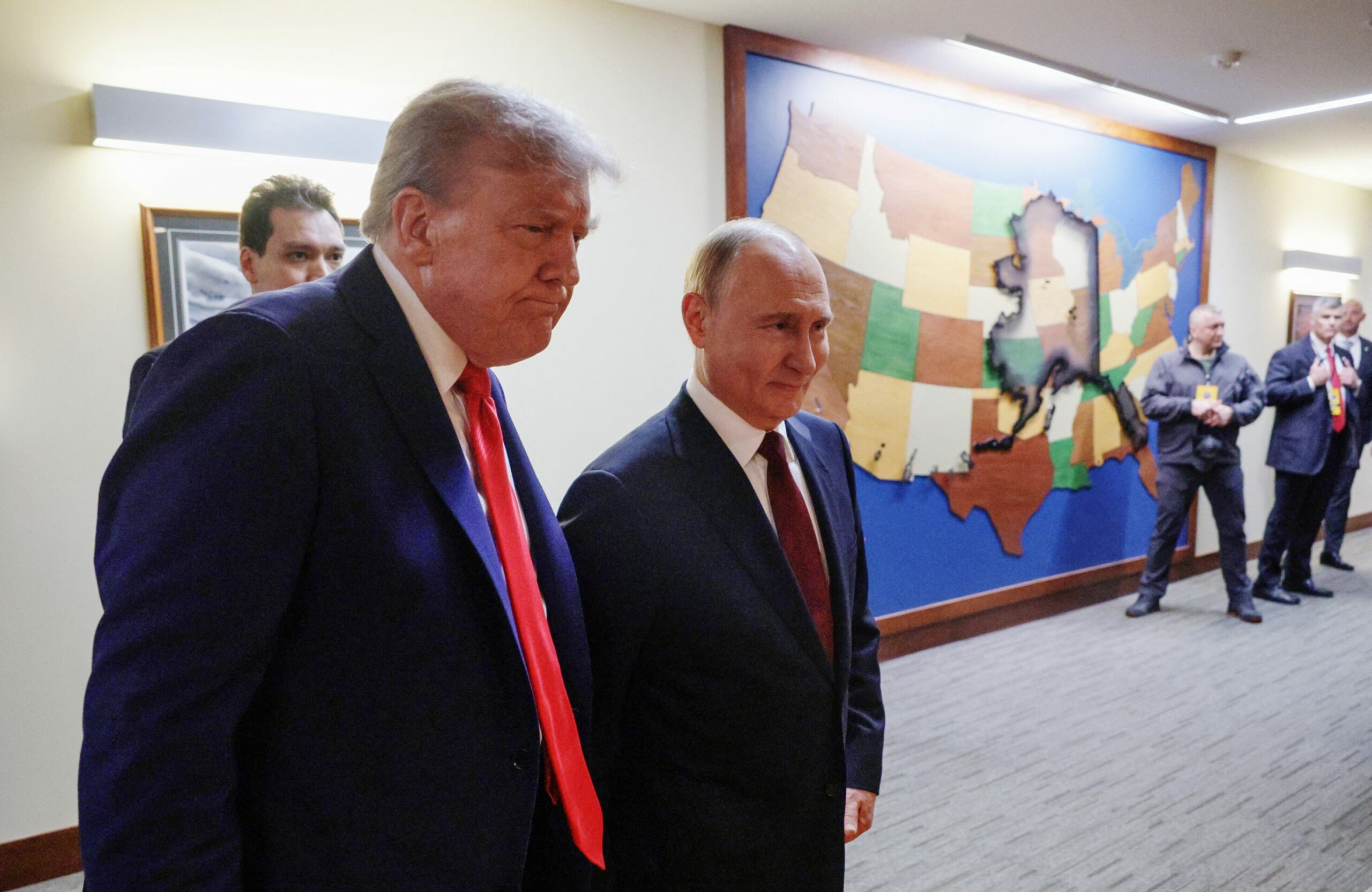
In this pool photograph distributed by the Russian state agency Sputnik, US President Donald Trump (L) and Russian President Vladimir Putin (R) walk during a US-Russia summit on Ukraine in Alaska, on August 15, 2025. Credit: Belga / AFP
The US strategy claims that the Ukraine war has increased Europe’s external dependencies, singling Germany out for building some of the world’s largest chemical processing plants in China, "using Russian gas that they cannot obtain at home."
Moreover, the Trump administration goes on to accuse the EU of wanting to extend the war, as often claimed by Hungarian Prime Minister Viktor Orbán. Yet the EU has pushed back on this, seeing Russian aggression as the main culprit that should pay the price for starting this war.
"The war in Ukraine drags on because Russia refuses to stop. Putin pretends that Europe is the obstacle to peace when nothing could be further away from the truth," Kallas said on Tuesday.
Moreover, shredding the European principle that borders should not be changed by force – a key tenet of the post-World War international order – remains a driving force.
"This war is taking place on European soil. So how the war ends matters to Europeans. It is not in any of our interests that Russia comes back for more," the EU official underlined.
