
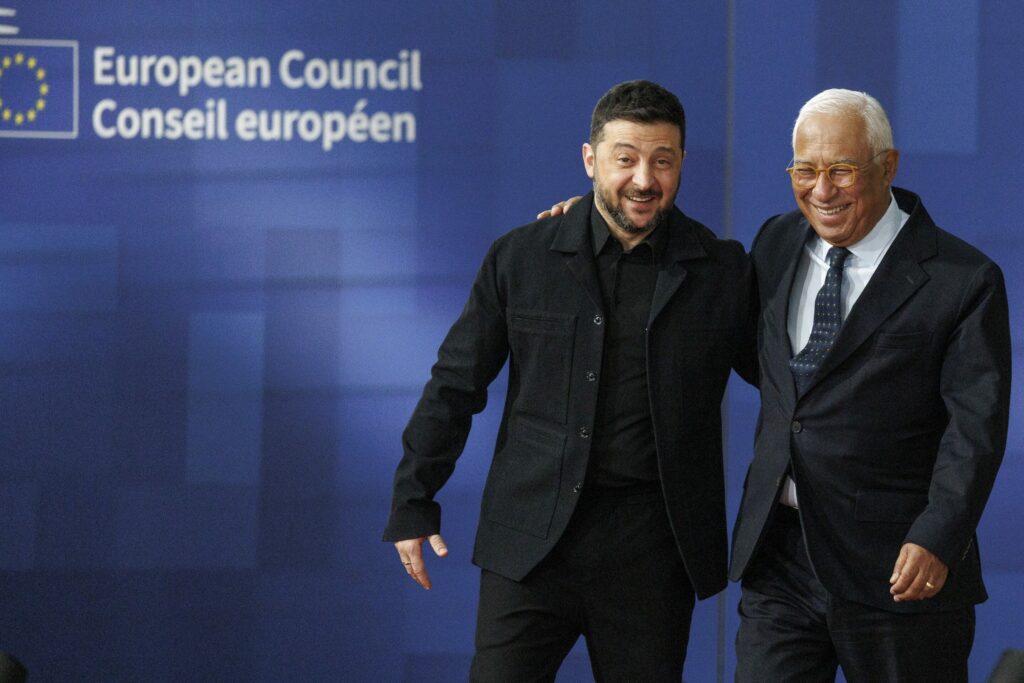
European leaders have agreed on a €90 billion joint loan to support Ukraine over the next two years, announced European Council President António Costa early Friday morning following a summit in Brussels.
Initially, two options were under consideration for financial aid to Ukraine in 2026 and 2027: a joint loan from EU markets or a “reparations loan” tied to frozen Russian assets, an idea backed by the European Commission.
Ultimately, leaders chose the joint loan route, guaranteed by the EU budget. Belgian Prime Minister Bart De Wever expressed relief at the decision, citing concerns over financial and legal risks as well as potential retaliation if Russian assets were used.
António Costa celebrated the agreement, stating, “We committed to it, and we achieved it.”
German Chancellor Friedrich Merz had strongly supported the reparations loan. In a post-summit statement, Merz clarified that Ukraine would receive the aid as a zero-interest loan.
Ukraine would only repay the loan after Russia has paid reparations, Merz explained. “If Russia fails to provide reparations, we will use frozen Russian assets, entirely within the framework of international law, to repay the loan.”
Ukrainian President Volodymyr Zelenskyy welcomed the decision on Friday, writing on a social media post that "This is significant support that truly strengthens our resilience."
He added: "It is important that Russian assets remain immobilized and that Ukraine has received a financial security guarantee for the coming years. Thank you for the result and for unity."
I am grateful to all leaders of the European Union for the European Council’s decision on €90 billion in financial support for Ukraine in 2026–2027. This is significant support that truly strengthens our resilience. It is important that Russian assets remain immobilized and that…
— Volodymyr Zelenskyy / Володимир Зеленський (@ZelenskyyUa) December 19, 2025
The loan decision was adopted unanimously except for Hungary and Slovakia, which opposed the plan due to their closer ties with Russia. These countries, along with the Czech Republic, will exercise an “opt-out,” meaning the loan will proceed with the participation of 24 EU members instead of all 27.
Ursula von der Leyen, President of the European Commission, addressed questions about possible disappointment over the rejection of her preferred option. She noted, “If member states hadn’t tasked us with proposing multiple ways to fund Ukraine, we likely wouldn’t have had the political courage to freeze Russian assets permanently. This is a major victory.”
Last week, EU member states decided to keep Russia’s frozen assets immobilised indefinitely, eliminating the need to renew the decision every six months.
Von der Leyen emphasised that the final solution combines the two ideas: a joint EU loan and the use of frozen Russian assets for repayment if Russia refuses to compensate Ukraine after the war.
On Friday, Kirill Dmitriev, Russian president Vladimir Putin's special envoy for investment and economic cooperation, called the decision to not use frozen assets a "major win for law and common sense."
