
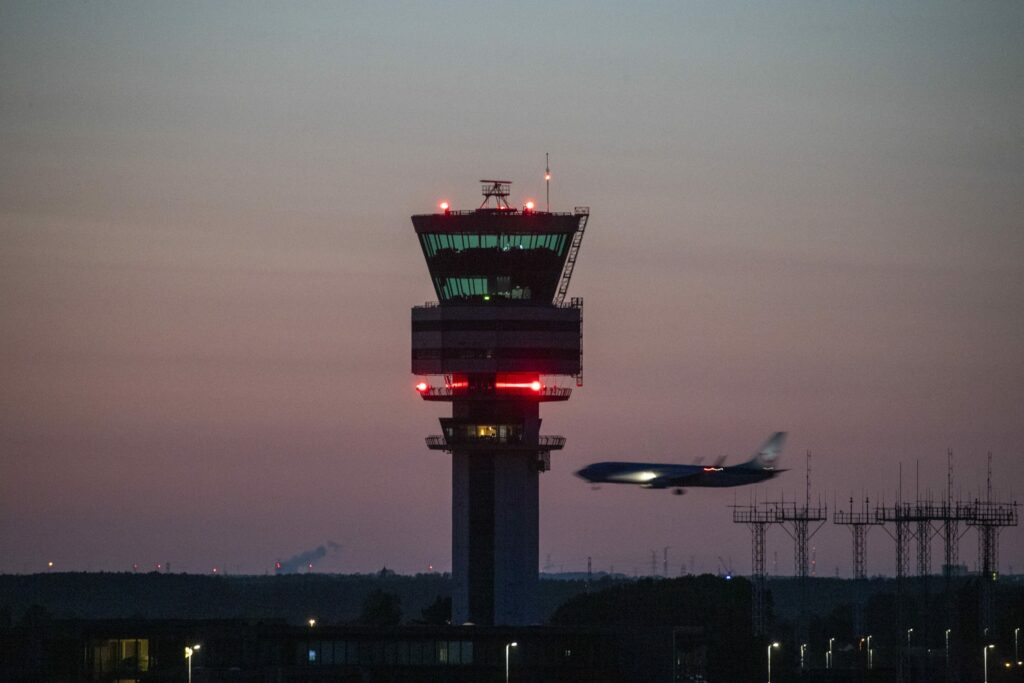
A Brussels grassroots campaign is sounding the alarm over a surge in low-flying aircraft, warning that thousands of planes have been passing over densely populated neighbourhoods at very low altitudes for several consecutive days.
According to the group Collectif Stop le Survol de Bruxelles-Ouest et RNP 07 rectiligne, aircraft have been flying over parts of Molenbeek, Koekelberg, Jette, Brussels city centre, Laeken, Schaerbeek and Haren. These areas together are home to more than 450,000 residents.
In a sharply worded letter addressed to Federal Mobility Minister Jean-Luc Crucke (Les Engagés), local mayors and air traffic authorities, including Skeyes (formerly known as Belgocontrol), the group accuses the federal government of ignoring repeated warnings.
They describe the situation as "massive, concentrated and unprecedented", arguing that such a volume of air traffic has never before been imposed on neighbourhoods with comparable population density.
The group claims the route has resulted in aircraft flying at altitudes of less than 350 metres, from early morning until late at night, including during what it describes as sensitive hours.
It says noise levels regularly exceed Brussels Region standards, with a direct impact on residents' quality of life, particularly during the holiday period.
In a letter addressed to The Brussels Times, Henri Brocard, writing on behalf of the collective, argues that technical alternatives exist.
He says curved RNP approaches could significantly reduce the impact on the most densely populated districts, but have not been implemented.
"The central issue is that other trajectories are possible," the letter states, adding that similar procedures are used at airports elsewhere in Europe to limit overflight of residential areas.
The group questions why the new route was introduced without public debate, during the festive period, and why traffic is being concentrated over Brussels-West rather than redistributed.
It also raises concerns about potential health and environmental consequences, particularly for children, and says legal action is now being considered.
The letter cites a 2018 assessment by the aviation authority DGTA, which, according to the collective, warned that the RNP 07 procedure could lead to systematic breaches of Brussels noise regulations.
It also criticises the role of Skeyes, questioning whether economic and operational considerations have been prioritised over residents' health.
Related News
- Belgium presents new anti-drone air defence system
- Airbus: 6,000 planes urgently need new control software
- Ryanair scraps 1 million seats and 20 routes from Belgium after 'wholly stupid' tax hikes
Residents say they have gathered testimonies, photographs, videos and flight path data and are willing to provide evidence to journalists and authorities.
They are calling for the immediate reconsideration of the route and the introduction of alternative procedures.
Additional reporting by Bruzz highlights similar concerns raised by several citizens' groups, including Free Air Brussels North and Stop Survol Bxl Nord et RNP 07L.
At the time of writing, the petition opposing the RNP 07 by Free Air Brussels North approach routes had attracted more than 2,000 signatures.
According to the collectives quoted by Bruzz, the RNP 07R and 07L approach routes were temporarily introduced during infrastructure works at Brussels Airport in the summer of 2025.
That temporary arrangement has since been extended until the end of 2025 and then until spring 2026, without what they describe as any public consultation or evaluation.
The collectives fear what they call a "creeping installation", in which temporary measures risk becoming permanent.
The Brussels Times contacted Minister Crucke's office, which said it was aware of the nuisance and of the citizens' campaign but had not received the letter, as it was sent on a public holiday. The cabinet added that the issue would be examined after the holiday period.
Bruzz contacted Philippe Touwaide, the Federal Aviation Ombudsman, who argues that the RNP 07 approach route is not new and is not a political decision.
According to Touwaide, the procedure was already applied in 2016, 2018 and 2020 and has been mandatory under European regulations since 25 January 2024.
Touwaide said the route is legal, does not require public consultation, and is currently unavoidable due to persistent easterly winds.
"Aircraft have to land into the wind. This is a technical and meteorological necessity, not a conscious decision to fly over certain neighbourhoods," he said, adding that alternative runways could be used again once wind conditions change.
Brussels Airport Company and Skeyes have not yet publicly commented on the specific allegations.
In a follow-up letter sent on Saturday morning, groups strongly criticised statements made in recent media interviews by the Federal Aviation Ombudsman.
The collectives accuse the federal mediation service of what they describe as a "fabrication of ignorance", arguing that key elements are systematically omitted from public explanations of the RNP 07 approach routes.
In particular, they contest the claim that the RNP procedure is a European obligation. According to them, while EU regulations impose technical navigation standards, they do not require a single, straight and concentrated flight path over the most densely populated areas.
"Europe sets performance criteria, not political choices of trajectory," the letter states.
They also dispute the argument that RNP technology necessarily reduces nuisance. While RNP allows for greater precision, the collectives argue that this precision could also be used to disperse or curve flight paths to limit overflight of residential areas, as is done at other European airports, including Nice.
In Brussels, they say, the technology is instead being used to create a permanent urban air corridor.
The collectives further challenge claims that continuous descent approaches significantly reduce noise. They argue that available studies do not confirm a meaningful reduction in sound levels and say measurements on the ground do not support the official narrative.
Any potential energy savings for aircraft, they add, cannot justify what they describe as a sharp increase in noise exposure for more than 450,000 residents.
They also question the effectiveness of noise regulations, noting that current standards do not take cumulative exposure or long-term health impacts into account. Being "within the norm", they argue, does not mean the situation is tolerable or compatible with public health requirements.
The groups warn that concentrating air traffic in a way that breaches Brussels regional noise standards could expose the federal authorities to legal challenges, including possible environmental injunctions.
Responding to the ombudsman's statement that no public consultation was required and that the route had already been used temporarily between 2016 and 2020, the collectives argue that a temporary measure is now being turned into a permanent one without democratic debate, at a moment when flight paths risk being locked in for decades.
While taking into account the need for aircraft to land into the wind, the groups reject the idea that current weather conditions leave no alternative.
They argue that choosing to impose this constraint repeatedly on the same neighbourhoods is a political decision rather than a technical inevitability.
Mayors back petition
Olivia P'Tito (PS) of Koekelberg, Amet Gjanaj (PS), and Audrey Henry (MR), the mayors of three municipalities in Northern Brussels have joined the wagon by formally backing the petition. In a joint statement issued on Monday, they said they were concerned by the growing use of runway 07L at Brussels Airport, which increases noise pollution.
They also denounced the 'lack of dialogue' from Crucke's cabinet.
According to figures cited by the municipalities, 1,217 landings were recorded on runway 07L in December alone. More than 6,000 aircraft have already flown over some of Brussels' most densely populated neighbourhoods this year, making 2025 the second-worst year in a decade in terms of overflights. In recent days, up to 98% of landings are reported to have used this route.
The mayors are calling for an end to the intensive use of the route and are asking Brussels Environment to step in to enforce regional noise regulations, including through the installation of additional noise meters.
The issue of night flights remains particularly sensitive, as shifting air traffic away from Brussels often results in increased overflights of the Flemish periphery, a long-standing source of political and community tension around Brussels Airport.
The collectives say they will continue to mobilise and are considering further legal and political action.
