

Lego's recent unveiling of an interactive brick has divided fans, with some criticising the use of technology in the traditional toys and its potential impact on creativity.
Dubbed the Lego SMART Play, the system uses a custom-made chip to power a 'smart brick’ that responds with sounds and lights to the way a Lego user plays with certain Lego builds.
The Head of Lego's Creative Play Lab, Tom Donaldson, described the system as a way to “make building worlds and stories even more engaging” without the need for a screen.
“We truly believe we are setting a new standard for interactive, imaginative experiences and can’t wait to see this innovation in the hands of kids when we launch this year,” he said in a statement.
While the Lego Group enthusiastically called the development one of its "most significant evolutions” since the Lego Minifigure was introduced in 1978, not every Lego fan is convinced.
'That's what imagination is for’
The online reaction to the Lego announcement has been mixed. While some welcomed the novelty, others lamented the departure from the traditional bricks and the risks of limiting imagination.
“Need to learn more, but boy do I wish anything would just stay analog. Not everything has to be connected,” reads one reaction to the announcement on Instagram.
“You don't need lights and sound. That's what your imagination is for,” another commenter wrote.

Close up of the smart brick. Credit: LEGO
However, Tom De Bruyker, the head of the Belgian Lego enthusiast group (BeLUG), says creativity is a common characteristic of Lego users, and it is likely they will find their own way of using the smart brick.
“That is actually something typical of our community: free imagination,” he told The Brussels Times. “The possibilities for movement, interaction with other smart bricks, colour and light are immense, so I'm already looking forward to it.”
When asked about the criticism, Lego Communications Manager Jessica Benson told The Brussels Times the company does not have anything to add beyond the previously issued statements, which highlighted "the importance of imagination and creativity in children" and noted that the smart system was "complementary to the traditional Lego Brick."
An invitation to experiment
Speaking to The Brussels Times, developmental psychologist Martijn Van Heel, from the Brussels University VUB, says that while it is too early to determine the impact of the product, he actually sees possible benefits.
“I think it's also an invitation to experiment a little bit more for children,” he said.
Van Heel further welcomed the fact that the new product does not require a screen or a smartphone, and highlighted it as an additional component to traditional Lego rather than a replacement.

Illustrative image of child using LEGO's Smart Play System. Credit: LEGO
“The argument that it would suddenly annihilate all creativity and so on. I think that's a little bit too harsh,” said Van Heel. “It's really still a building block which children can use in their buildings.”
He added: “It's true, if you use the [smart] block, your police car will only make the sound the block makes, and you lose a little bit of freedom. But on the other hand, you're not obliged to use the block. Children can still use regular blocks.”
Children in a digital society
Van Heel says it is understandable that any indication of a toy becoming more interactive is seen as a “red flag” for some within the context of an increasingly digital society.
Nonetheless, he underscores the importance of “nuance” when discussing these topics, noting that the impact of interactive or digital devices can vary significantly depending on what they allow access to and how they are used.
“I think it's also a part of life in which we need to educate and to guide youngsters to say if [something is] bad and you can't have it until you're that many years old,” he added.
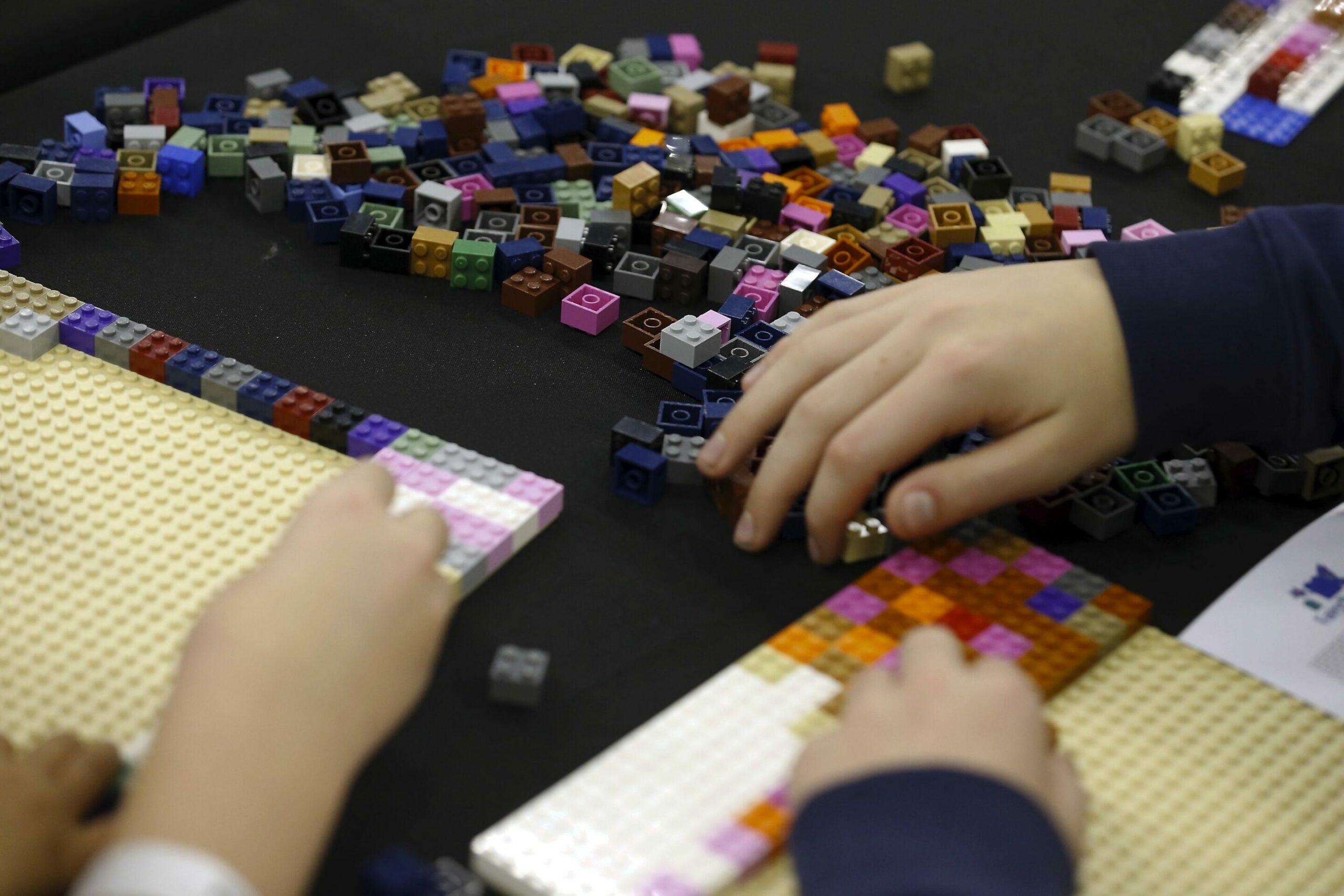
Children playing with typical LEGO bricks. Credit: Belga/Nicolas Maeterlinck
Regarding the new Lego technology, he suggests that strong reactions to the product could be due to the fact that it feels like a significant change. However, in reality, similar features already exist in other toys, such as train sets.
“Sometimes it feels like an event is happening and it feels like a singular event, but it's part of a much bigger thing,” he said.
Ultimately, while Van Heel doesn't personally see the new Lego addition as necessary, he says it is far from a sign that Lego is abandoning the “iconic” traditional toy and limiting creativity.
