
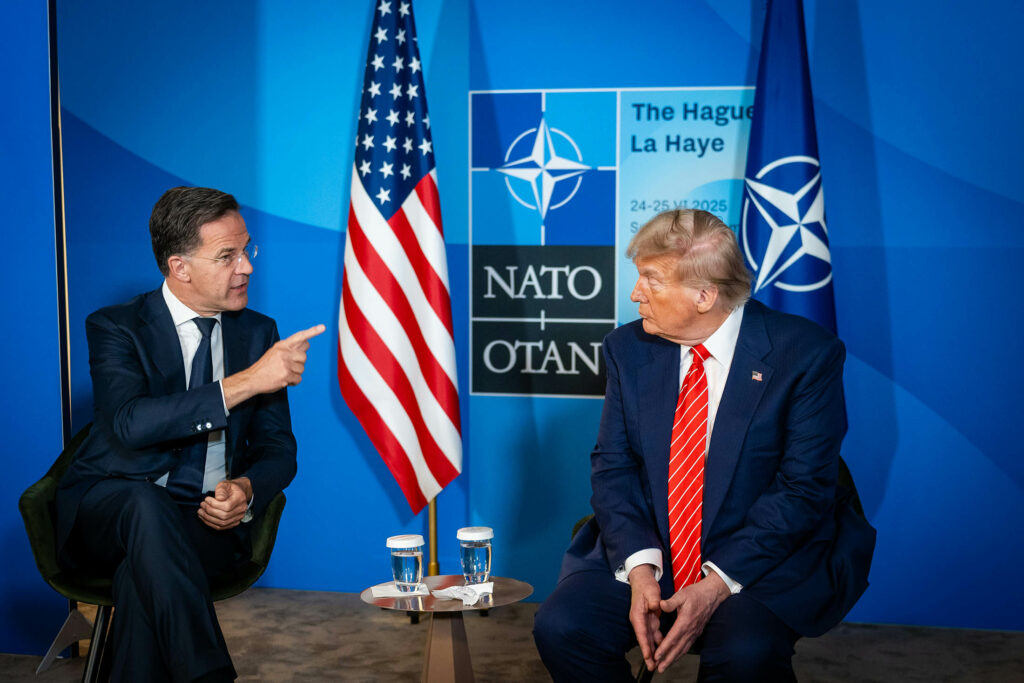
Being an Atlanticist has never been more challenging. The idea that Europe and North America form a single security space, bound by shared interests and values, is becoming increasingly incompatible with the worldview of the second Trump administration.
During Donald Trump’s first term, Europeans could still hope that his harsh rhetoric was mostly tactical — a means to an end, designed to encourage Europe to increase its defence spending.
However, his second term suggests no such strategic purpose. Instead, the president and some of his advisers appear intent on pushing aside whatever they perceive as an obstacle to their mission to “Make America Great Again”.
Washington’s European allies are understandably concerned: will NATO be the next victim of an administration that is becoming increasingly erratic?
It is well known that President Trump harbours no particular affection for international organisations. Unlike other institutions from which the US simply withdrew, however, Trump prides himself on having rejuvenated NATO as a more lethal fighting force.
Moreover, he has not questioned the US “nuclear umbrella”, i.e. the US commitment to protecting Europe with nuclear weapons. Trump’s recent National Security Strategy (NSS) is more of an ideological manifesto than a coherent policy document, but it does acknowledge that Europe is too important for the US to write off.
None of this guarantees NATO’s continued existence. However, the US is about much more than a difficult leader. America still has a safety net to ensure that its alliance policy is not determined solely by the whims of a few: the security establishment.
This group of congressmen and women from both parties, military experts, think tankers and journalists is slowly but surely finding its voice again. The US Congress, in particular, has begun to restrict the executive branch’s room for manoeuvre, notably with respect to NATO.
Even during Trump’s first term, Congress ensured that the president could not withdraw the US from the alliance. The recently passed National Defense Authorization Act goes even further by imposing strict limits on any reduction in US troop numbers in Europe.
This document, which was signed by Trump, also stipulates that the role of NATO Supreme Allied Commander will remain in American hands.
These moves by Congress demonstrate that, even within Republican circles, there appears to be little inclination to abandon NATO. It is not difficult to see why. Not only does NATO provide security for Europe, which remains a major trading partner of the US, it also affords Washington considerable influence in European political, economic and military affairs.
In Asia, the US has to work through bilateral relationships with politically and culturally diverse allies. In Europe, by contrast, NATO has helped institutionalise an almost unreservedly cooperative political environment.
And there is more. Many in Congress and in large parts of the American “strategic community” are wary of Trump’s Russia-friendly policy or his idea of taking over Greenland.
Trump initially succeeded in taking the US political and economic establishment by surprise, but the self-healing powers of American democracy are now becoming apparent, albeit rather late.
When die-hard “Trumpists” now accuse Congress of “betraying” the president, something is changing. In short, NATO will most likely survive Trump. However, there will be no return to the previous transatlantic status quo. The shock of Trump has made Europeans aware of the risks of being overly dependent on US military capabilities.
They will therefore continue on their path towards greater independence. This process will no longer, however, take place amid the mixture of panic and defiance that currently characterises the debate. As the protection of Ukraine after a peace agreement soon could demonstrate, difficult security challenges are best met by Europe and America together.
Martin Erdmann is Germany’s former Ambassador to NATO and Turkey. Michael Rühle worked in NATO’s International Staff.
