
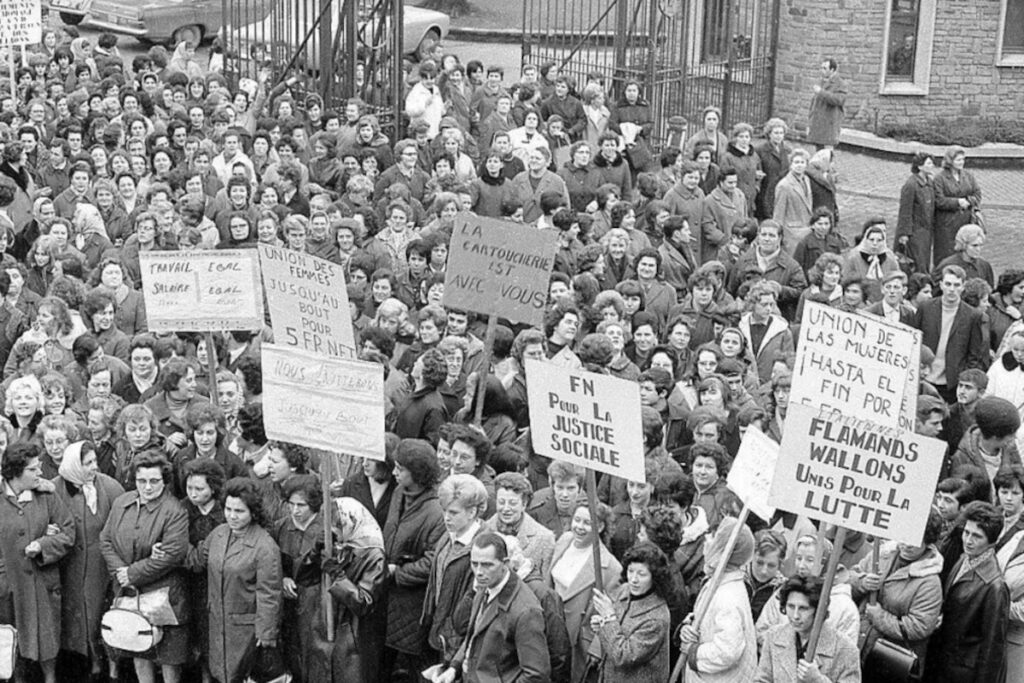
The 16th of February marks the 60th anniversary of the start of the strike led by female workers at the Fabrique Nationale (FN) in Herstal, advocating for equal pay for equal work.
The strike began on 16 February 1966 and saw around 3,000 women mobilised for twelve weeks, a remarkable display of mass action in terms of scale and duration.
Very soon, the movement extended beyond the factory, inspiring similar strikes at other companies in the Liège area, such as the Schréder workshops in Ans, Jaspar-Westinghouse in Awans-Bierset, and ACEC in Herstal.
The strike also garnered international solidarity, with support from trade union delegations and women’s movements in France, Italy, and the Netherlands.
The strikers rewrote the lyrics of Henri Salvador’s popular song, singing, "Work brings health, but only if paid fairly," during their repeated protests. A major march was held in Herstal on 7 April 1966, followed by another with several thousand participants in Liège on 25 April.
After three months of protests, a settlement was reached. The agreement granted an immediate pay rise of two francs per hour (equivalent to roughly €0.40 in purchasing power by 2026), followed by an additional increase of 75 centimes on 1 January 1967.
Beyond the factory, the strike pushed the issue of equal pay firmly onto the European agenda.
Yet, six decades later, the fight remains relevant. According to recent figures from the Institute for the Equality of Women and Men (IEWM), Belgium’s gender pay gap stands at 7% when corrected for working hours, and at 19.5% without the correction, with female labourers being the most affected.
