
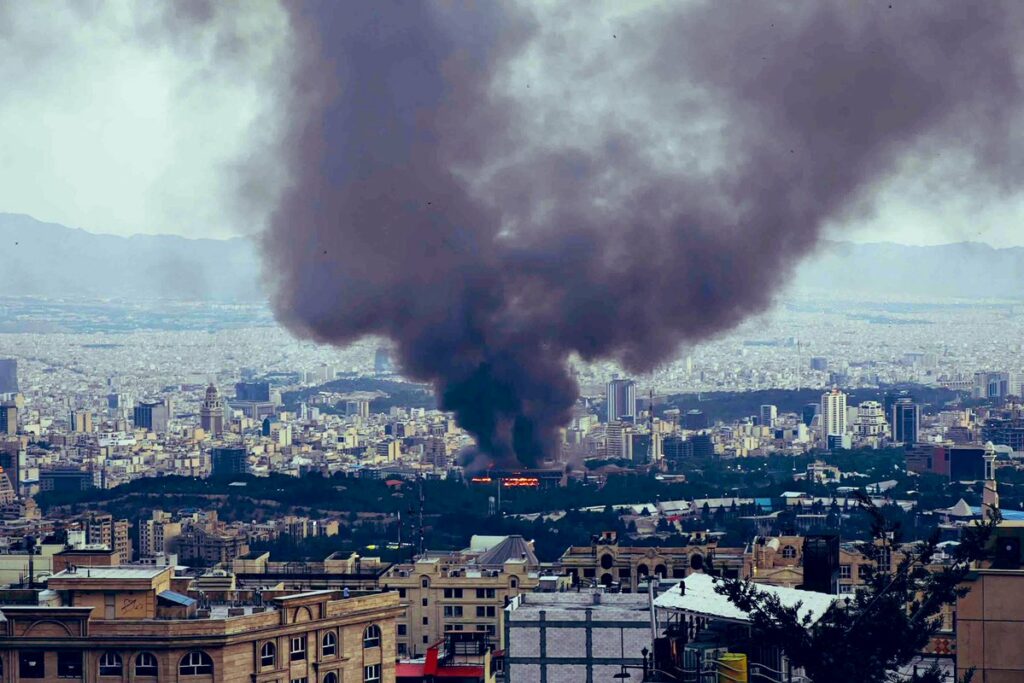
The joint US-Israeli air strikes against Iran - followed by Iranian counter-strikes against Israel, the Gulf countries, and American bases and embassies in the region - continue for the seventh day since last Saturday and have plunged the whole region into chaos and uncertainty about the future.
On Monday, the war spread to Lebanon when Hezbollah, under pressure by Iran, decided to revenge the killing of Iran’s supreme leader Ali Khameini despite calls by the Lebanese government not to drag the country into a new war. The cross-fire has already led to the displacement of hundreds of thousands of civilians from southern Lebanon and Hezbollah’s stronghold in Beirut.
At first, the rocket fire by Hezbollah seemed symbolic, but it gave Israel the pretext or window of opportunity to respond with massive strikes aiming at the full disarmament of the Iranian proxy. The Lebanese government has meanwhile decided to expel the Islamic Revolutionary Guard Corps but it was too late. The war has escalated with joint rocket fire by Hezbollah and missile barrages from Iran against Israel.
War expands regionally
Fighting for survival, the Iranian regime launched strikes against several Gulf countries to compel them to influence the US to end the war, but it might have the opposite effect and force them to defend themselves. A drone attack originating from Lebanon against a British military basis in Cyprus prompted Greece and other Member States to send naval forces to defend the country.
Last week, it still appeared as if US President Trump was giving diplomatic talks a chance and that the American military build-up in the region was used to put pressure on Iran. But Iran’s insistence on its right to enrich uranium, after a temporary suspension of some years, and its refusal to discuss non-nuclear issues, indicated that the gap between the US and Iran was still unbridgeable.
Trump could hardly accept the Iranian proposal after the US in 2018 unilaterally withdrew from the previous nuclear deal JCPOA (the Joint Comprehensive Plan of Action), which put enrichment on hold for a longer period and required Iran to hand over enriched uranium in exchange for lifting economic sanctions.
Iran was apparently playing for time in the talks hoping that Trump would not make true of his threats to attack it ahead of the midterm elections in the US but misjudged his intentions. Trump hesitated into the last moments to launch an attack and boasted that his threats had forced Iran to stop executing protesters.
In the US, the strikes are not supported by Trump’s voter base nor were they even approved by the Congress.
While a majority in the US question the Trump administration’s justification for the strikes, the opposite is the case in Israel, which more concretely feels that its existence is threatened by Iran’s ayatollah regime.
Israel did not believe that the talks would succeed and used the time to put its air defense on high alert and prepare for war to eliminate the threats that Iran’s nuclear and ballistic missile programmes pose.
For Israel’s Prime Minister Benyamin Netanyahu, genuine national security concerns are mixed with his short-term political survival ahead of elections this year. Refusing to take responsibility for the 7 October 2023 failure, and unwilling to transform military successes to political peace solutions, another war would rally the country, including the political opposition, behind him and may help ensure his re-election.
Washington’s demands
The American demands in the last-minute talks in Geneve last Thursday were manyfold: Iran should cease enrichment of uranium once and for all, hand-over its existing stockpile of highly enriched uranium, discuss limitations to its arsenal of long-range ballistic missiles, end its military and economic support to terrorist proxies in the region, and stop the brutal suppression of its own people.
“Iran can never have a nuclear programme,” Trump declared last Saturday. “They rejected every opportunity to renounce their nuclear ambitions, and we can’t take it anymore.” “Instead, they attempted to rebuild their nuclear program and to continue developing long-range missiles that can now threaten our very good friends and allies in Europe, our troops stationed overseas and could soon reach the American homeland,” he added.
He also turned to the Iranian people. “When we are finished, take over your government. It will be yours to take. This will be probably your only chance for generations.”
In January, the Iranian regime ordered its security forces to suppress the demonstrations and thousands of protesters were killed – according to Trump over 30.000. While many Iranians welcomed the strikes against the regime and the death of Khamenei, they are afraid of taking to the streets again.
For this to happen the security forces will have to disobey orders or desert. The regime is weakened after the strikes but there is no organised opposition or recognised opposition leader which could take power if the regime would fall. Reza Pahlavi, the son of the last Shah, says that he is willing to lead Iran during a transition period but living in exile in the US is no guarantee for wide support in Iran.
Europe watches closely
The EU was sidelined in the failed nuclear talks and is calling for a diplomatic solution without specifying the details. In principle the EU supports the American demands stopping short of possible regime change. At last week’s foreign affairs council meeting, High Representative Kaja Kallas made it clear that the US and Iran were inching dangerously towards war.
After the launch of the US – Israeli strikes on Saturday morning, Kallas issued a statement on behalf of all 27 EU Member States condemning Iran, indirectly justifying the strikes, repeating the US conditions for a diplomatic solution but stopping short of calling for regime change.
“The EU has consistently urged Iran to end Iran’s nuclear programme, curb its ballistic missile programme, refrain from destabilising activities in the region and in Europe, and to cease the appalling violence and repression against its own people.” The missiles are dangerous not only for the countries around Iran but also a threat to Europe, “considering how far they reach”, she said.
Whether the US-Israeli strikes against Iran are legal under the UN Charter and international law is disputed and depends if they are described as pre-emptive or preventive. Pre-emptive strikes against an imminent attack are viewed as legal self-defense. A preventive war to avert a future threat is considered illegal.
The Iranian regime is bent on Israel’s destruction and might have planned to attack first or in the near future. The Commission’s spokespersons declined to respond to questions about EU’s position on the legality of the strikes and in practice the distinction seems not to matter considering the geopolitical realities.
A short statement was also issued jointly by European Council President Costa and European President von der Leyen. It did not mention the US – Israeli strikes and described the developments in Iran as greatly concerning, referring to the actions of “Iran’s murderous regime” and EU’s “diplomatic efforts aimed at addressing the nuclear and ballistic programmes through a negotiated solution”.
On Monday, the European Commission convened a “security college” meeting to review the “evolving situation in Iran and the Middle East and the spill-overs for the EU”. Asked about the main security risks for the EU, chief spokesperson Paula Pinho referred to a read-out which exceptionally had been published despite the confidential nature of the meeting.
In fact, the document does not disclose any state secrets and mainly deals with supporting Member States and protecting EU citizens from the adverse consequences of the events unfolding in Iran and the Middle East. Focus is on Member States' evacuation and repatriation efforts.
The Commission is also reinforcing monitoring of transport disruption risks around the Strait of Hormuz and the Red Sea, closely tracking the impact of the war on energy prices and supply, cooperating with Europol and Member States regarding potential internal security risks, and enhancing its preparedness on eventual war-driven migration.
“The whole Middle East stands to lose from the current situation and a prolonged war,” foreign affairs spokesperson Anouar El Anouni told The Brussels Times. “We’ll continue using all diplomatic efforts to reduce tension and bring about a lasting solution to prevent Iran from acquiring nuclear weapon,” he added, urging Tehran to genuinely change its behaviour.
For a brief moment, change seemed possible with the establishment of a temporary leadership chaired by Ali Larijani, the secretary-general of the National Security Council, who was appointed by Khamenei in case he would be killed.
Larijani is considered a pragmatist who is familiar with the nuclear talks in the past. There were speculations that he would use the opportunity until a successor to Khamenei was elected by the 88-member Assembly of Experts to reach an agreement with Trump which would leave the regime intact if it ended the suppression. But this turned out to be wishful thinking. Iran is prepared for a prolonged conflict with the US and Israel, he said already on Monday.
The US has encouraged Iranian-Kurdish militias located in the Kurdish autonomous region in Iraq (KRG) to invade Iran but that may be an impossible mission. It could also be a risky mistake by the Kurds considering how the Kurdish autonomous region in north-east Syria (Rojava) has already been abandoned twice by the Trump administration.
The US and Israel have complete air superiority and are systematically destroying Iran’s ballistic missile launchers and missiles but it can take some more time. The war is likely to continue for 1 – 2 more weeks (according to Israel) or even a month or more (according to the US), unless Trump would suddenly declare victory.
The Iranian regime stands alone in the war, without any support from its ally Russia which it supported with drones against Ukraine. If it was rational, it would change course and not risk total collapse, chaos, and civil war. A reformed or new regime which would give up the nuclear programme and focus on Iran’s economy and the wellbeing of its people may be the best scenario now.
