
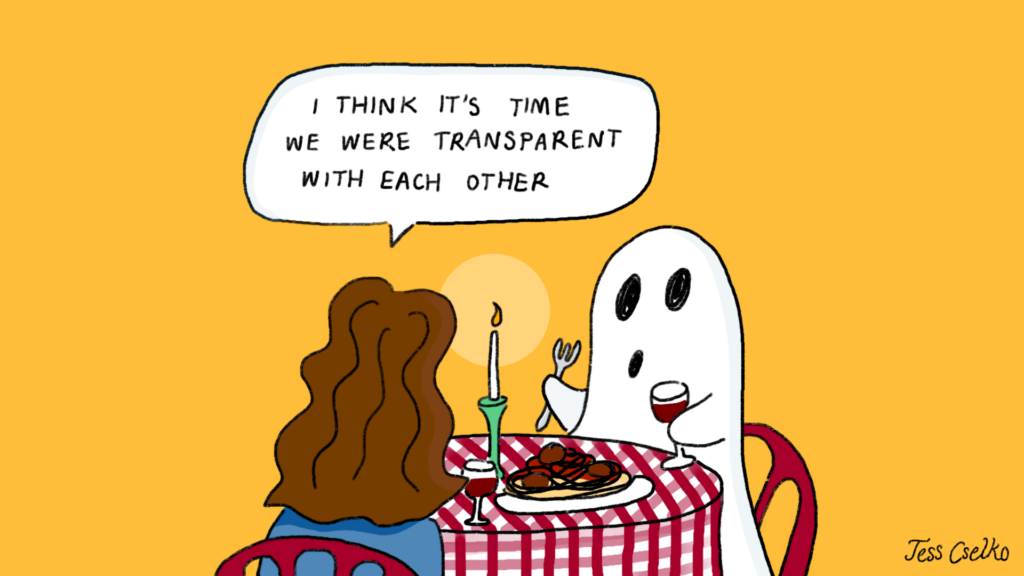
Brussels is haunted; ghosts plague every corner of this town. I'm not talking about the spooky ones from cartoons you watched growing up – I'm referring to the kind you start dating who suddenly drop off the face of the earth, never to be heard of again.
This article is part of The Brussels Times' dating series, which includes columns and interviews with experts and members of the public on all matters of the heart.
Carrie Bradshaw's back in Brussels and ready to talk you through her dating woes once again. Remember that good date I had from last time? The one which restored my faith in the apps and men generally? Well, dear reader, it seems I spoke too soon.
The Irishman in question took me on two great dates. Wine was flowing, and sparks were flying – or so I thought.
Just as all was going well and we had agreed on an evening for date three – I had even made the dinner reservation (and obviously chosen what I wanted off the menu two days in advance) – he vanished into thin air.
Was he dead? Had he been hit by a STIB tram? Surely he'd had his phone stolen? But no. The iconic 2009 film title was ringing in my ears: 'He's just not that into you'.
Which, I should add, is absolutely fine. I'm not going to be everyone's cup of tea – especially when I start cracking sub-par jokes after two (or more) glasses of wine.
But what's not fine is not saying anything at all, and most importantly, nearly making me miss out on a night of pasta (luckily, a friend stepped in at the last minute to fill the empty chair across the table from me).
No rhyme or reason
What I've described above is an increasingly common phenomenon known as ghosting, in which someone ends a relationship by suddenly cutting all communication without warning or explanation. It happens in friendships, families and professional settings, but most frequently in the world of dating.
I still vividly remember my first experience of it. It was 2019, and I was 21. I'd been chatting quite intensely with a Spaniard for a month. We lived in different countries, but would FaceTime for hours. There was even talk of him coming to the UK for a weekend.
After several weeks of what felt like a long-distance relationship, I noticed something strange. Despite telling me he lived in Barcelona, everything was pointing to him living in Pamplona, a five-hour drive away. When I asked him about this, I never heard from him again. I'll never find out why he lied and never replied, and I often think about it to this day.
To try and make sense of why people behave in this way, I spoke to Dr Janneke Schokkenbroek, Assistant Professor of Health Psychology at Erasmus University Rotterdam, whose doctoral research focused on harmful technology use in romantic relationships.
Dr Schokkenbroek says the reasons for ghosting range from avoiding confrontation and wanting to protect the other person's feelings, to feeling like the relationship wasn't yet developed enough to warrant an explanation, or wanting to disengage with the other person's hurtful behaviour, such as racist remarks or harassment.
In some cases, she says, ghosting is justified, such as when people feel unsafe, or when they use it as a "last resort" after attempting and failing to reject someone.
The examples I've given are of men, but this isn't an inherently male problem: studies show that women actually ghost slightly more than men (47% and 44%, respectively), though they are more likely to do so out of fears for their safety.
Move on up
Ghosting is cowardly, confusing and cruel – whether it happens after two weeks, two months, or two years. Helena* from the previous article in the series describes the feeling as "someone slamming a door" in her face. "It's just infuriating. It's not something our brains are made for; we're not supposed to have those kinds of interactions as humans."
It can trigger a "rollercoaster of emotions", according to Dr Schokkenbroek, from sadness and anger to self-blame and shame, and it can have a lasting impact on the victim's self-esteem, trust, and emotional well-being.
What makes it particularly difficult to deal with is that there's never any concrete marker of how or why things ended. Dr Schokkenbroek describes this as "ambiguous loss".
"It's an unresolved, uncertain, and ongoing loss, lacking closure or clear definition. To move forward, I think it is very important to acknowledge this, that part of the puzzle will remain unsolved. It is very rare for ghosters to return and actually provide answers to the questions the ghostee probably has," she says.
"Some ghostees embrace acceptance. [...] They delete messages, block the ghoster, and focus on hobbies, friends, or even new romantic prospects. Some ghostees can't move on without trying to understand why, for example, by scrolling through the ghoster's social media or sending one last message."
Dr Schokkenbroek says there are ways of taking back control. One option is to send a final message to the ghoster acknowledging the connection has ended, but that ghosting is hurtful, and it would have been more respectful to make the rejection explicit.
She adds that this is purely optional and that it's "not the ghostee's responsibility to provide the ghoster with psychoeducation", but that it can help create a sense of closure and regain power and agency.
Sign of the times?
In one of her recent surveys, Dr Schokkenbroek found that a staggering 93% of respondents had experienced ghosting. Is ghosting a symptom of the society we live in today? Has our ability to communicate with each other broken down entirely?
Nowadays, we can connect with more people than ever before, but it's also easier than ever to silently withdraw and digitally dump. With the click of a button, you can remove someone from your life forever. We've become completely disposable.
Dr Schokkenbroek says "online dehumanisation" plays a role. She describes this as "the tendency to view people we meet online as less human, particularly compared to people we meet in person. The fact that we do not see the person on the other side, and also do not have to face the consequences of our words and actions, further exacerbates this process."
But wanting to avoid confrontation predates the online world, she says. We've always struggled to reject others.
The oldest example she has found of ghosting is from 1897. In a famous love letter from Irish poet and playwright Oscar Wilde to Lord Alfred "Bosie" Douglas, he wrote that he had not received "a single line, or any news or message even" from his lover while imprisoned for two years for "gross indecency", and that "after long and fruitless waiting" he had decided to write to him himself.
So, there's no shame in double texting if even the great Oscar Wilde did it.
Wolf in sheep's clothing?
What's odd in the case of the Irish ghost is that he was a seemingly nice guy, with no red flags in sight. How could someone so nice and well-intentioned disappear with no forewarning?
But a good friend of mine quickly pointed out that being nice doesn't necessarily mean someone is kind.
Related News
Anyone can appear nice. It's how we want to present ourselves to the world (especially the people pleasers among us), and it's therefore often superficial. Kindness, on the other hand, is internal. It comes from a place of empathy, wanting to be a good person and do the right thing.
Because ghosting isn't about doing the right thing: it's about choosing the more convenient option.
There are some silver linings to being ghosted, though: the sheep's clothing was whipped off in a not-altogether-sexy way, and exposed his true colours. It's good I know this now, because frankly, I'd prefer not to date someone with the emotional maturity of a peanut anyway.
Maybe it's time I tried speed dating. Stay tuned…
If you have a story to share of dating in the city, get in touch! i.vivian@brusselstimes.com
*Name has been changed to protect the speaker's identity.
