
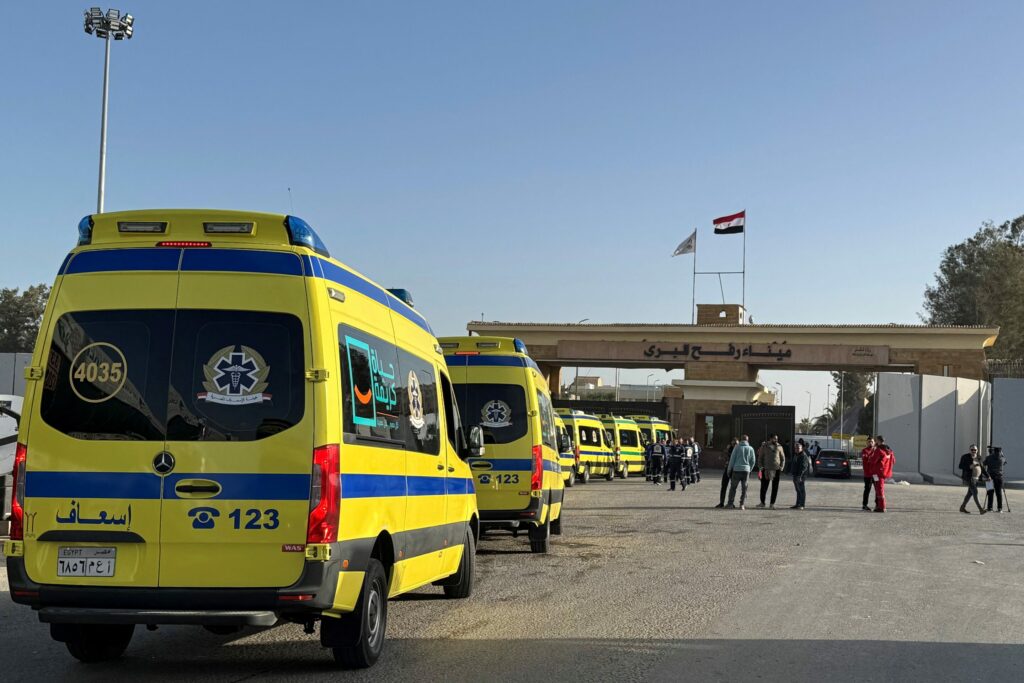
The EU Border Assistance Mission (EUBAM) at the Rafah border crossing between Gaza and Egypt has been in stand-by mode since the crossing was closed by Israel on 28 February, when the US-Israeli strikes against Iran were launched.
On the first day of the strikes, the Israeli Coordinator of Government Activities in the Territories (COGAT) announced that the crossing would be closed on alleged security grounds. The crossing at Kerem Shalom for the entry of humanitarian aid into Gaza was also closed. This crossing was reopened a few days later under pressure from the US, but other crossings for aid to Gaza remained closed.
"The basic needs of Gaza's population cannot be delayed," the High Representative of Gaza's Board of Peace, Nikolay Mladenov, commented on X.
The situation in Gaza has largely slipped under the radar during the US-Israel-Iran war.
European Commission President Ursula von der Leyen hardly mentioned it in her speech on Monday to EU ambassadors regarding EU foreign affairs policy and diplomacy. She was outspoken about the war.
"You will hear different views about whether the conflict in Iran is a war of choice or a war of necessity. But I believe this debate partly misses the point. Because Europe must focus on the reality of the situation, to see the world as it actually is today," she said. "There should be no tears shed for the Iranian regime that has inflicted death and imposed repression on its own people."
The Rafah crossing was opened at the beginning of February, with staff from EUBAM supervising the crossing. However, traffic at the crossing remained limited in both directions. Sick and wounded people with their escorts were allowed to leave, and people who left Gaza during the war were allowed to return.
EU’s High Representative for foreign affairs, Kaja Kallas, welcomed the opening at the time. "The opening marks a concrete and positive step in the peace plan," she said, referring to Trump’s peace plan for Gaza.
"The EU’s civilian mission is on the ground to monitor crossing operations and support Palestinian border guards. For Gaza's sick and wounded, the reopening is a lifeline. It will allow families to reunite after far too long apart," Kallas said.
How EUBAM works
"EUBAM stands ready to be redeployed as soon as the crossing point reopens and the parties allow it," an EU foreign affairs spokesperson told The Brussels Times after the closing. "The humanitarian needs on the ground remain as acute as they always have been."
The EU welcomes the reopening of the Kerem Shalom crossing for humanitarian aid and calls for the reopening of the other crossings.
EUBAM Rafah currently includes 30 experts in border management and security staff from 11 EU Member States: Belgium, Bulgaria, Germany, Greece, Spain, Finland, France, Ireland, Italy, Romania and Denmark. This includes personnel deployed through three Specialised Teams provided by EU Member States via the European Gendarmerie Force, notably Spain, Italy and France.
The EUBAM has no mandate to enforce procedures. It is not present at the Israeli military checkpoint inside Rafah, where mistreatment or harsh control of incoming Palestinians has been reported.
"We have no visibility over procedures conducted elsewhere and are therefore not in a position to comment on reports concerning other locations," an EUBAM spokesperson told The Brussels Times.
Since the Rafah border crossing was opened in February, the number of people crossing it has been fluctuating day by day, the spokesperson explained. "The figures depend on what has been agreed between the parties for each day and on the arrangement made with all the partners involved in the passenger crossing."
"Questions regarding the rationale behind the arrangements and any linkage between departures and arrivals should be addressed to the parties concerned," the spokesperson added.
"If the parties were to agree on allowing a higher number of passengers to cross, EUBAM Rafah can reinforce its capacity at short notice. The mission’s current staffing and operational set-up are sufficient for the present volume of movements and can accommodate a reasonable increase."
"As a civilian mission under the EU's common security and defence policy (CDSP), EUBAM has access to established mechanisms for rapid reinforcement, including the deployment of additional Specialised Teams, subject to Member State approval. Any structural or permanent expansion of the mission’s capacity would require a formal decision by EU Member States."
