
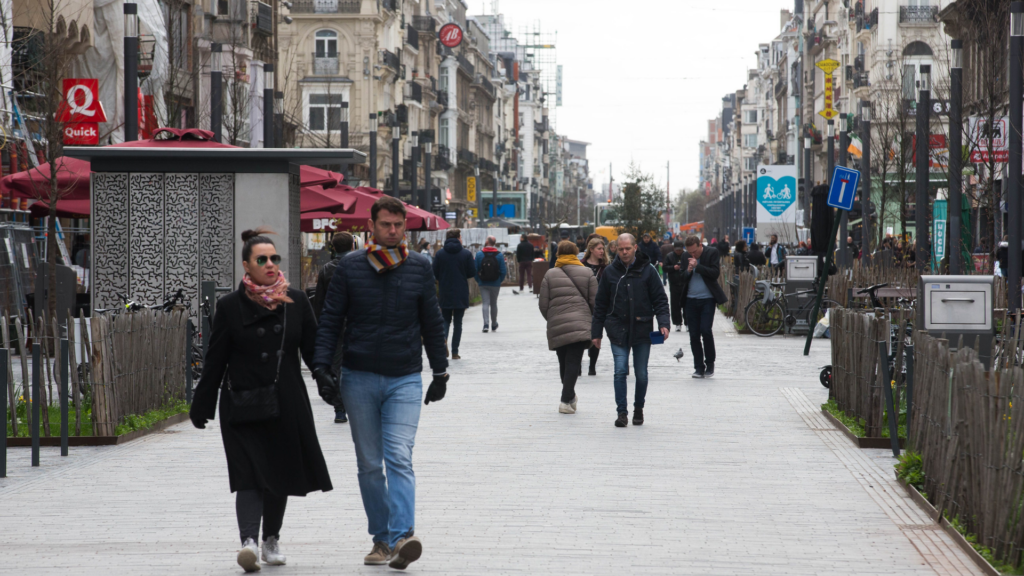
As the capital of Europe tries to move away from the hum of cars to become a more pedestrian-friendly place, some residents say the changes are cutting them out of their city.
The car-first attitude that used to prevail in Brussels is often attributed to the previously-held 'functional view' of the capital, where, for a long time, Brussels was designed as a place to work in rather than as a place to live.
Since the creation of the Brussels-Capital Region in 1989, several projects have materialised to prioritise pedestrians instead, with the demarcation of pedestrian zones as one of the most obvious examples.
Earlier this year, the city's iconic Place Royale received a pedestrian-friendly makeover – one of the latest initiatives showcasing Brussels’ shift from its car-centric ways.
But for Marika*, a Brussels resident in her 70s, the news served as a reminder of the growing list of areas she has to avoid, since old age and health complications increased her and her husband's dependence on cars.
“We feel not like second-class citizens, but third-class citizens,” she told The Brussels Times.
‘Excluded from normal life’
Originally from Greece, Marika has lived most of her adult life with her husband in Brussels, where she worked for the European institutions.
The couple's ability to move freely has diminished over time, with her husband now regularly having to use a walking stick for shorter distances, and a wheelchair for longer ones.
As a result, they began using their car frequently to reach their destinations with ease. But with increasing traffic restrictions, particularly in the centre of the City of Brussels, Marika says she has felt "skilfully excluded from normal life”.
Amid the hassle of having to work out where exactly they can drive through and whether there is parking close enough to their destination, the Greek national says she and her husband find themselves with “almost no" social life. “We stay at home, watching TV, reading. We go to the supermarket, to the doctor, and that's it,” she said.
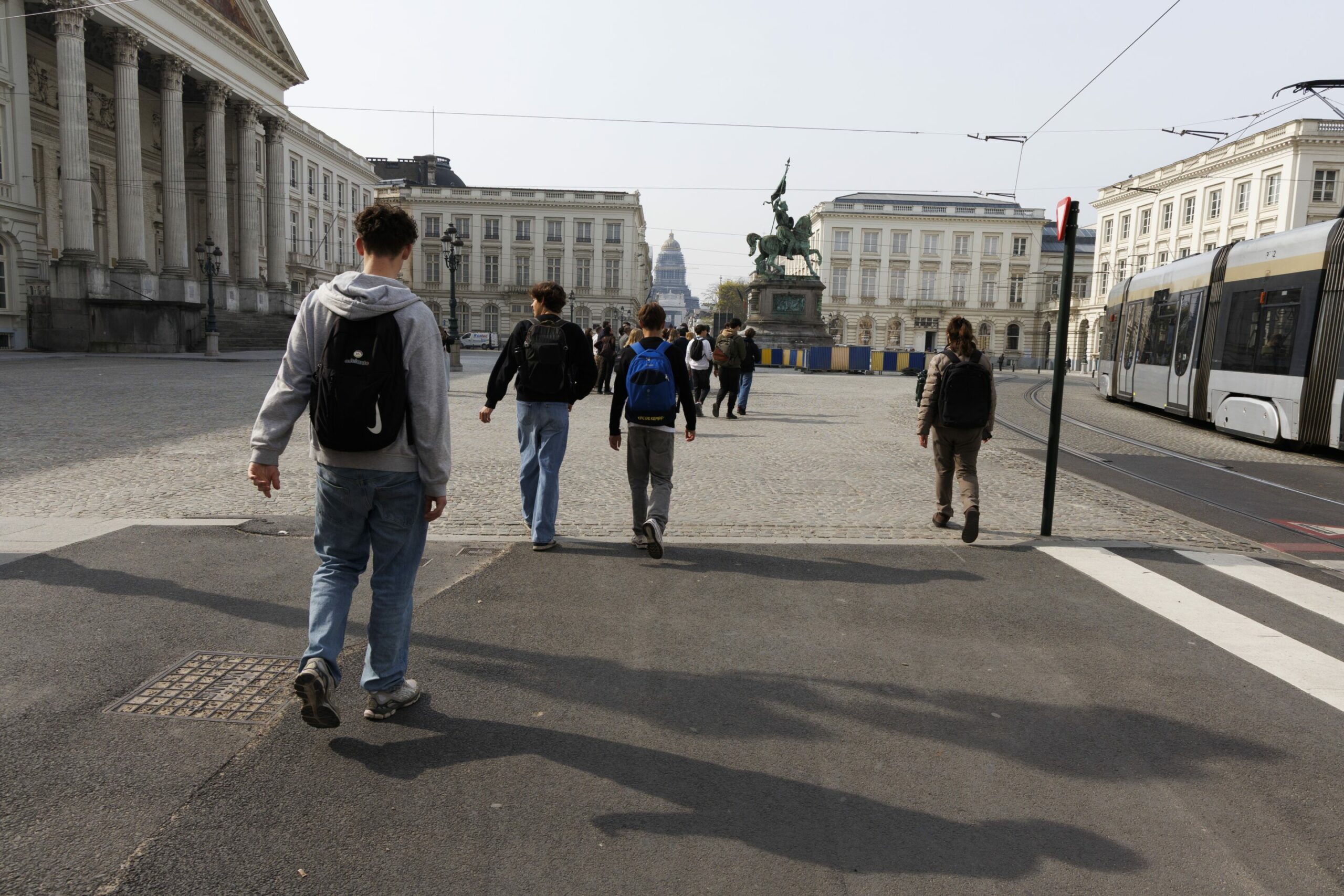
Illustration picture shows the renovated Place Royale in Brussels, on Monday 23 March 2026. Credit: Belga/Nicolas Maeterlinck
While Marika acknowledges that there are alternatives to cars, such as public transportation and taxis, she says these options are not always reliable or particularly flexible.
She feels that the system could be made much more inclusive by expanding the criteria to grant car access to pedestrian zones for more people with restricted mobility. The current approach, she believes, is too restrictive and leaves out several members of the population, including the elderly.
Their frustration with the situation and the feeling of being overlooked by local politicians is such that the couple have considered leaving the city they have called home for over three decades.
Conflicting needs
But not all residents with mobility issues share Marika's experience. David Seffer, 54, is wheelchair-bound as a consequence of multiple sclerosis. He says he is "quite happy” with the pedestrian zones around Brussels.
"They are flat, there's no kerbs, and there's less cars, so for me it's less dangerous and less annoying as a wheelchair user,” he told The Brussels Times.
However, he says he understands Marika's feelings, explaining that he's seen how some people with reduced mobility are personally affected by significant changes to their own daily routines.
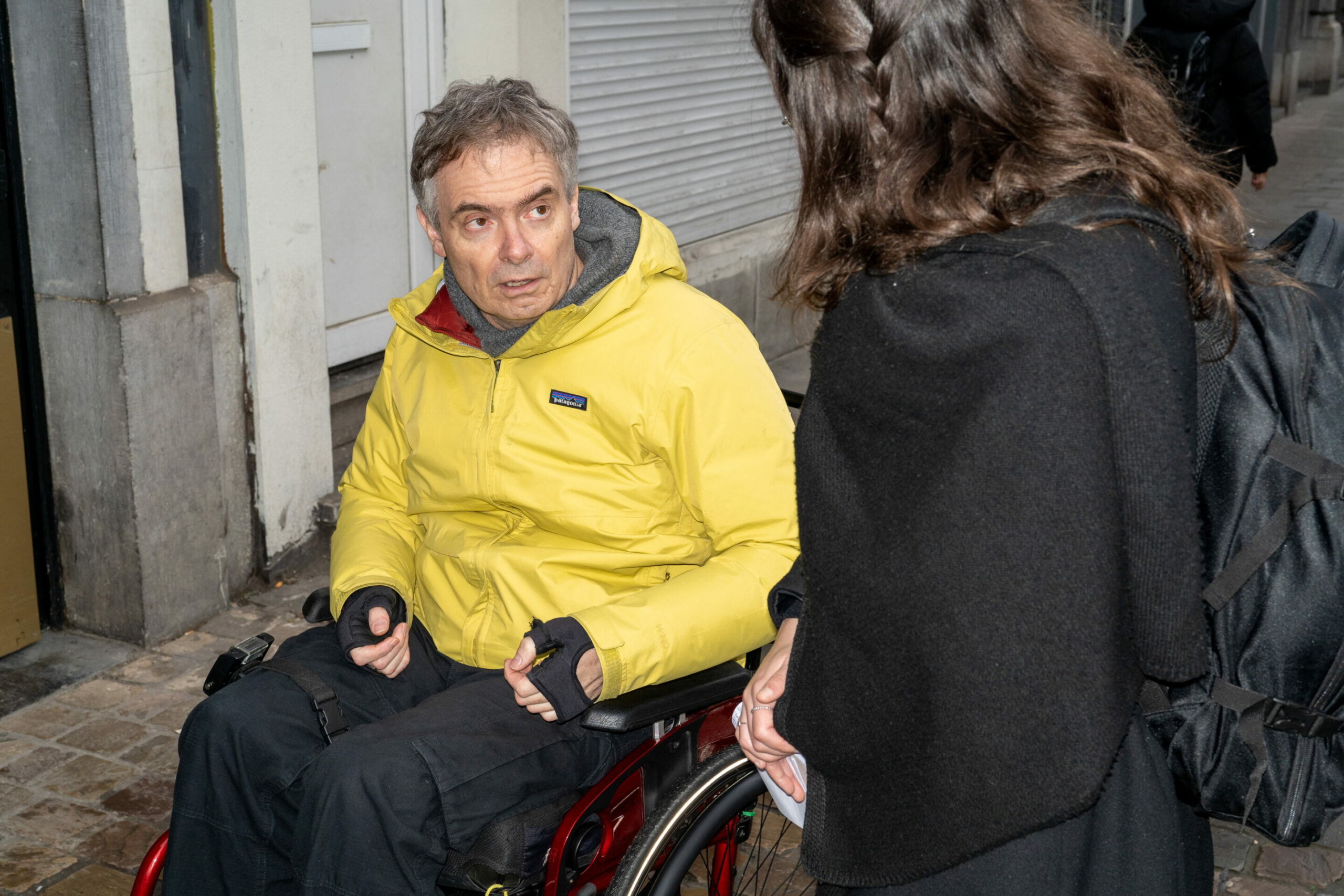
Davide Seffer, a wheelchair user who lives in Brussels. Credit: Vicente Torre Hovelson/The Brussels Times
He further notes that making pedestrian areas accessible for all residents is complicated due to the conflicting needs of different conditions.
An example, Seffer says, is how stretches of empty flat areas in some pedestrian zones are beneficial for wheelchair users but pose a challenge for those who are visually impaired and use physical structures to help guide them.
The communication advisor for the non-profit Brailleliga, Sylvie Degrelle, confirmed the challenge, explaining that pedestrian zones can be problematic for those with visual impairments if there is little tactile or visual contrast between different surfaces, and if (e-)scooters and bicycles are allowed to circulate in the areas freely.
The latter complaint, however, has already been addressed in some parts of Brussels, such as with last year's announced restrictions on bicycles and e-scooters on Boulevard Anspach.
'There is no single accessibility solution’
The various needs of residents is one of the main challenges in designing accessible pedestrian zones in Brussels, according to VUB urban mobility researchers Dr Sara Marie Tori and Dr Samyajit Basu. “There is no single accessibility solution,” they told The Brussels Times.
In addition to the “competing needs”, the researchers noted that infrastructure gaps need to be addressed to ensure pedestrian zones don't negatively impact accessibility, as “inappropriate design of transport stops or vehicles, poor signage can significantly increase travel times and walking distances” for those with disabilities or mobility issues.
They further added that accessibility is in general still “often treated as an ‘accommodation’ after a project is finished rather than being integrated ‘by design’ from the start.”
While the researchers believe Brussels should “not retreat from its broader ambition to create a more liveable, less car-dominated city”, they emphasised that more efforts need to be made to embed “accessibility and inclusion much more systematically from the outset.”
Central concern in Brussels?
Despite some complaints from local residents, the City of Brussels’ mobility councillor, Anaïs Maes (Vooruit), says that “accessibility for people with reduced mobility is a central concern in Brussels’ mobility policy".
According to her spokesperson, Rens Gijsen, Brussels' pedestrianisation projects have proved beneficial for local residents. "For many elderly residents and people with health conditions, reduced traffic and wider, obstacle-free walkways actually improve day-to-day comfort and safety".
Gijsen further added that the pedestrian zone on Boulevard Anspach in the city centre was designed to keep in mind the residents who depend on cars, pointing to “several public car parks” nearby and parking spaces for those with disabilities.
Additionally, the councillor's spokesperson added that “drop-off possibilities, taxi access and adapted transport services are maintained under regulated conditions”.
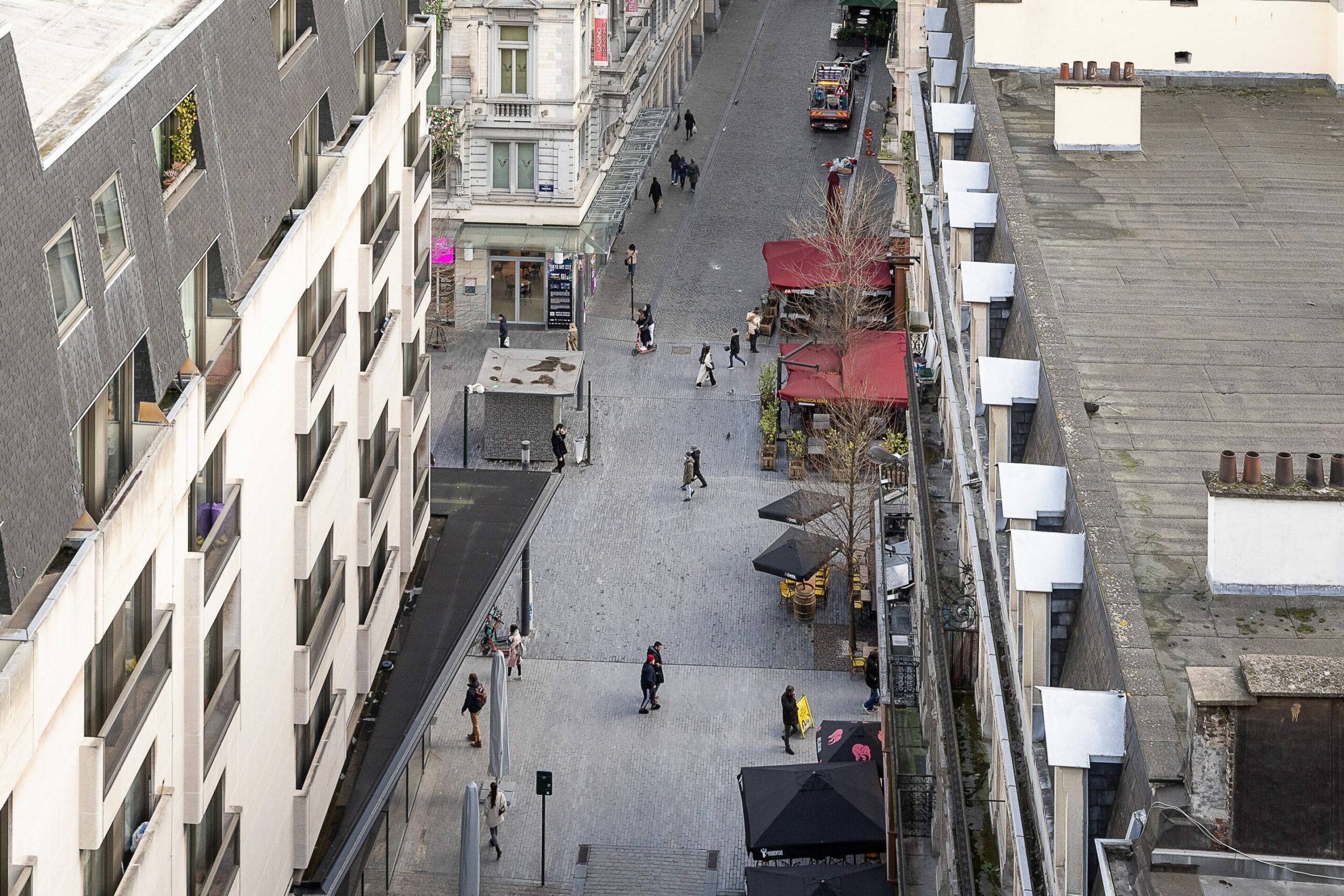
Boulevard Anspach in the city centre of Brussels, on Monday 30 January 2023. Credit: Belga/James Arthur Gekiere
Maes further rejected any idea that those with reduced mobility are overlooked because they make up a smaller percentage of the population. “The City works in dialogue with associations representing people with disabilities and continuously evaluates improvements in signage, accessibility standards and drop-off infrastructure,” said Gijsen.
The councillor's spokesperson further underscored that the City of Brussels takes into account the needs of those who are blind or visually impaired when designing pedestrian zones.
“On larger open areas or squares, it is true that continuous guidance is not always present everywhere. However, various elements are integrated to assist orientation, such as drainage lines, subtle level differences, and changes in materials or textures,” he said.
Nonetheless, the spokesperson maintained that the councillor is committed to listening to residents who experience difficulties in the city. “We are aware that accessibility is an ongoing point of attention, and we continue to evaluate how public spaces can be improved for all users."
The Brussels Times contacted the Brussels-Capital Region's Mobility Minister, Elke Van den Brandt (Groen), for comment, but has yet to receive a response as of the time of publishing.
*Not her real name.
