
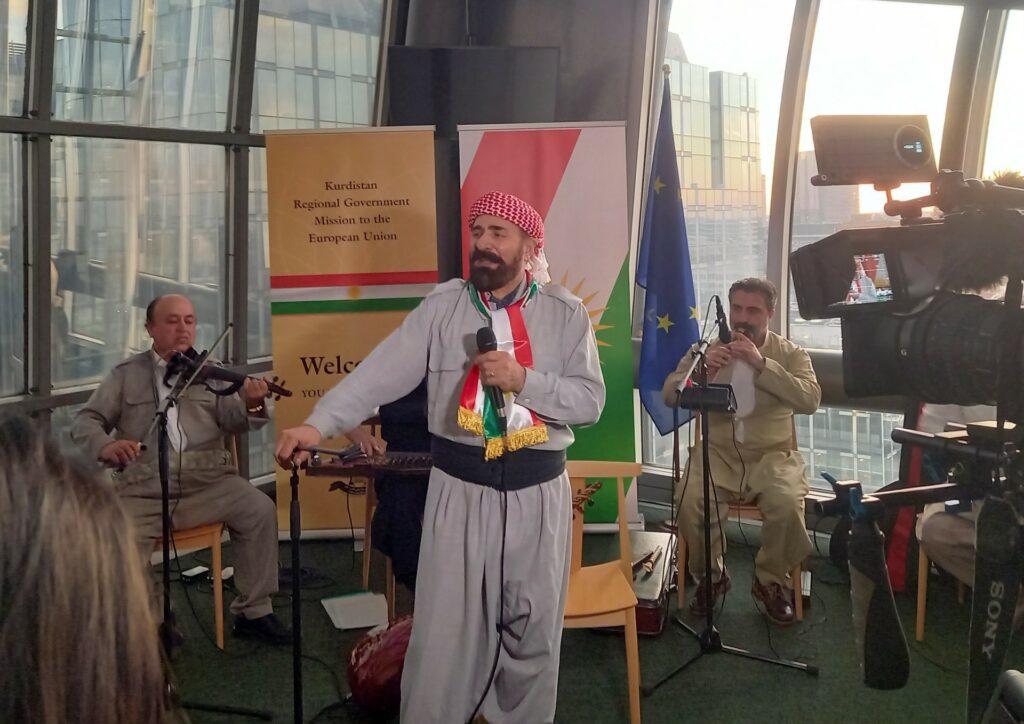
The ancient spring festival marks the rebirth of life on the day of the equinox when the lengths of day and night are equal, usually around 21 March. For the Kurdish people, Newroz has also a deeper meaning - inspiring hopes of peace, freedom and independence.
The festival this year was celebrated in the European Parliament at an event co-hosted by Swedish MEP Even Incir and the Kurdistan Regional Government’s (KRG) mission to the EU.
“For millions of Kurds, it is closely linked to political life,” Incir said, referring to an ancient Kurdish story of Kawa, a blacksmith who led an uprising against a brutal king, which brought an end to oppression.
Newroz, in Persian ‘Nowruz’ (new day), dates back thousands of years to the pre-Islamic era and is linked to Zoroastrianism, a monotheistic religion founded in ancient Persia.
It believed in a dualistic struggle between good and evil, and considered fire and light to be sacred symbols of purity. Nowadays, it is celebrated as a secular holiday uniting diverse cultures in the region and beyond.
Its legacy has been recognised on the world stage. In 2009, UNESCO inscribed the festival on its list of the intangible cultural heritage of humanity, acknowledging its role in fostering mutual understanding among different communities.
In 2010, The United Nations General Assembly proclaimed 21 March as the International Day of Nowruz because of its themes of peace, unity, and renewal.
However, for many years, in many countries where Kurds live, they could not celebrate Nowruz freely. In Turkey, it has only been celebrated legally since 1992 after the ban on the Kurdish language was lifted. In Syria, Newroz became an official holiday only this year.
“I hope that the last year’s attacks and human rights violations in Syria will come to an end and that we will see a future Syria that is free, democratic, and pluralistic for everyone: Arabs, Kurds, Druze, Alawites, Christians, women, and young people,” Incir said
“Newroz reminds us that even after the darkest periods, there is always the possibility of a new beginning.”
She was referring to the national Syrian army’s invasion into the Kurdish-controlled autonomous region in north and east Syria (AANES or Rojava) and the defeat of the Syrian Democratic Forces (SDF).
In his speech, ambassador Delavar Ajgeiy from the Kurdistan Regional Government in Iraq said that the agreement reached between the Syrian government and SDF represents a significant step towards de‑escalation and stability in northeast Syria and called on all parties to fully implement it.
“KRG is committed to supporting peace, dialogue, stability and unity for all communities in the region,” he said.
The famous Kurdish poet, writer and musician, Sivan Perwer contributed to a joyous celebration of Newroz in the European Parliament.
Born in Turkey, where his songs were banned, he has been living in exile most of his life. His music has carried Kurdish culture and stories across generations and across borders.
“Wherever I go, music is my best friend. It’s my soul, my thoughts, my hope, my truth, my joy, sorrow. It tells about nature, all kinds of creature, human being, peace and freedom,” he says in one of his many albums, ‘Destana Rojava’ (The Epic of Rojava).
