
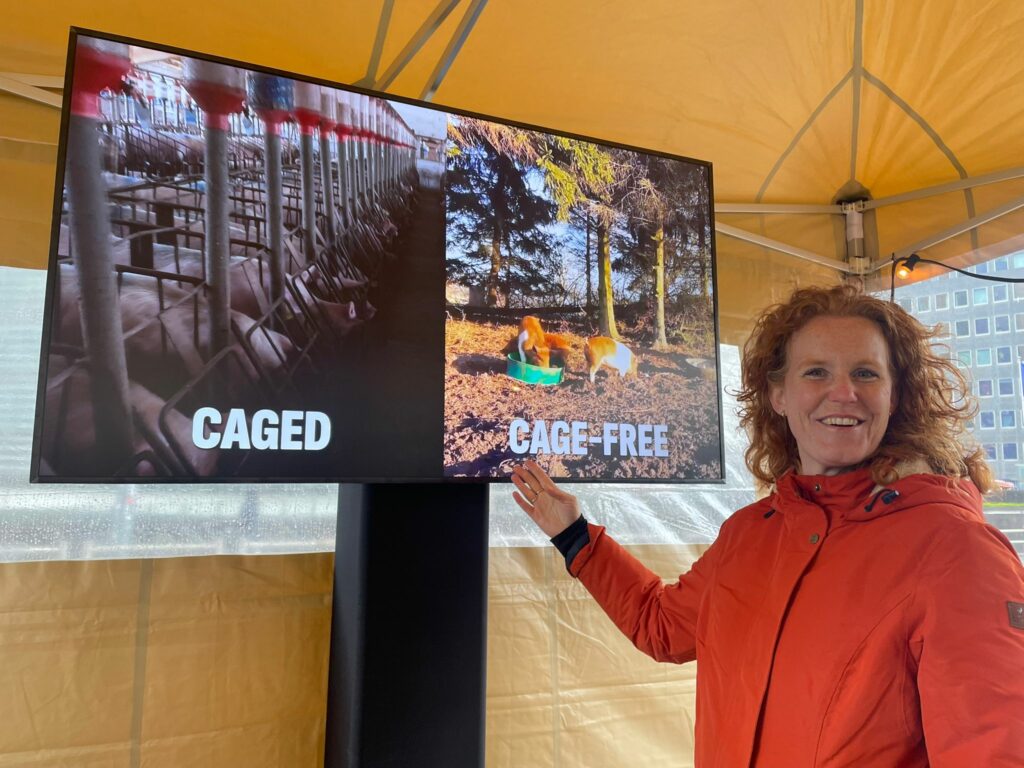
Animal welfare organisations marked World Cage Free Day on Wednesday with a protest action opposite the European Council and the European Commission, calling on the EU to ban caged animal farming for all farmed species.
This time, they were joined by farmers who already run cage-free farms.
“Too often the debate paints farmers as being against animal welfare legislation,” Inge Vleemingh, a Dutch pig farmer, told The Brussels Times. “But many of us have already moved to cage‑free systems. As a farmer and young mother, I want my sows to enjoy a safe, happy life, rooting freely with their piglets by their side, the way nature intended. And it works.”
According to Compassion in World Farming, pioneering food companies are taking the lead and are paving the way for a cage-free future in Europe. The majority of laying hens are already cage-free.
As regards pigs, almost all breeding sows are still kept in cages. But in the Netherlands, for example, a transition is on its way to animal-friendly pig meat production along the whole chain from breeding to electrical slaughtering (instead of using high concentrations of carbon dioxide gas, which is still permitted in the EU).
'Stuck in a distorted market'
Together with her husband, Inge is managing a small-scale pig farm with about 10 sows and 200 piglets. Her husband, who grew up on a big pig farm where the animals were screaming in their cages, was first not interested in continuing the business. Inge, with a background in landscape architecture, designed a cage-free farm to prove that the concept works.
Now, there are 300 similar farms like hers in the Netherlands, she says, stressing that the transition to cage-free farming does not have to take years. “"Choose another breed with better maternal traits, then you can switch within one pig's lifetime. Unfortunately, such a life in an industrial barn does not last very long."
Her farm sells the meat directly to consumers, not via retailers. “Farmers like me are stuck operating in a distorted market. We invested in higher‑welfare systems, we made it profitable and resilient, but we’re still competing against cheaper products made in cages at the expense of animals and the environment.
“Today’s World Cage-Free Day must be the last one without legislation to ban cages,” she concluded. “Farmers are ready. The only piece missing is the EU keeping its word and the funding to support it.”
World Cage-Free Day was founded in 2020 during the campaign for European Citizens' Initiative (ECI) "End the Cage Age." The initiative was formally submitted in October 2020 to the European Commission after it had collected around 1.4 million signatories across all EU Member States – well above the minimum number of at least 1 million signatories in at least seven Member States.
The protest action was organised jointly by Compassion in World Farming, Eurogroup for Animals, Anima International, and FOUR PAWS as a public installation to kick off a 190-day countdown to the beginning of the last quarter of 2026. Then they expect the European Commission to submit its first animal welfare reform proposals.
Modernising outdated rules
The initiative calls on the EU to revise the 1998 Council Directive 98/58/EC on the protection of animals and phase out all cages in EU animal farming by 2027. To facilitate the transition, farmers should be provided with financial support. The EU should also require that imports meet its enhanced animal welfare standards.
By now, many MEPs across the political party groups have lost patience with the Commission. In a recent request for an oral answer, they raised concerns about the timing, scope and ambition of the revision of the EU’s animal welfare legislation.
“A well-structured process is essential to modernise outdated rules, align EU policy with the latest scientific evidence and meet the expectations of EU citizens and Parliament,” they wrote. The Parliament wants the Commission to clarify, among other things, whether it will submit its promised legislative proposal on animal welfare in the fourth quarter of 2026.
This week, activists from Animal Equality gathered outside the Directorate-General for Health and Food Safety to protest against its handling of animal welfare legislation. The Directorate-General is headed by the Commissioner for Health and Animal Welfare, Olivér Várhelyi.
According to the NGO’s analysis of 708 public meeting records, industry access to the Commission to discuss animal welfare outweighed NGO access by 10 to 1.
