

The start of April is always a tricky date to announce changes, but this list of new measures and rules in Belgium from this month is not an April Fool's joke.
From the latest on Brussels LEZ to what's happening with Peppol, business closures, and unemployment benefits: the most important changes and how they will impact people can be found here.
Companies not yet connected to Peppol risk fines
Since 1 January, Belgian VAT-registered companies have been required to be connected to the Peppol network for their invoices.
Three months later, the grace period has ended, and the Finance Ministry will begin imposing penalties, the office of Finance Minister Jan Jambon (N-VA) confirmed to The Brussels Times.
Companies that do not (yet) have the necessary technical means to send and/or receive a structured electronic invoice risk a fine. The same risk applies to companies that do not issue structured electronic invoices.

Credit: Pexels
Penalties depend on the specific circumstances of the case, which will be assessed on a case-by-case basis. "Technical issues will, of course, continue to be dealt with flexibly."
Just over 90% of VAT-liable businesses in Belgium are ready for Peppol, according to figures by Jambon's office.
Brothels around Brussels-North must close at night
Businesses in the Brabant and North districts of Brussels, including the brothels on Rue d'Aerschot, must close between 01:00 and 06:00 from this month.
The measure, which will initially apply for three months, is part of a security plan for the neighbourhoods near Brussels-North station at a time of worsening security issues in the North District.
Drugs, such as crack and heroin, are dealt or consumed in these areas. Some businesses are also said to act as front companies for drug trafficking.
Other measures include an extension of the ban on the sale and consumption of alcohol on public roads, and increased police presence in the neighbourhoods.
Another group loses unemployment benefits
A third group of long-term unemployed people in Belgium – those who have been unemployed for fewer than eight years during their working lives – will lose their unemployment benefits from 1 April as part of the Federal Government budget reform plan.
At the start of this year, a first group of unemployed people (those who had been fully unemployed for at least 20 years) lost their benefits.
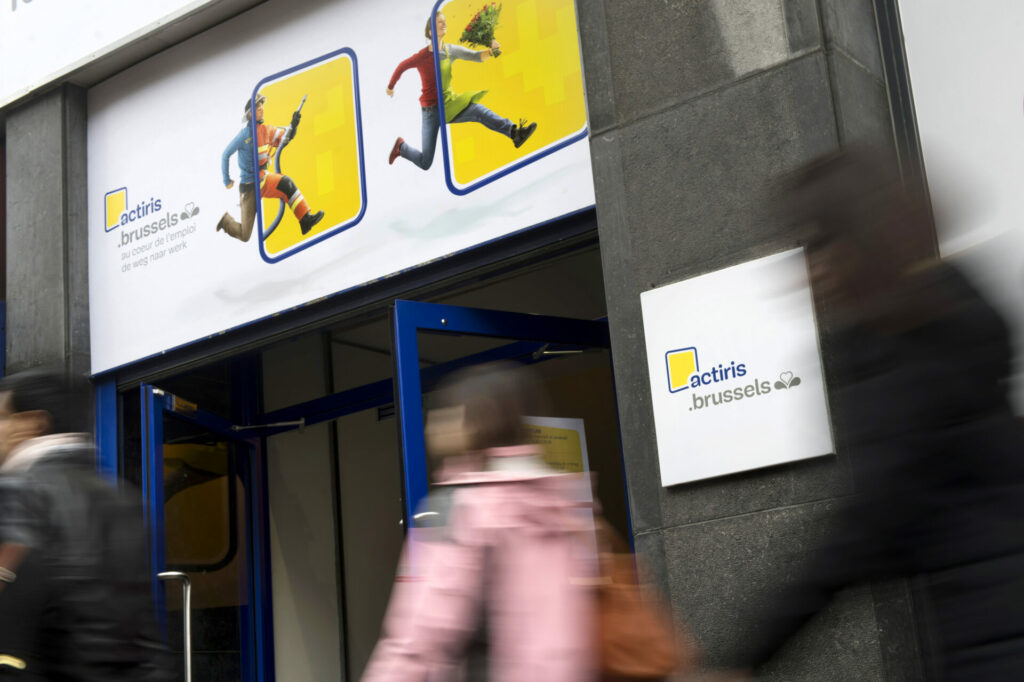
The Brussels employment office Actiris. Credit: Belga / Jonas Hamers
In March, this was followed by those who had been unemployed for between eight and 20 years, and now those who have been unemployed for up to eight years.
The National Employment Office (RVA/ONEM) expects that a total of nearly 173,000 unemployed people will lose their entitlement to benefits.
Further phases will follow in the coming months.
Minimum wage to rise
From this month, the minimum monthly wage in Belgium will increase by €35.70 gross. The increase had already been agreed in mid-2021. As a result of the increase, the guaranteed average minimum monthly income will stand at €2,189.81 gross per month.
The minimum wage is the absolute lower limit for employees from 18 years old in Belgium. It is binding and applies to all sectors. This means that no employee, in any sector or company, may be paid less.
Illustrative image of a person holding money. Credit: Belga/Olivier Hoslet
However, sectors are permitted to agree on higher wages, and they often do so.
According to trade union figures, around 100,000 workers in Belgium are on the minimum wage.
New transition period for Brussels Low Emission Zone
Under Brussels' new rules for the Low Emission Zone (LEZ), owners of Euro 5 and Euro 2 cars driving in Brussels would, in principle, face a fine from April; the transition period that the previous government had put in place ended on Tuesday.
However, the new Brussels Government is working on a new LEZ framework, which is due to come into force from 2027. Until that new model has been fully finalised within the government and is also legally watertight, a new transitional phase will begin on 1 April.
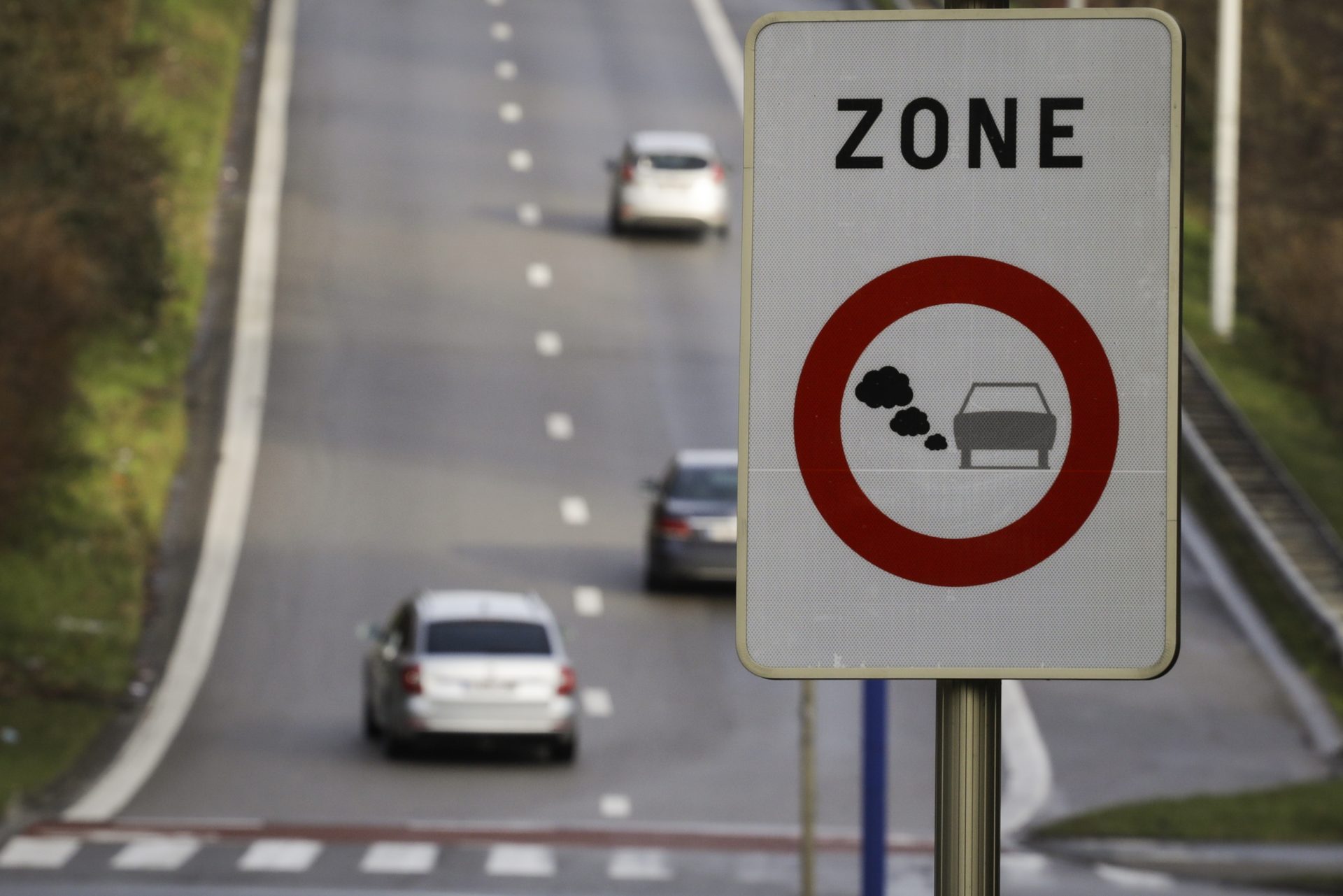
The Brussels Low Emission Zone (LEZ). Credit: Thierry Roge/Belga
As a result, no fines – which were previously set at €350 per quarter – will be issued for violations involving Euro 5 and Euro 2 vehicles for the time being, stressed Brussels Finance Minister Dirk De Smedt (Anders).
Increase in social tariffs for gas and electricity
Social tariffs for gas and electricity will rise in the second quarter of 2026, by 5.1% and 2.6% respectively, compared with the previous quarter.
For electricity, the single-rate social tariff for the second quarter is just over €0.23 per kilowatt-hour (kWh), the two-tier daytime social tariff at €0.25/kWh, the two-tier night-time social tariff at €0.24/kWh and the exclusive night-time social tariff at €0.20/kWh.
As for the social tariff for natural gas and heating, it stands at €0.04/kWh – an increase of 5.1% compared with the first quarter of 2026.
Flanders makes solar panels mandatory for some buildings
Solar panels are being made mandatory in Flanders, but only on buildings where electricity consumption exceeds 1 gigawatt-hour (GWh) per year. For government buildings, the threshold is 250 megawatt-hours (MWh) per year.
The owners and leaseholders of buildings are subject to this obligation and must check for themselves whether consumption exceeds the threshold. As consumption can vary from year to year, they must carry out an annual assessment.
In some circumstances, the building owner may also choose to invest in alternatives, such as a new wind turbine, a biomass or biogas combined heat and power plant, or a heat pump.
Anyone failing to comply with the obligation risks a fine.
Military personnel now guard all nuclear infrastructure
Military personnel will secure the National Institut des Radioéléments in Fleurus (just outside of Charleroi), rather than the police. This is the final step in the handover of duties to free up officers for other assignments.
The institute's laboratory processes radioisotopes for innovative applications in nuclear medicine.
In June last year, Defence Minister Theo Francken (N-VA) and Home Affairs Minister Bernard Quintin (MR) signed a memorandum of understanding to deploy military personnel for the security of nuclear infrastructure.
Francken is providing personnel, equipment and infrastructure for this purpose, but the federal police remain responsible for the command of operations.
The handover took place gradually. Since 1 July, military personnel have been responsible for the security of the Doel and Tihange nuclear power stations. Since 1 December, this has also been the case for the nuclear infrastructure in Mol, Geel and Dessel.
Ypres city centre to become a major cycle zone
The city centre of Ypres is becoming a major cycle zone, meaning cars will no longer be allowed to overtake cyclists. This way, the city aims to place greater emphasis on road safety.
The city centre has long been a 30 km/h zone – a speed limit that will remain in place.
Motorised traffic will still be permitted in the city centre, but cyclists will be given more space within the cycle zone: they may use the entire width of the road in a one-way street. In a two-way street, they may use the entire right-hand half.
The city emphasises that right-of-way rules remain in force, including giving way to traffic from the right. This also applies to cyclists.
Childcare Innovation Centre begins operations
The Knowledge and Innovation Centre for Early Childhood begins operations on 1 April in the centre of Ghent. There, childcare workers can access educational materials, coaching and online training courses, amongst other things.
The centre is organised by the non-profit organisation Reform of Basic Services for Young Children (Vernieuwing in de Basisvoorzieningen voor Jonge Kinderen - VBJK) and brings together existing support for childcare, which is currently fragmented.

Illustrative image of childcare. Credit: Belga / Laurie Dieffembacq
The knowledge centre will collaborate with Ghent University (UGent) and KU Leuven, among others. Other centres of expertise, the sector itself and several European partners are also involved.
A budget of over €676,000 has been allocated for the launch in 2026. From 2027, the annual subsidy will amount to €936,357.
