
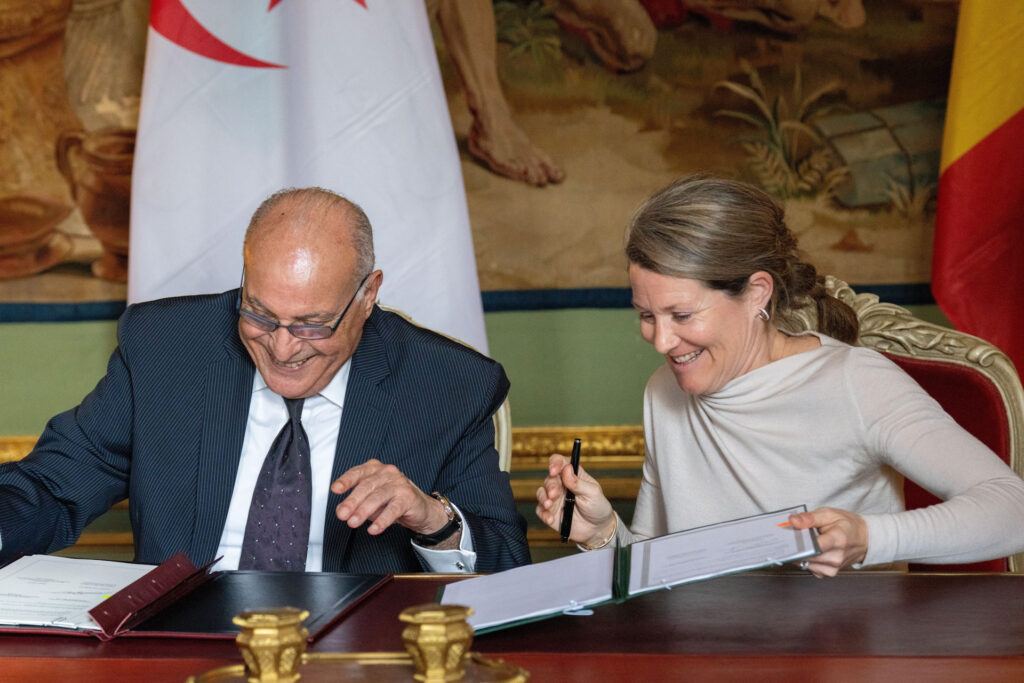
Belgium and Algeria signed agreements on Tuesday to move ahead with the readmission of Algerian nationals residing in Belgium illegally, and allow visa exemptions for holders of diplomatic and service passports.
Belgian Foreign Minister Maxime Prévot (Les Engagés) and Asylum and Migration Minister Anneleen Van Bossuyt (N-VA) have announced the agreement, along with Algerian Foreign Minister Ahmed Attaf, following a working visit to Brussels by the Algerian foreign minister.
"We made a commitment there: to make up for lost time," Prévot said. On Tuesday, this commitment was partially "fulfilled," he said, citing contracts secured by Belgian companies, new avenues for cooperation in the energy and mining sectors, as well as the two migration-related agreements signed that same day.
Van Bossuyt has made agreements with countries of origin a priority in her policy aimed at reducing asylum applications and increasing actual returns after a deportation order. She referred to the agreement with Algeria as "historic," one that had been awaited for years.
According to figures released by her office, 2,251 people claiming Algerian nationality received a deportation order last year. Only 85 have actually left the country.
Furthermore, "780 people claiming to be Algerian are currently incarcerated in our prisons, 700 of whom lack legal residency status."
The readmission agreement, which still needs parliamentary approval, includes several concrete commitments: faster identification of those concerned (approximately 15 days), and a travel document (laissez-passer) whose validity is extended to 30 days for returns.
Minister Anneleen Van Bossuyt also announced "the possibility of transferring several people per flight and using direct or indirect flights," and the possibility "of using Algerian escorts" for forced returns.
"These are concrete steps," Van Bossuyt stated after the signing. "Both countries are making commitments, and the two agreements go hand in hand," she said.
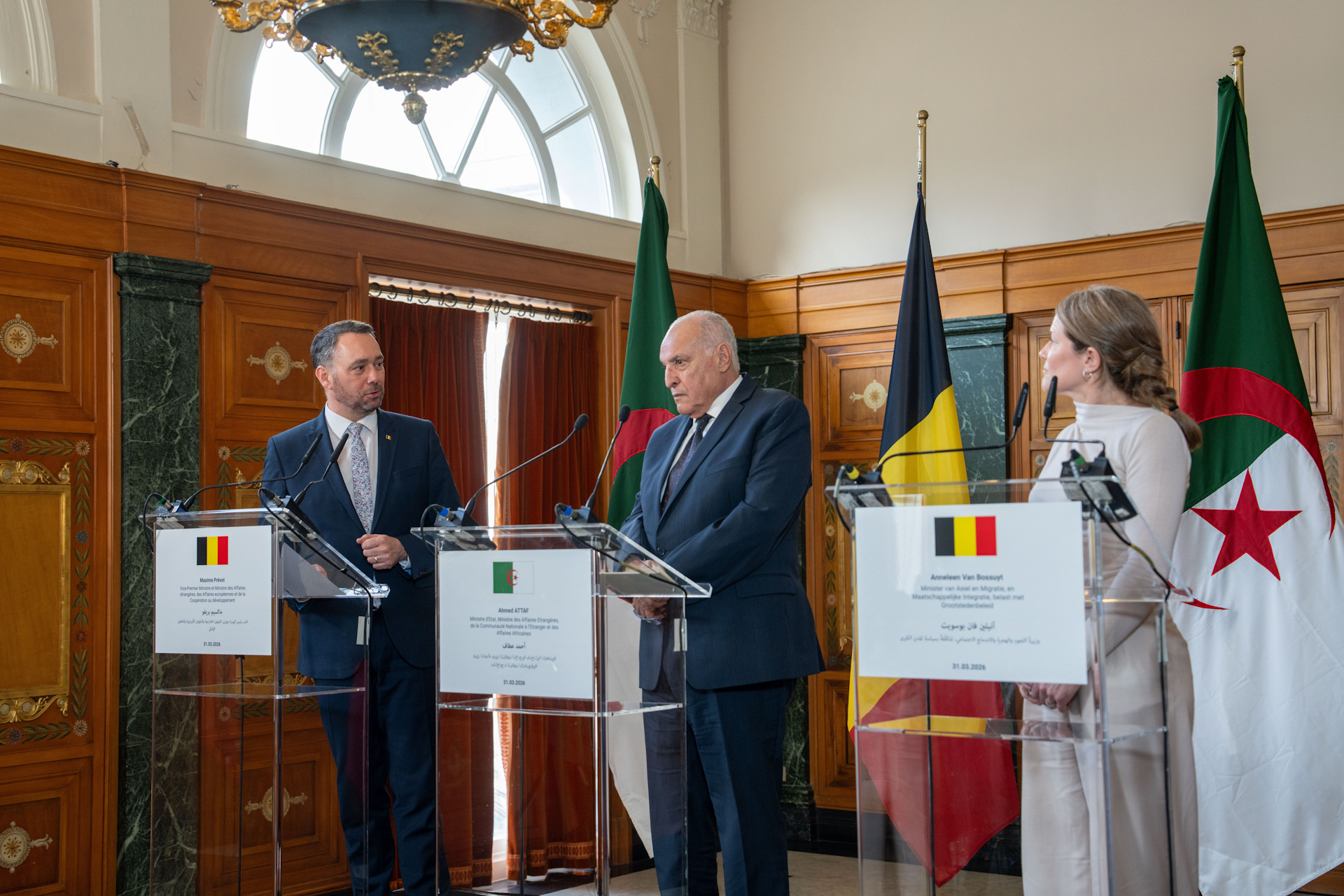
Minister of Foreign Affairs Maxime Prevot, Algerian Foreign Minister Ahmed Attaf and Minister of Asylum and Migration Anneleen Van Bossuyt at a press moment after the signing of a readmission agreement and an agreement on visa exemption for holders of diplomatic and service passports between Belgium and Algeria, on Tuesday, 31 March 2026, in Brussels. Credit Belga/Marius Burgelman
Energy cooperation
Prévot has also highlighted new opportunities for Belgian companies, as well as a partnership to be developed in the energy sector. "Algeria is the fourth largest gas supplier to the European Union, and the second largest by pipeline," he stressed.
"When we talk today about diversifying our supplies, when we consider the consequences of the crisis in the Gulf and the closure of the Strait of Hormuz on energy prices, when we also see the impact this has on global food security, we realise how much more than ever Algeria is a strategic partner.
At Algeria's invitation, "Our special envoy for 'energy' will travel to Algiers at the end of next month to deepen our cooperation in the fields of energy, renewable energy and critical mineral resources," he said.
The cabinet also added that "discussions are underway" for a partnership between Sonatrach and John Cockerill in the hydrogen sector. Sonatrach, Algeria's national hydrocarbon company, has been a long-standing partner of Belgium for LNG deliveries since the 1980s.
Currently, trade between Belgium and Algeria amounts to some €1.7 billion annually. "In construction materials, port dredging, heavy vehicles, mobility, and airport logistics, there is considerable potential that we are only just beginning to explore," said Prévot.
Attaf welcomed a "renewed interest from Belgian companies in the Algerian market" and called for a further increase in the presence of Belgian businesses in his country.
Investment opportunities are there, "particularly in the energy, mining, agriculture (including Saharan agriculture), industry, transport, and innovation sectors," he stressed.
