
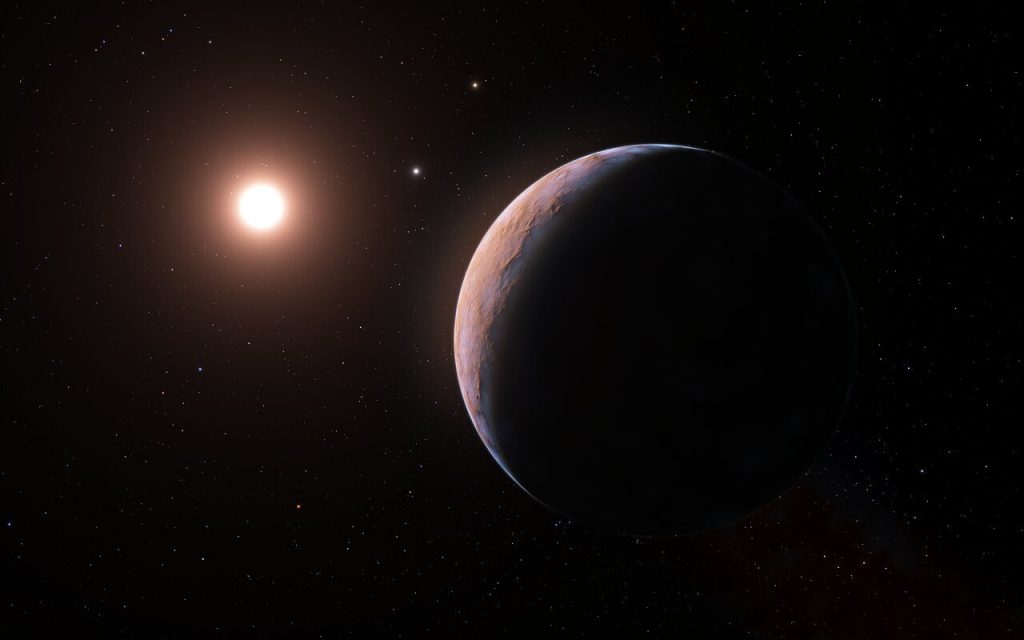
A team of astronomers found evidence of another planet orbiting Proxima Centauri, the closest star to our Solar System, the third detected in this system so far.
Using the European Southern Observatory’s Very Large Telescope (ESO’s VLT) in Chile, they detected the candidate planet, which is the lightest yet discovered orbiting this star, which is the closest star to the Sun, lying just over four light-years away.
"The discovery shows that our closest stellar neighbour seems to be packed with interesting new worlds, within reach of further study and future exploration," João Faria, a researcher and lead author of the study about the discovery published in Astronomy & Astrophysics.
At just a quarter of Earth’s mass, the newly discovered planet, named Proxima d, is also one of the lightest exoplanets (any planet beyond our solar system) ever found. It orbits the Proxima Centauri at a distance of about four million kilometres, less than a tenth of Mercury’s distance from the Sun.
Related News
- James Webb Space Telescope will revolutionise observation of outer space
- NASA astronaut shares photo of Brussels from space
The other two planets already known to be orbiting around the star are Proxima b, a planet with a mass comparable to that of Earth that orbits the star every 11 days and candidate Proxima c, which is on a longer five-year orbit around the star.

ESO’s Very Large Telescope (VLT) at Paranal, Chile. Credit: ESO
At just a quarter of the mass of Earth, Proxima d is the lightest exoplanet ever measured using the radial velocity technique, which works by picking up tiny wobbles in the motion of a star created by an orbiting planet’s gravitational pull. The effect of Proxima d’s gravity is so small that it only causes Proxima Centauri to move back and forth at around 40 cm/second.
"This achievement is extremely important," Pedro Figueira, an ESO instrument scientist of ESPRESSO, one of the most precise so-called planet hunters.
"It shows that the radial velocity technique has the potential to unveil a population of light planets, like our own, that are expected to be the most abundant in our galaxy and that can potentially host life as we know it."
