
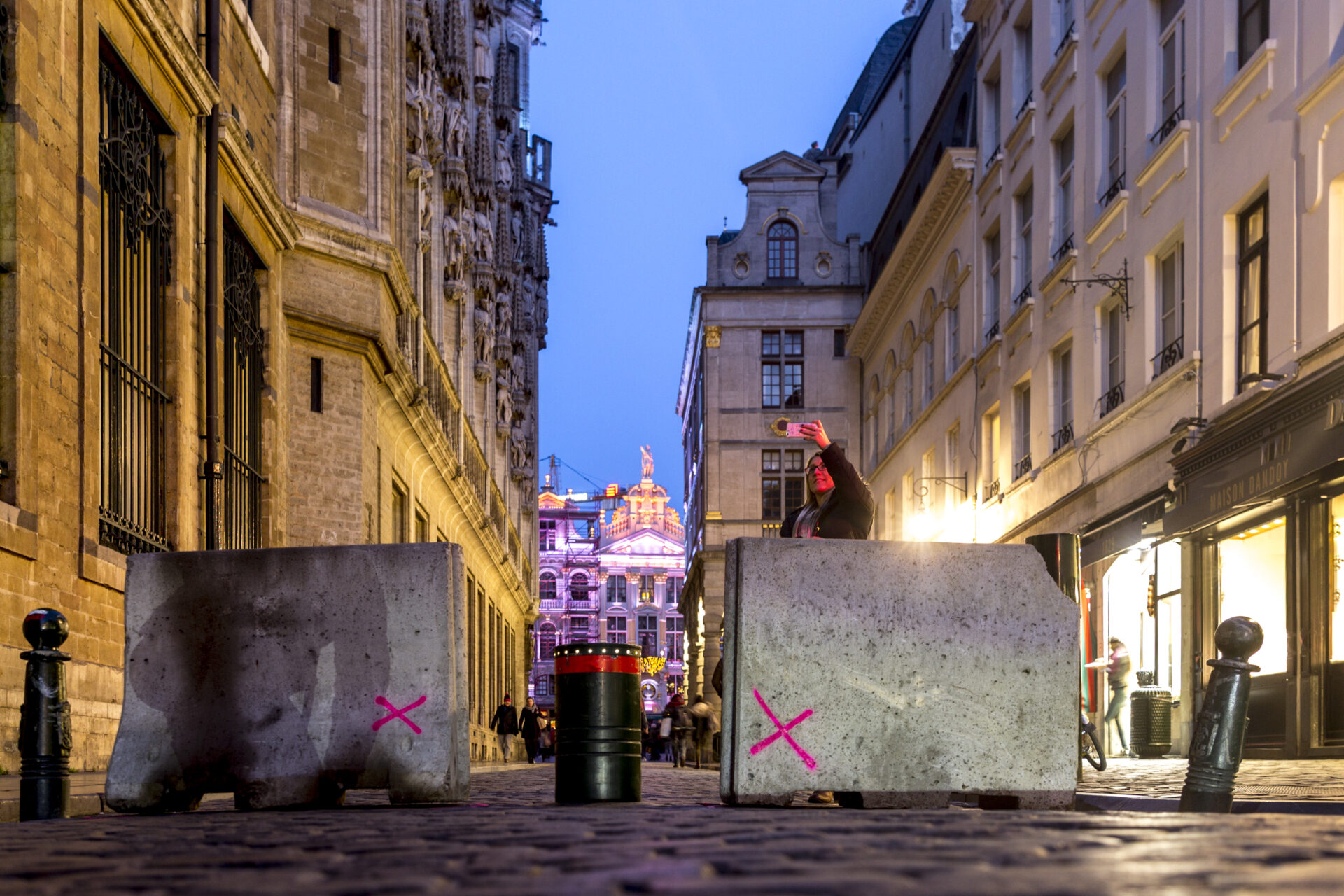
Introduced as emergency tools for security and mobility, concrete blocks have spread across Brussels over the past decade, and in 2026, they remain at the heart of legal disputes and political tensions.
Concrete blocks were never meant to define Brussels’ streets, but they do today.
Their first widespread appearance dates back to the mid-2010s, when cities across Europe, including Brussels, installed heavy barriers to prevent vehicle-ramming attacks in public spaces. Known as “New Jersey” blocks, they were designed as a rapid response: highly visible, effective, and immediate.
Over time, their use expanded well beyond security. By the early 2020s, they had become a standard tool for managing circulation and testing new layouts.
Figures cited in La Dernière Heure in 2022 show that "2,838 concrete blocks have been ordered and installed by Brussels Mobility on regional roads since 2016", with authorities defending their role in improving road safety and reducing accidents.
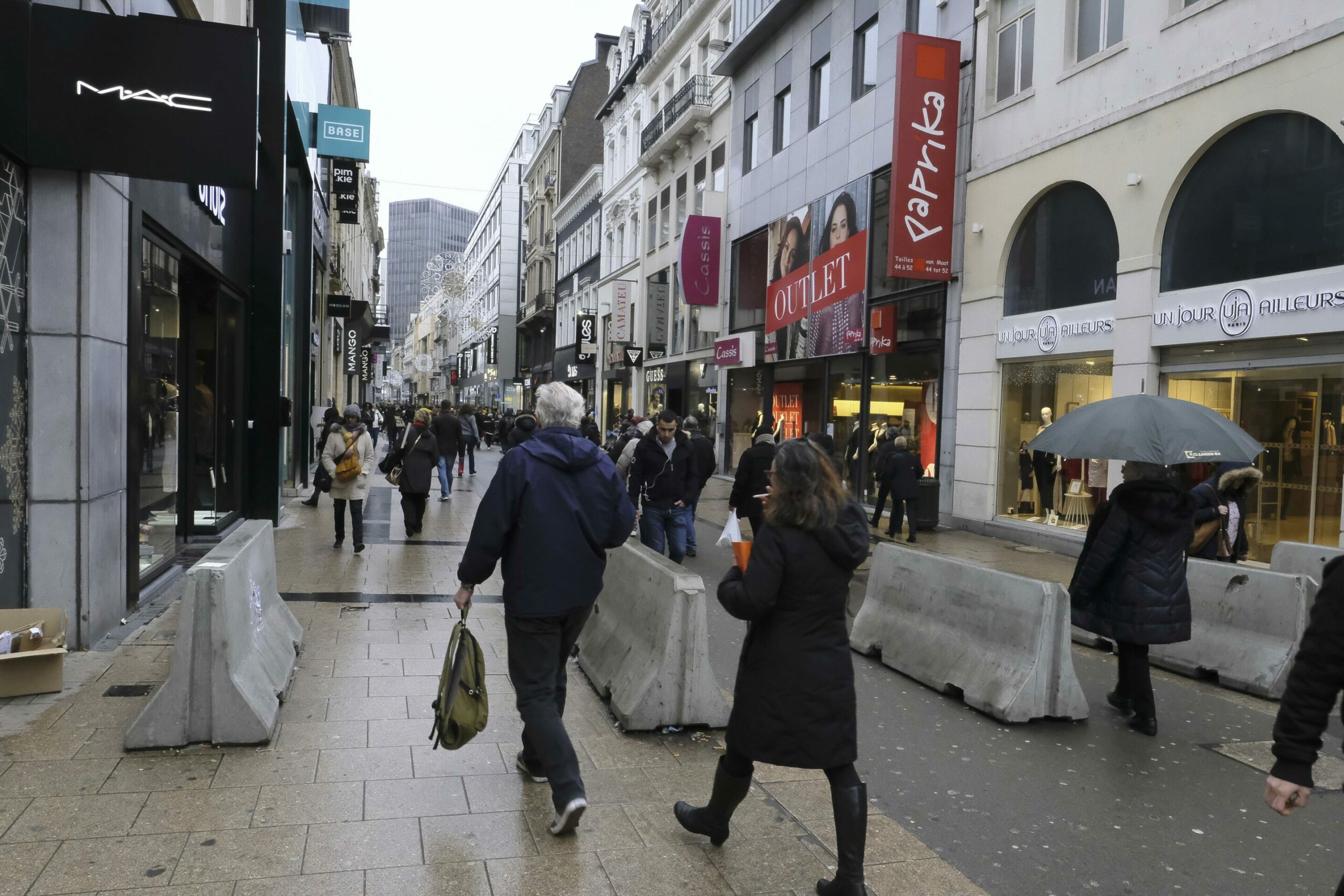
Illustration picture shows concrete blocks to prevent cars entering a pedestrian zone, as extra protection, during Christmas shopping on the last Saturday before Christmas Eve, in Brussel, Saturday 23 December 2017. Credit: Belga / Nicolas Maeterlinck
The Covid years and the rise of 'temporary' urbanism
The turning point came during the Covid-19 pandemic. Faced with an urgent need to reorganise public space, Brussels Mobility relied heavily on concrete blocks to implement rapid changes across the city.
Bike lanes were created, streets were closed to through traffic, and new mobility schemes were tested. The approach, often described as tactical urbanism, was based on flexibility: interventions could be installed quickly and, in theory, removed just as easily.
But the temporary nature of these measures quickly became blurred. Installations meant to last months remained for years, gradually becoming part of the urban landscape.
When temporary turns into violation
This shift has triggered growing legal concerns. According to Urban Brussels, temporary road layouts are only authorised "for a maximum duration of two years", and "the decree does not provide for any extension". Maintaining them beyond that period without a permit "constitutes an urban planning offence".
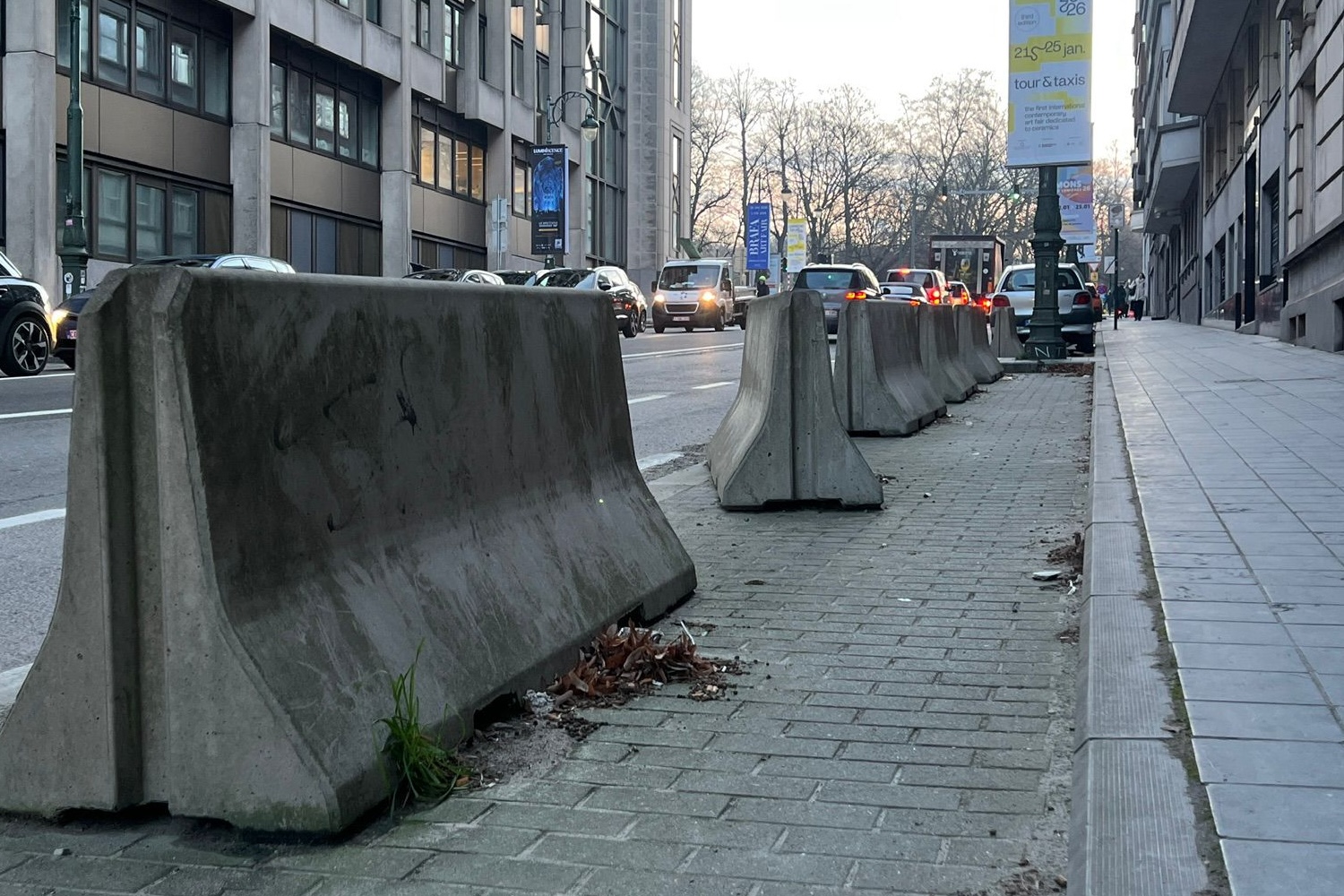
Concrete blocks in Brussels in 2026. Credit: MR Brussels
Several cases have brought this issue into the spotlight. In 2025, RTBF reported that Urban Brussels had formally warned Brussels Mobility over installations on Avenue Broustin, in between Jette and Ganshoren, stating that "an infringement has been identified since the temporary layouts exceeded the legally permitted duration". Authorities were asked to restore the site to its original state. Since then, the concrete blocks have been replaced by flower boxes.
Similar concerns have been raised elsewhere. The neighbourhood committee Montgomery-Tervueren in Etterbeek argued on Facebook that concrete installations linked to a test phase have "been in violation since March 2024", questioning how many other sites across Brussels might be affected by the same problem.
A political fault line
As their numbers grew, concrete blocks also became a symbol of deeper political divisions, particularly in relation to the Good Move mobility plan of Brussels Minister Elke Van den Brandt (Groen).
Used to restrict traffic and reshape circulation, they have been both praised for improving safety and criticised for disrupting daily life. Residents have denounced a lack of consultation and the knock-on effects of traffic being redirected into neighbouring streets.
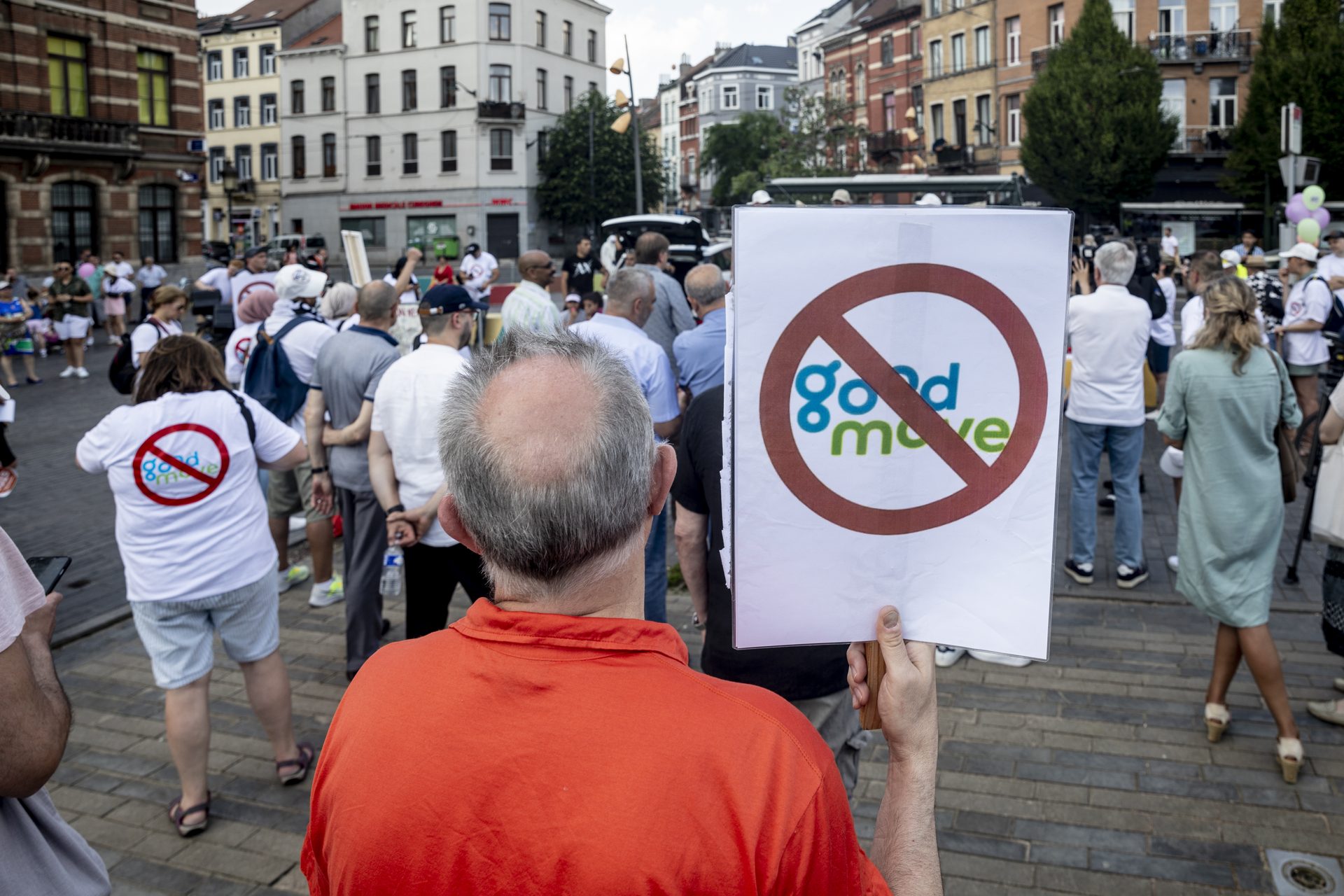
Demonstration of the 'Non au plan Good Move' group to request a review of the current mobility policies in Brussels, Sunday 11 June 2023. Credit: Belga / Hatim Kaghat
Some have taken action themselves. In the case of Avenue Broustin, citizens filed a complaint with Urban Brussels after discovering the legal time limits. One resident told RTBF: "We needed a way to enforce our rights… Urban responded quickly."
Opposition parties have also weighed in. The Brussels branch of MR described an "invasion of 3,000 New Jersey blocks", criticising what it sees as a costly and uncoordinated approach to public space.
The Bois de la Cambre turning point
The controversy escalated further in 2026 with the case of the Bois de la Cambre. Concrete blocks installed to regulate traffic in this protected site were found to have been placed without planning permission.
At the request of Brussels Secretary of State Audrey Henry (MR), Urban Brussels issued an official complaint against the City of Brussels.
The administration stressed that safety measures cannot be implemented "outside the legal framework nor at the expense of the quality of urban planning". Henry made the broader message clear: "Respect for planning rules is not optional… Solutions exist, but not concrete blocks."
Recent projects, such as the redesign of Rue de la Poudrière in the City of Brussels, show a shift in approach, with authorities opting to remove blocks and replace them with more structured and integrated solutions.
A city still living with its 'temporary' choices
In 2026, Brussels is still dealing with the consequences of a decade of rapid, often improvised interventions. Concrete blocks remain scattered across the city, sometimes removed, sometimes replaced, but often still in place without a clear long-term vision.
An Instagram account called mercyforthebrusselsjerseys, founded in 2018, has shared more than 1,000 posts documenting concrete blocks across Brussels. "Which place in the world has more concrete blocks than public benches? Yes: Brussels! Don’t feel ashamed! Please have mercy for the Brussels Jerseys!" the page reads.
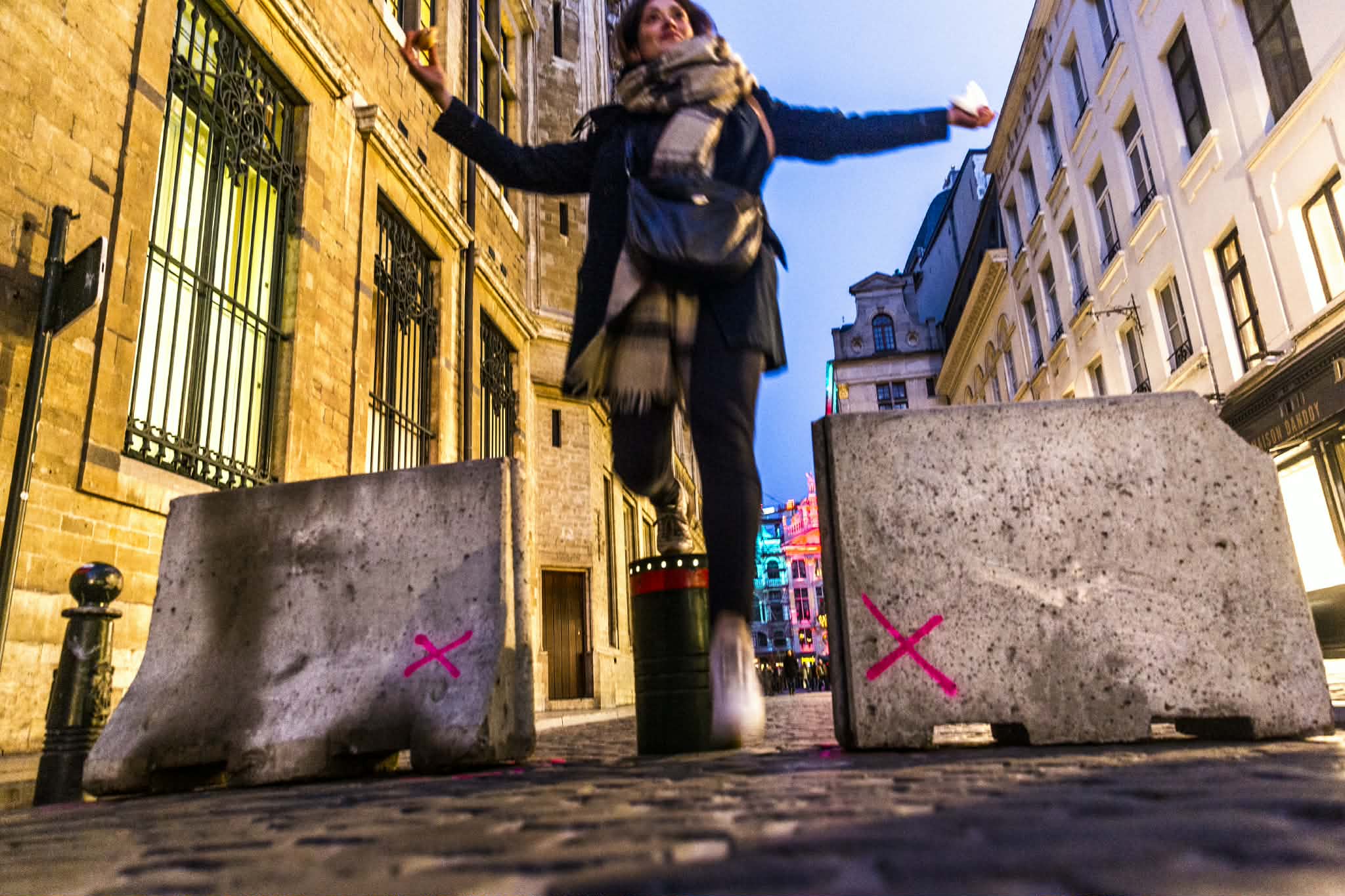
Why are there so many concrete blocks in Brussels? Credit: Belga
A surreal ending
If there is one thing Brussels knows how to do, it is turning the temporary into something almost… institutional.
What began as a quick fix – a few concrete blocks placed in urgency – has, over the years, quietly settled into the décor, somewhere between urban planning and contemporary art installation.
In a city that proudly celebrates René Magritte, the situation feels almost fitting. These blocks were meant to disappear, yet they remain. They were supposed to be neutral, yet they have become political. They were designed to simplify the city, yet they have arguably made it more complex.
One could almost imagine Magritte himself looking at them and shrugging: "Ceci n’est pas un aménagement temporaire." [This is not a temporary arrangement]
In Brussels, even a concrete block can tell a story.
