
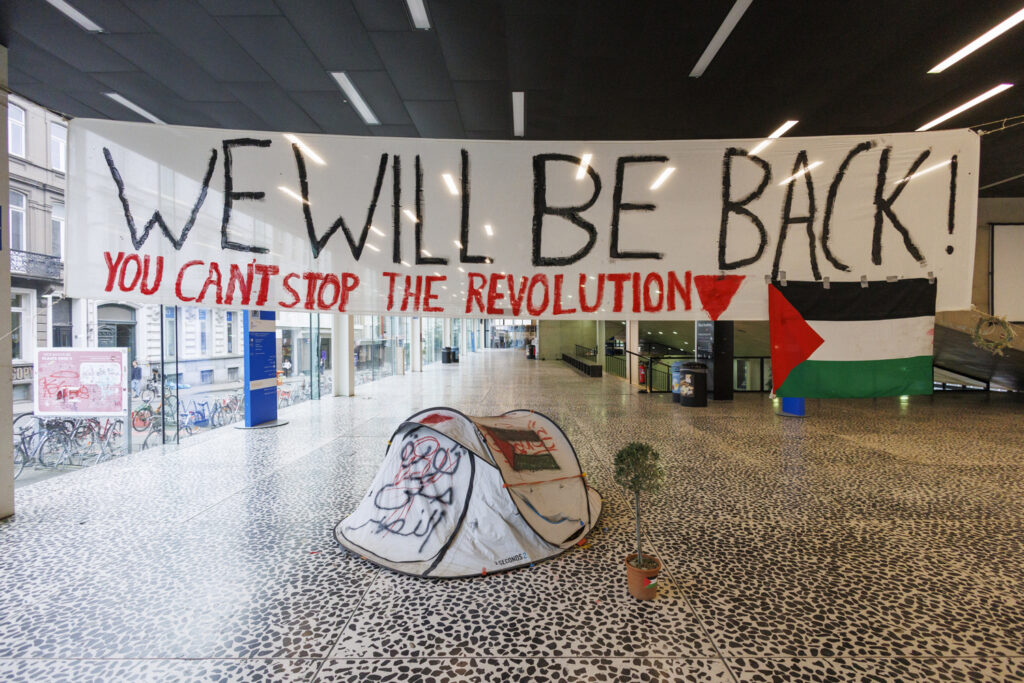
Pro-Palestinian activists plan to occupy another campus at Ghent University on Wednesday, 22 April, demanding a full academic boycott of Israel.
The exact location of the occupation remains undisclosed, but organisers anticipate more than a hundred participants. Wednesday’s protest follows previous actions, including a weeks-long occupation of the university’s UFO building in 2024. During that event, the participants left voluntarily before eviction measures were enforced, leaving behind a banner stating, “We will be back.”
The activists have outlined three key demands: ending all existing collaborations with Israeli institutions, refraining from starting new partnerships, and lobbying to exclude Israel from the European research programme Horizon Europe. They argue that an academic boycott is an essential tool to exert pressure.
While the 2024 occupation failed to secure a comprehensive boycott, it prompted the university to pledge a review of all projects and suspend several problematic collaborations. Legal constraints were cited as the reason for consulting the EU, given that many of the projects were linked to Horizon Europe.
To date, only one such collaboration, Osteonet—focused on ageing and bones—has been terminated. This decision was made in March, with the university affirming its continued commitment to withdrawing from problematic partnerships with Israeli organisations.
University officials describe their approach as “less visible but aimed at structural change.” They highlight efforts with rectors from five other nations to establish stricter human rights criteria in the next European research and innovation programme.
The university also emphasises that exiting Osteonet serves as proof that such decisions within Horizon Europe are feasible, potentially accelerating evaluations of other projects. However, a blanket boycott has been ruled out, as the institution considers it discriminatory.
Instead, Ghent University is pursuing a targeted strategy to exclude “problematic partners,” rather than indiscriminately barring all institutions located in Israel.
The university’s rector and vice-rector are set to meet with the protesters on Monday. They expressed shared concerns about human rights and acknowledged the seriousness of the situation. However, they cautioned that prolonged building occupations are “not a sustainable solution.”
Preventing further occupations may pose challenges, as Ghent University operates 271 buildings across roughly 20 campuses. The lack of systematic checks on students and staff means activists could potentially gain access again, making forced evictions a complex and sensitive matter.
