

"Fuck instead of Facebook, love instead of liking, and dance instead of tweeting."
This provocative rallying cry from the Radical Anti-Smartphone Front (RASF) has been appearing on signs, flyers and stickers across Berlin, Paris, London – and now Brussels. It has sparked an urgent debate over our digital dependencies in 2026.
While the RASF manifesto labels smartphones a "poison" to our social lives and a killer of creativity, the reality on the ground is more nuanced.
Indeed, Brussels has become the latest battleground in the struggle to remain present in an increasingly virtual world – from psychology experts who view the devices as a modern necessity, to young residents adopting 'dumb phones' (e.g. a Nokia 3310) to reclaim their focus.
"The world is changed. Digital media are transforming our lives more profoundly than any other innovation in the past century," the Radical Anti- Smartphone Fronts (RASF) states in its manifesto. "Smartphones have penetrated the most remote corners of our lives and turned many areas of our daily routine upside down."
Originating from Germany, RASF is a movement aiming to challenge the presence of digital media and smartphones in our everyday lives.
The group argues that these forms of entertainment and connectivity are actually poisoning our social lives and making us less connected, and more susceptible to staying in our own digital corners.
Phones are also making us less creative because we are constantly entertained, leading us to cease generating new ideas or thinking in complex ways. But is it tangible to live life offline in 2026? Or are smartphones certainly here to stay?
An expert's view on smartphones place in our society
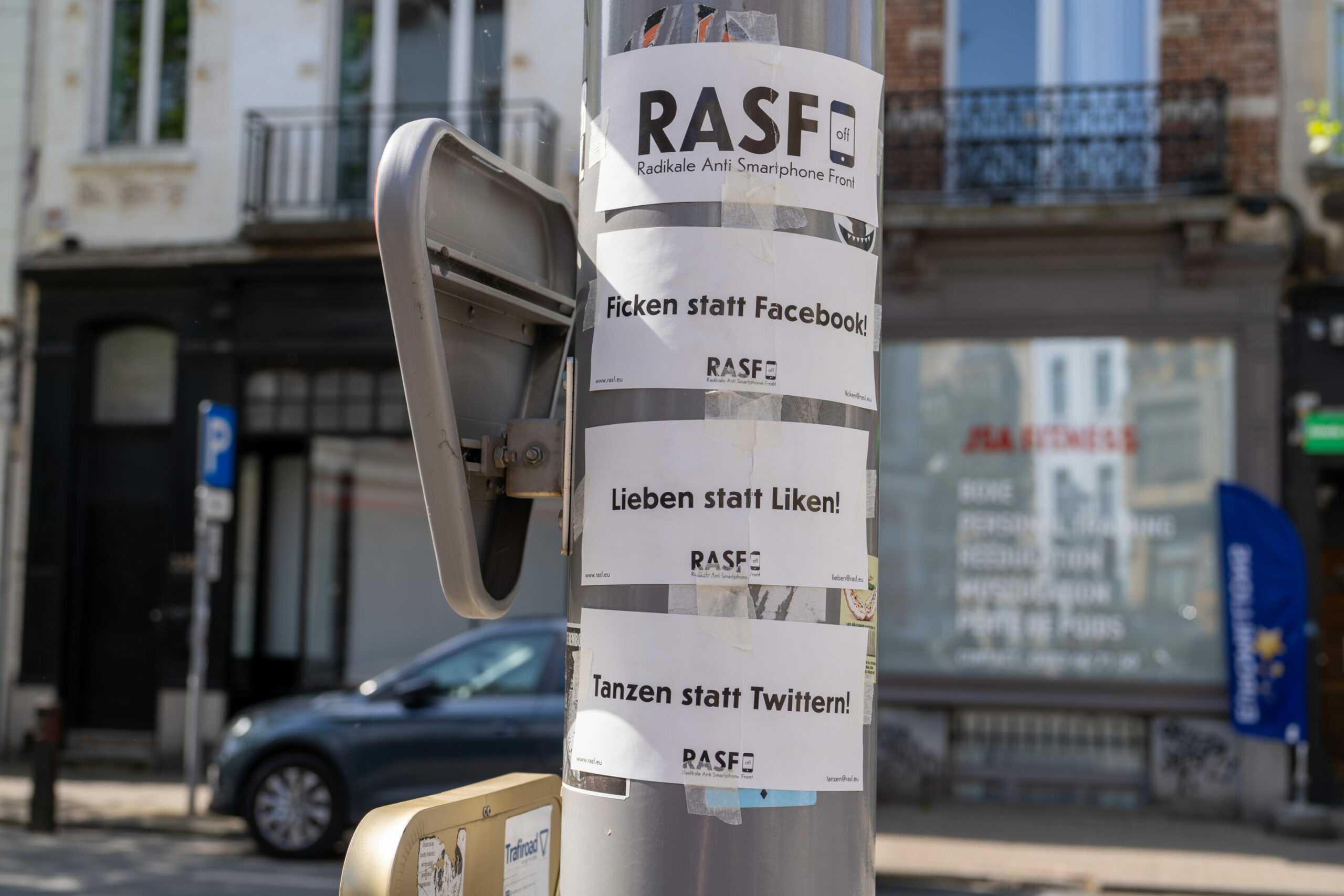
Radical Anti-Smartphone Front (RASF) poster in Brussels. Credit: Vicente Torre Hovelson/The Brussels Times
"I would be careful with framing smartphone use itself as inherently damaging. The key issue is not the device but how it is used, and in today’s society, that "how" often involves spending large amounts of time on social media, particularly among young people, even though smartphones are also used for many other activities," said an assistant professor of psychology at VUB, Dr Martijn Van Heel.
Van Heel sees smartphones as a necessity in our time and doesn’t see them going anywhere. However, he believes overuse is harmful to certain individuals, especially regarding social media use. He also said that excessive use can interfere with our sleep and how people act with one another in person.
Despite the harmful effects smartphones can have, Van Heel is not fully on board with movements like the RASF.
"I would be cautious about framing smartphones themselves as the problem. That risks oversimplifying what is actually a much more complex issue and may shift attention away from underlying factors such as platform design, social pressures, or broader mental health challenges," he stated.
Van Heel also believes the EU is far ahead of other regions in regulating digital platforms, citing the Digital Services Act as a good example, as it gives EU internet users more online rights.
Opinions on smartphone use from the public
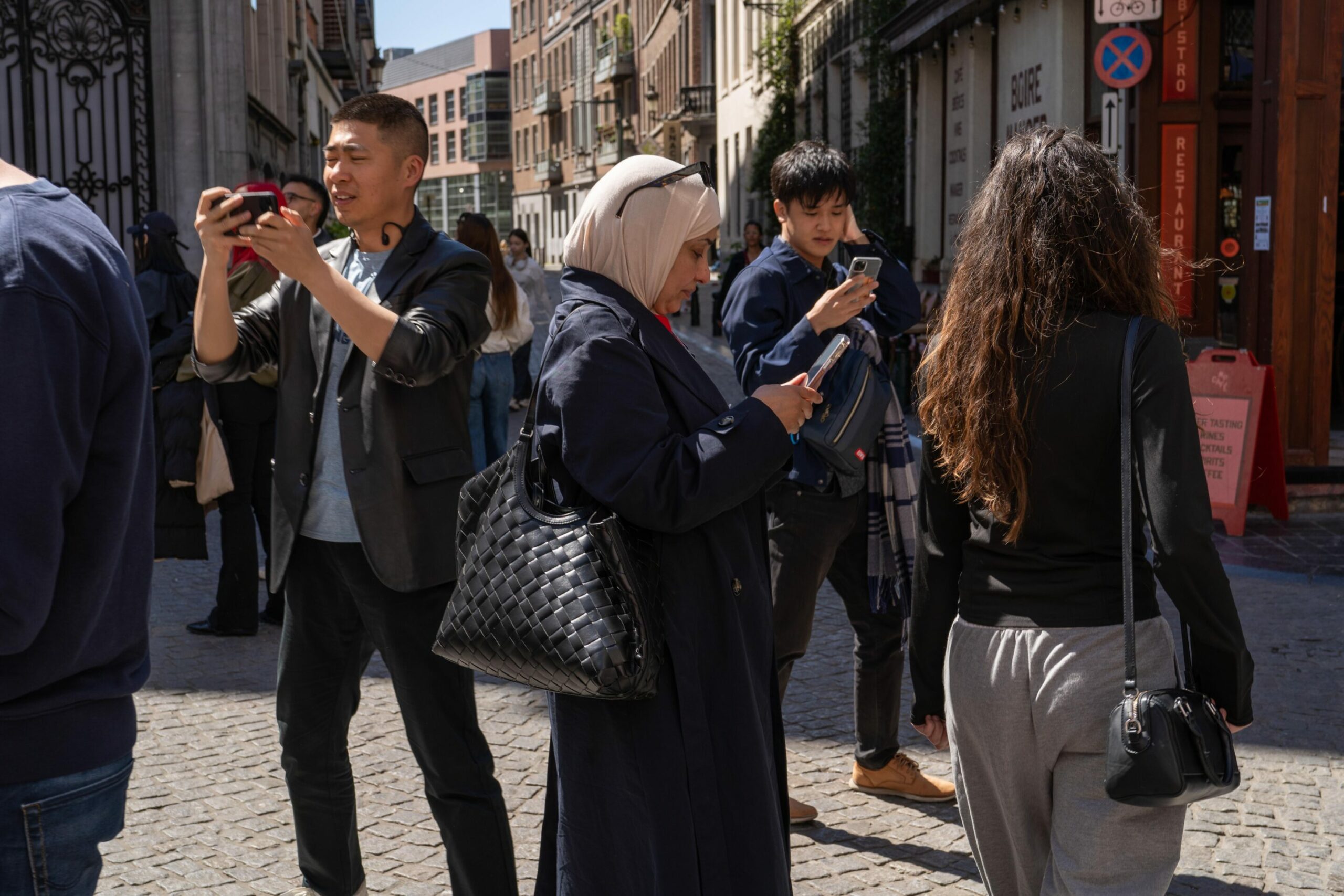
Multiple people staring at their phones near the Manneken Pis in Brussels, Belgium. Credit: Vicente Torre Hovelson/ The Brussels Times.
Marija Jevdacina, a 21-year-old journalism student, explained that she had not heard of the Radical Anti Smartphone Front (RASF) explicitly, but had indeed heard of people buying old flip phones.
Jevdacina also said that she does try to limit her smartphone use: "I do limit my use, when I see that I have been using TikTok too much, I delete it for months at a time."
She is also a big advocate of getting offline and doing activities outdoors or socialising in the wild. "I only use my phone when I want to rest at home or when I need to kill time. Other than that, I'm pretty much always offline. I walk, meet friends, watch movies, and do other fun activities."
Rúben Berben, a 22-year-old retail worker, explained that he feels smartphone use messes with his motivation and sometimes leaves him feeling distracted in his everyday life.
Berben has even turned to using specialised applications to curb his phone usage.
"I have used apps like Burnout Buddy, trying to emulate a 'dumb phone.’ It does work, but it’s also pretty easy to turn off whenever you get a social media craving," Berben stated.
Aerin, a 27-year-old intern at World Federation of Democratic Organisations (FMDO), said this regarding smartphone overuse being problematic.
"It's about one's ability to be present. When we cannot offer presence to our surroundings and to those around us, we miss out on quite a lot. We don't notice the small joys like birds in the sky or streams of light passing through. We don't pay attention to conversations, and we cannot actively listen."
She emphasised that she is especially worried about children, being particularly disturbed by parents giving iPads or phones to their children at very young ages to soothe them or keep them quiet.
"When parents have the habit of scrolling, their children will likely follow. When parents have the habit of reading actual books, their children will likely follow," Aerin said.
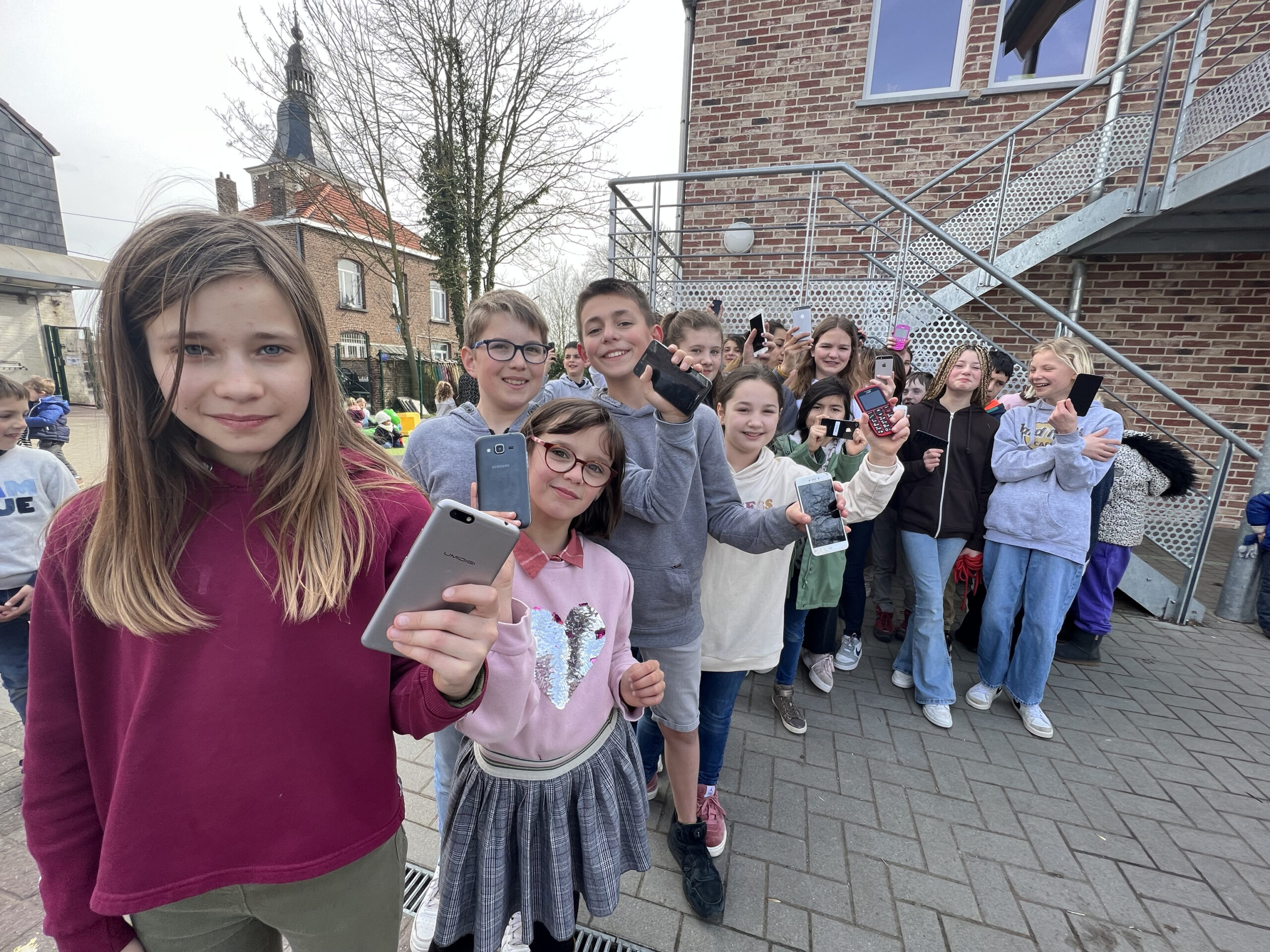
Children at a school with smartphones. Credit: Belga / Didier De Hoe
Yet some people claim there is no strong evidence that smartphone use lowers young people's attention span.
When Werner Goossens, a 61-year-old university lecturer, gives a lesson, he says that most students have the discipline to stay off their phones during class. "I can't see any big impact in terms of attention or concentration. They are mature enough to distinguish between classwork and private life," he said.
However, in his personal life, Goossens has chosen to stay away from smartphones and social media. "I'm defending my concentration, my focus, my inner peace. I don't have a mobile phone, which is sometimes uncomfortable for my partner and some of my friends," Goossens said.
With this no-phone lifestyle, Goossens instead spends his free time reading physical books and newspapers, gardening, hiking, and listening to music on CD's and vinyls rather than streaming. His life outside of work is lived completely offline, and with that, Goossens had one final statement. "I can't wait to enter the post-digital world, whatever that may look like."
