
On a fine August day in the sleepy Belgian village of Geel, a mug sits abandoned on a bench from someone’s morning coffee moment. It’s got a collage of family snapshots – newborns, toddlers, a smiling grandfather – along with the year 2024 in purple block print.
The bench is just outside the building that houses the psychiatric hospital’s elderly division. Inside, a wheelchair-bound patient gives her story. She’s a survivor of childhood sexual abuse and physical abuse that left her briefly in a coma. She suffers from chronic pain, has taken over a hundred ambulance rides and has struggled her whole life to even sleep through the night – until coming to Geel.
“It’s here,” she explains, “where I’ve learned to find peace.”
Geel is a town with a reputation. Belgian school children still tease each other by saying someone ought to be sent there, and long-time residents say they’re often met with raised eyebrows when people hear where they live or work.
Oh. That place.
But to people who come to the Openbaar Psychiatrisch Zorgcentrum (OPZ) Geel, the professionals they meet with, and the locals who foster them as full-fledged members of their families, Geel is a haven of healing – the product of a fusion of modern psychiatric care and a 700-year old history that includes saints, kings, miracles, princesses, graverobbers, holy relics, and the sort of compassion that becomes, literally, legendary.
Yes. This place.
The princess and the priest
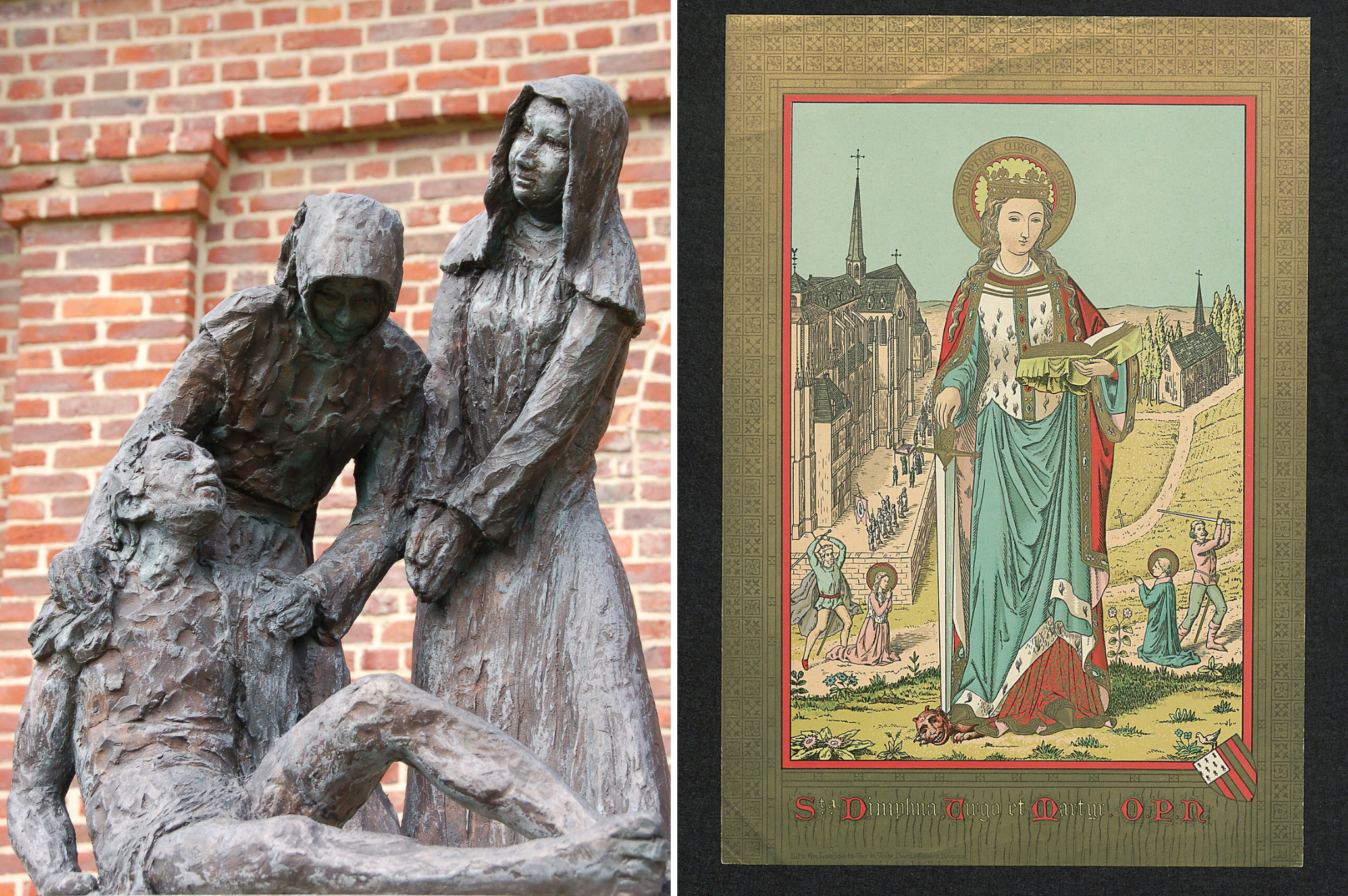
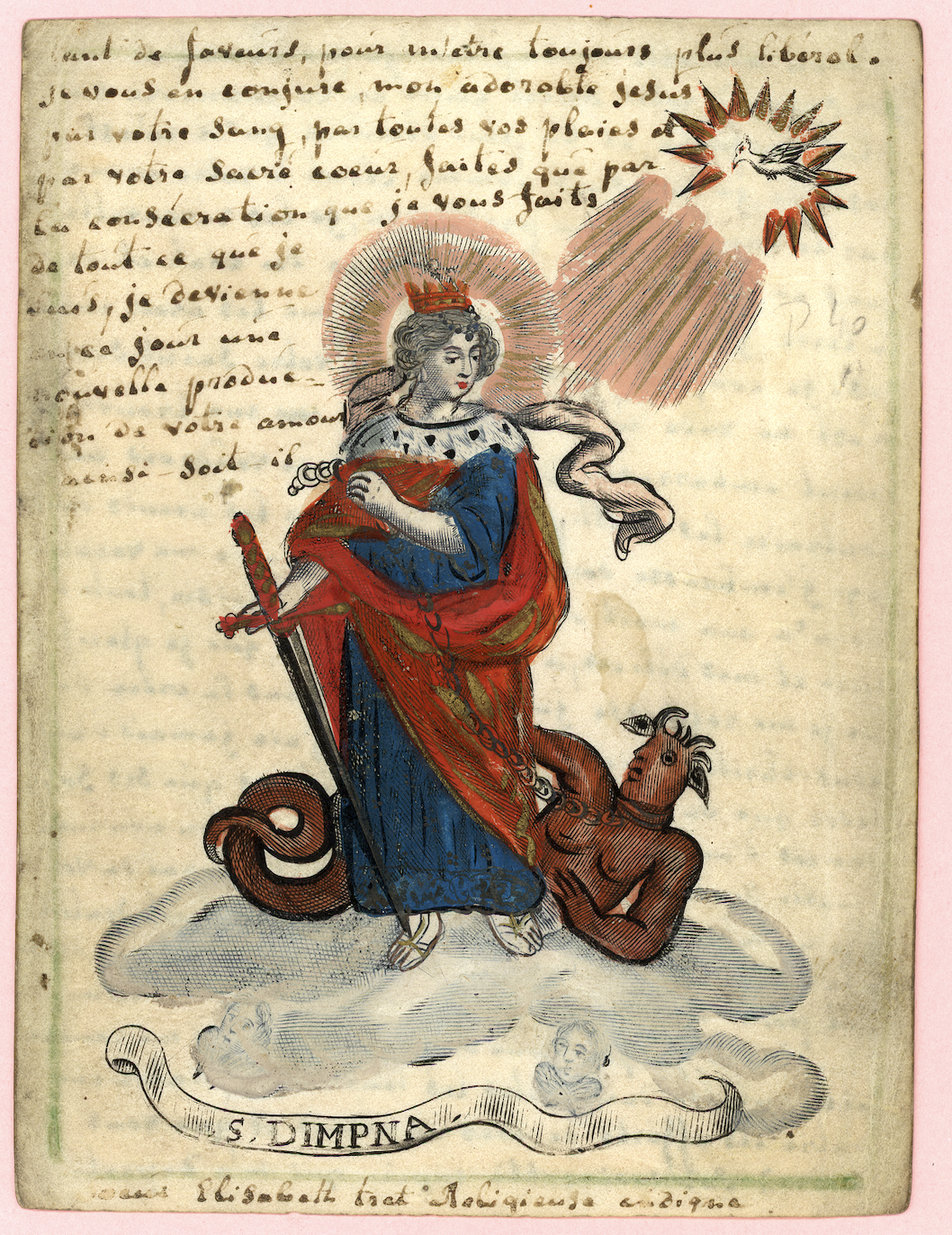
The story of Geel’s unique programme, in which people with mental illnesses are fostered by ‘host families’ in town while receiving care from the local psychiatric hospital, begins with Dymphna.
In short, Dymphna was an Irish princess who fled to Belgium with a priest to escape her incestuous father, only for him to track her down to Geel and personally chop off her head in a fit of madness because she refused to marry him. For her courage, her purity and her devout Christian beliefs, Dymphna became the patron saint of the mentally ill, and her priest protector the patron saint against – in typical Roman Catholic specificity – fever and gout.
As for the long version, well, it depends on who you ask.
That the details of her story are so varied is perhaps what prompted Belgian priest and scholar Hippolyte Delehaye to describe the tale of Saint Dymphna in his 1906 Légendes Hagiographiques as an almost typical example of how folklore bleeds into history. Three main narratives emerge: the Irish one, the Belgian one and an American version brought by Irish immigrants and adapted or otherwise muddled. But in the Church of Saint Dymphna, less than 10 minutes from the hospital by bicycle, Griet Wouters gives the more-or-less official story from the Church.
“I’m no historian,” she’s quick to offer as a disclaimer. “But in terms of how we in Geel tell the story, the regionally-accepted version, if you will, you can see all around you.”
She refers to the church with its stained-glass windows, priceless paintings and countless works of art depicting the life of the young Irish princess – one who would die a martyr and spark seven centuries (and counting) worth of miracles.
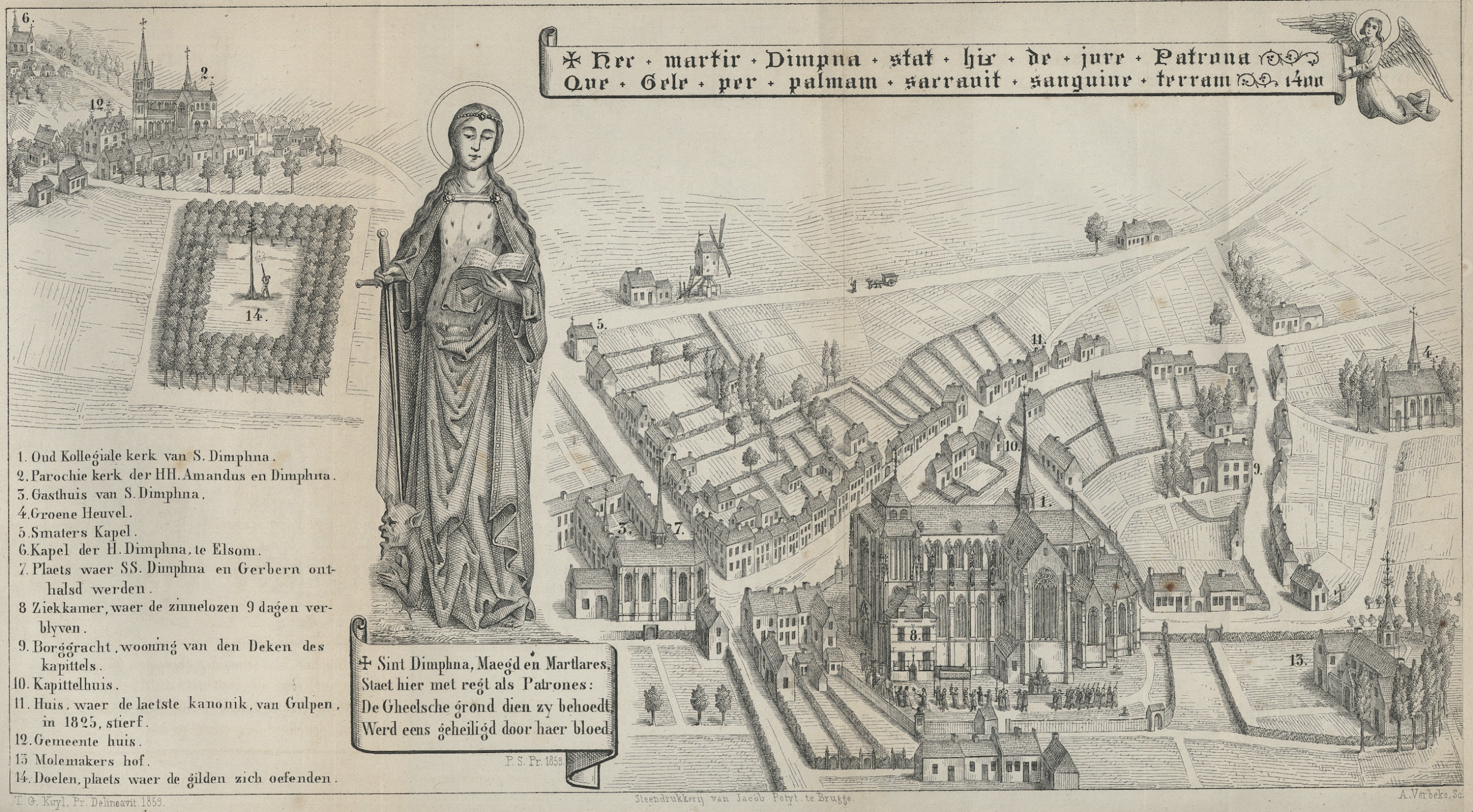
Dymphna was born in Ireland sometime in the Middle Ages, around the year 600, to a pagan king and his devoutly Christian wife, who was said to be famous for her beauty. She had Dymphna baptised in secret by a priest named Gerebernus, who became Dymphna’s close confidant and confessor. When the queen died while Dymphna was still quite young, the king was inconsolable. His courtiers urged him to remarry, but he swore he’d only wed a woman who was as beautiful as his late wife.
Fourteen-year-old Dymphna, as fate would have it, was beginning to grow into her mother’s image. Whether the king was urged by his advisors, driven mad by his grief or whispered to by the devil himself, he proposed to his daughter. Dymphna rejected the marriage, but her father continued to insist with increasing aggression until finally Dymphna was forced to flee his court with Father Gerebernus, and – depending on the account – maybe a court jester, an elderly Christian couple or some courtiers.
The ensemble arrived in Antwerp with only Irish coin to pay for food and lodging, eventually fleeing to the forests of the Kempen region until finding a proper hiding place in Zammel, a hamlet of Geel.
“There they built a hut, leading a reclusive life, tending to the poor and needy,” the official story, mapped out in a colourful booklet for church visitors, goes.
“The king pursued Dymphna to Antwerp, dispatching agents to find her. The landlady of an inn near Zammel noticed that these men used the same strange coins to pay her as a young girl who lived nearby, thereby inadvertently revealing Dymphna’s location. The king found Dymphna and asked her yet again to marry him, but yet again she refused him. The furious king ordered that Gerebernus be killed to pressure Dymphna, but she kept on refusing. He ordered his soldiers to kill his daughter, but for fear of later reprisal, none dared to do so. Therefore, in a fit of madness, the king beheaded his own daughter with his sword.”
The innkeeper is an important part of the story, Wouters explains. For giving up Dymphna (deliberately or not is a matter of debate), God locked her arm and hand in the permanent position of pointing towards the hamlet where the saint was hiding. In the commemorative plays, parades and performances that still take place in Geel to this day, one person always takes on the role of this character, holding their hand in the accusatory pose for up to hours on end.
After their murder, the bodies of Dymphna and her loyal priest were left where they lay, but the people of Geel buried them with reverence. Prayers were soon offered at those graves against insanity. Later, when the martyrs were exhumed to honour the altars in the church with their relics, the bones of Dymphna and Gerebernus were found in two white coffins made of white sandstone, a material that was unknown in Geel. Thus, the inhabitants believed that the martyrs were buried by angels at that time.
They invoked them as saints for healing various ailments, but especially against madness, since Dymphna was murdered by her father in a fit of insanity. Soon their graves became a place of pilgrimage, and Dymphna was venerated as a saint against mental illness because she had defeated the devil by dying a martyr.
Alban Butler, a Roman Catholic priest and hagiographer, puts it more bluntly in the parlance of his time, writing in The Lives of the Saints that “the elevation of the relics of Saint Dymphna was followed, it is alleged, by the restoration to normal health of a number of epileptics, lunatics and persons under malign influence who visited her shrine. Ever since then she has been regarded as the patroness of the insane, and the inhabitants of Geel have been distinguished by the kindly provision they have made for those so afflicted.”
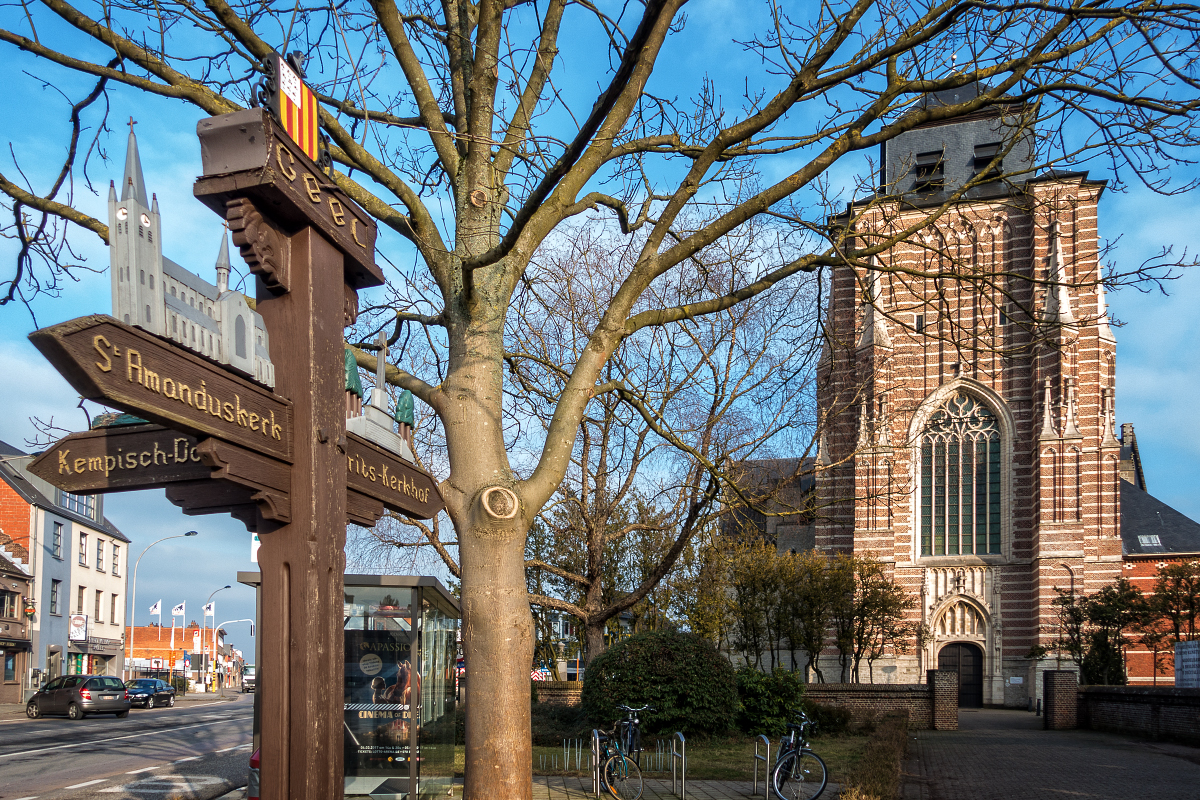
Exterior of St. Dimpna Church. Credit: Kristof Donné
On this matter, there is no debate: those people who live in Geel are possessed of an exceptional compassion; and those who came to the tomb for healing of mental afflictions were met with miracles.
No wonder, then, that the site drew the attention of graverobbers. Legend (no reliable medieval record exists to confirm the story) has it that with relics fetching a high price among believers, thieves from Germany (or perhaps even Frederick Barbarossa himself) came to steal the bones of the two saints. Pursued by the people of Geel, there was a skirmish, and most of the bones were returned to the Belgian hamlet.
Butler, in a footnote, remarks that “an interesting feature in the case is the fact that lunatics who go to Geel to be healed are made to pass through an archway immediately underneath the shrine of the saint. One finds many early examples, even at Jerusalem itself, in which the squeezing through some narrow aperture is believed to be a condition for obtaining special favour.”
This archway still exists today, in Saint Dymphna’s church, just behind the altar. The structure there is comprised of two relics: a relic of the first order consisting of remains from Saint Dymphna and Saint Gerebernus’ bodies, and a relic of the second order consisting of the remains of their tomb – what was left after the battles with graverobbers. These rest above the archway, where people still come to this day in hopes of healing.
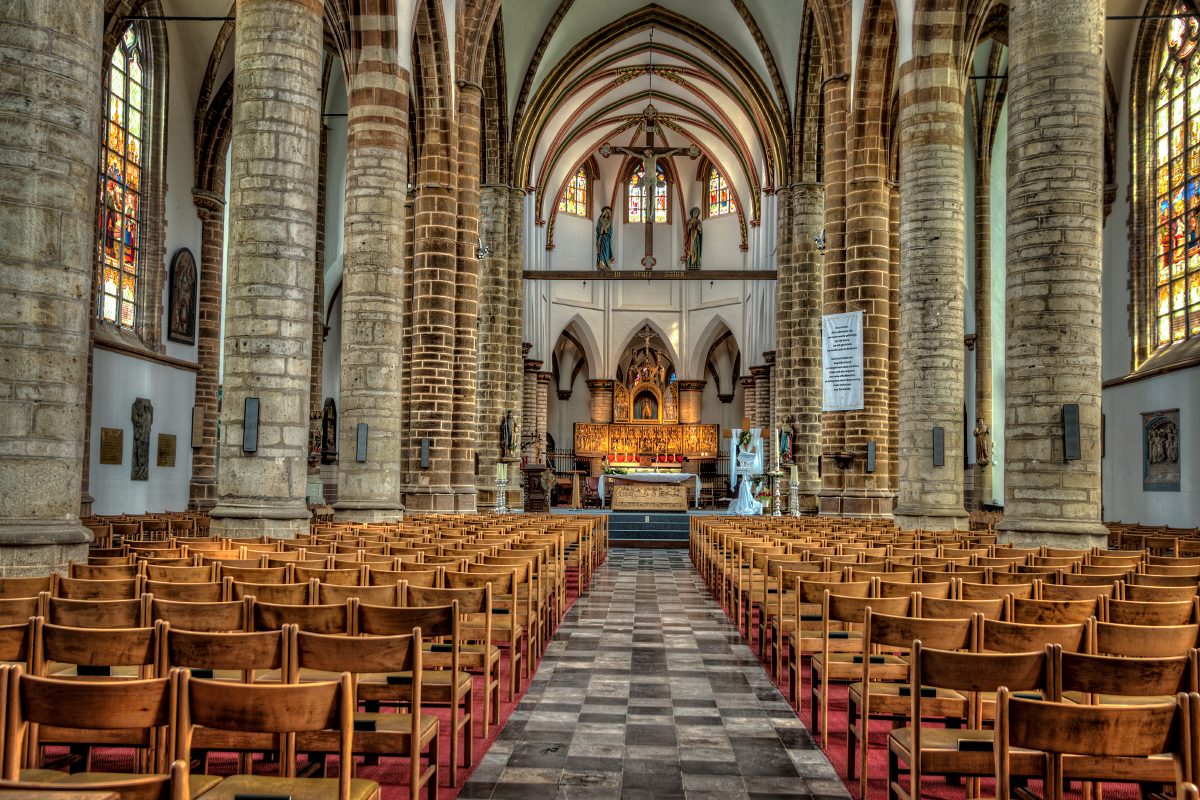
Exterior of St. Dimpna Church. Credit: Kristof Donné
“People believed you had to pass through the archway nine times, on nine consecutive days, praying a different prayer for each of them,” Wouters explains.
“Spending nine days in a village inn would be expensive, so most people slept in the streets. In some cases, people were brought by family members who simply abandoned them here. The nuns in the church started taking them in, building a room to house them on the back of the church. But it wasn’t enough. Then a hospital was built, and it still wasn’t enough. Finally, the people of Geel took them in – sometimes in exchange for working on their farm, but often just out of the kindness of their hearts. And then, they became part of the family. They never left. This was their home now.”
For hundreds of years, people continued to travel to the church to pass under that same archway as the medieval pilgrims did. They’d bring religious medals, Bibles, scarves and photos, which they would rub against the relic of the second order in hopes of creating a relic of the third order. The church eventually had to erect plexiglass around the ancient box to protect it from damage.
Today’s pilgrims arrive by car and rub their precious objects against the plexiglass.
Exceptional and ordinary at the same time
In the hospital nearby, psychiatrist Ragnar Verbraeken and psychologist Wilfried Bogaerts are wary of putting too much emphasis on the legend that has come to define the town. Not because they aren’t believers, necessarily, but because they worry that too many people think it’s the defining factor that makes the programme work, rendering the model unreplicable unless you’ve also got two saints, a handful of relics and 700 years of results.
“Some people think Geel is a holy city and that a programme like ours can only be set up here, in this environment, with this background, with this history, but I think that you can set similar programmes up practically all over the world,” Bogaerts says.
“The further away people are from the work being done here, the more they tend to put the programme on a pedestal. But the essence – that you offer chronic psychiatric patients a place to stay – that’s something you can realise anywhere.”
This aspect – that patients are ‘adopted’ by foster families – is a critical factor in the success of treatment.
Verbraeken points out that while many people manage to make significant progress in traditional psychiatric care facilities, once they’re sent back into the outside world with its burdens and responsibilities, big and small, some of them often relapse.
Installing and maintaining daily routines, managing medication, things like doing the grocery shopping, staying on top of the laundry – these can quickly overwhelm someone who struggles with mental health issues. But when the patients at OPZ Geel go back home, it’s to a foster family waiting to help them manage it all, to hold structure in place. A ‘CareBNB’, so to say.
“Instead of going back and maybe being alone, with no one to talk to in the evenings, your family is waiting for you,” Verbraeken says. “Someone is always there. It’s a big difference.”
Bogaerts and Verbraeken explain that the treatments they use in the hospital are not really any different from what one would find in any modern care centre. There’s talk therapy, medication management, volunteer programmes with local businesses. There’s a garden to work, filled with sunflowers, shrubs and a pumpkin plant that shows promising flowers. Patients create arts and crafts, from painted furniture and wooden bowls to lavender satchels and shawls that visitors can purchase.
These are displayed in the lobby, along with a gold frame hung at eye level. Inside, beneath the title Een kader vol hoop – A Frame Full of Hope – is a short poem. It tells of a plain wooden frame suddenly strung with ribbons, each bearing a tiny bag. Inside each bag is a small token, a surprise for whoever takes it: “A small thing, a grand gesture, a bit of love, made visible.”
The instructions are simple: take one if you like, leave the clips so more can be added. In its own way, the frame distils what Geel has been doing for centuries – the ordinary generosity of giving a stranger something to hold onto.
From pilgrims to patients
OPZ Geel is, Verbraeken and Bogaerts say, a humble community care institution.
“It used to be a very international population, people coming from Europe and even further away,” Bogaerts recalls. “But if you look at the last 30 to 35 years, it was mainly people from Flanders being referred to our programme, and if you look at the last 10 to 15 years, it’s even more regional.”
The main reason is that better help exists in more places than it did back then. While medieval sufferers had to walk for days or weeks or months to seek medicine or miracles in Geel, today most of the developed world has institutions or hospitals that offer psychiatric care.
In Belgium itself, Bogaerts explains, all the regions offer equally excellent care. There’s no need for a French-speaking Walloon to pick up their life and move it to Flanders, where they’d be at a major disadvantage if they didn’t speak Dutch, since Wallonia has its own model of the foster-family system. Similar community care programmes have also been established in Germany, France, the UK and Italy.
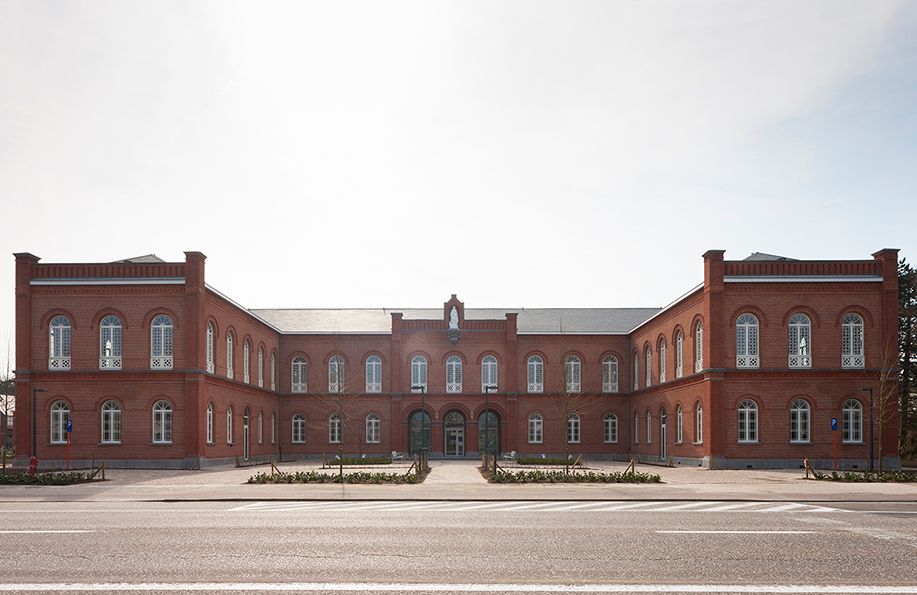
OPZ te Geel
When the arrangement is such that both the boarder and the foster family win, community care programmes such as the one in Geel can mean a fresh start, a new life, for someone grappling with mental illness.
“A lot of people who don’t have a lot of abilities, by the fact that they’re accepted and helped and welcomed, they start taking up chores around the house. They start functioning at a higher level and contributing to family life in a way that really makes a difference. It’s not an official thing, it’s just something that happens: taking care of the pets, the garden, even an elderly family member. The relationships, over many years, sometimes change in terms of who’s taking care of whom.”
A forever home
On this warm day, a van pulls up to the entrance, and a family pours out. They say hello to the patients passing time in the lobby or in the sunshine outside, who they know by name. Someone scoops up the abandoned coffee cup to bring it inside. Indeed, it is impossible to tell who among them is the patient and who is their adopted family.
A potential foster family is screened with care, educated about the programme and interviewed with questions like: what sort of disabilities are you comfortable working with? How is your typical day structured? How much time do you have to offer care? Why do you want to be a foster family?
Most new foster families have some link to another, whether it’s a case of seeing their neighbour or relative’s involvement in the programme or growing up in a house where their parents were fostering. Motivations for becoming a foster family could be financial (families are paid €40-44 a day), or for company, for help in the house, for a reason to get up in the morning.
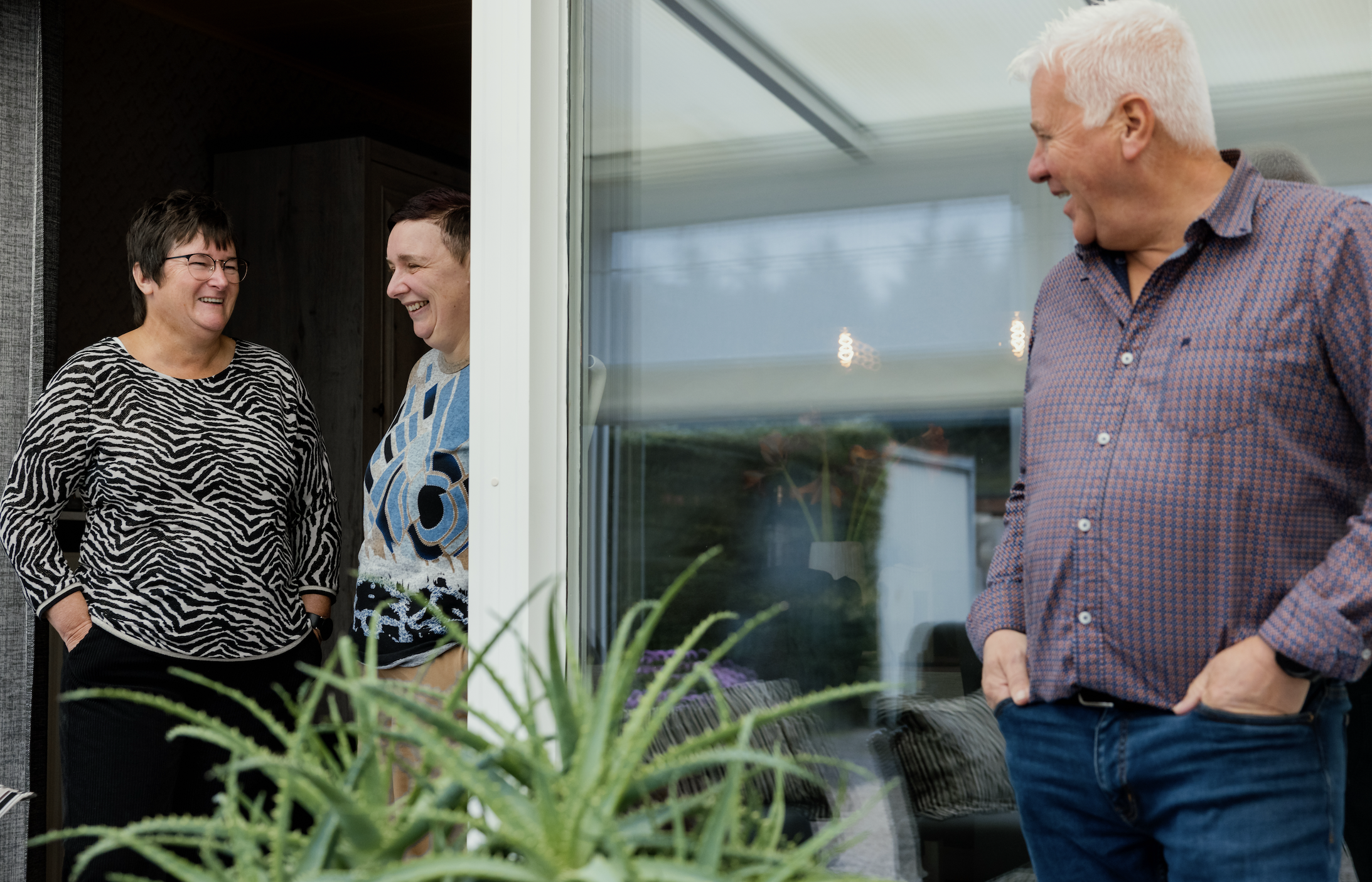
OPZGeel. Credit: Rhode Van Elsen
“With all this information, we try to get a clear idea of what type of care we can integrate into this family without destabilising it,” says Bogaerts. “What we always say to new foster families is that we don’t want you to change too much of your life. If you have to change too many things, it’ll be difficult to cope with in the long term.”
And what OPZ Geel wants is the sort of sustainable match that can be lifelong.
“The idea is,” Verbraeken says, “that when a patient goes to live with a family, they stay there as long as needed and wanted, maybe even for the rest of their life.”
A legend that lingers
Back in the church, Wouters welcomes a young man with a backpack who has wandered into the church. She asks him if there’s anything he needs, anything she can help with. He explains that he comes from Mol, was in the area and simply saw the church and wanted to see what it was like inside. Wouters leaves him to wander, gazing up at the stained-glass windows where a teenage girl is beheaded, where her tomb becomes the site of miracles, where pilgrims line up for a chance at healing.
The Catholic Church has no official role in the psychiatric hospital anymore, but the legend hasn’t been as finely extricated from life in modern-day Geel as one might think. Indeed, Wouters was appointed pastor of the town’s general hospital in 2017.
As a child growing up in Geel, her family fostered a psychiatric patient. She believes this work not only provides satisfaction and joy on a spiritual level but also reduces the stigma around mental illness.
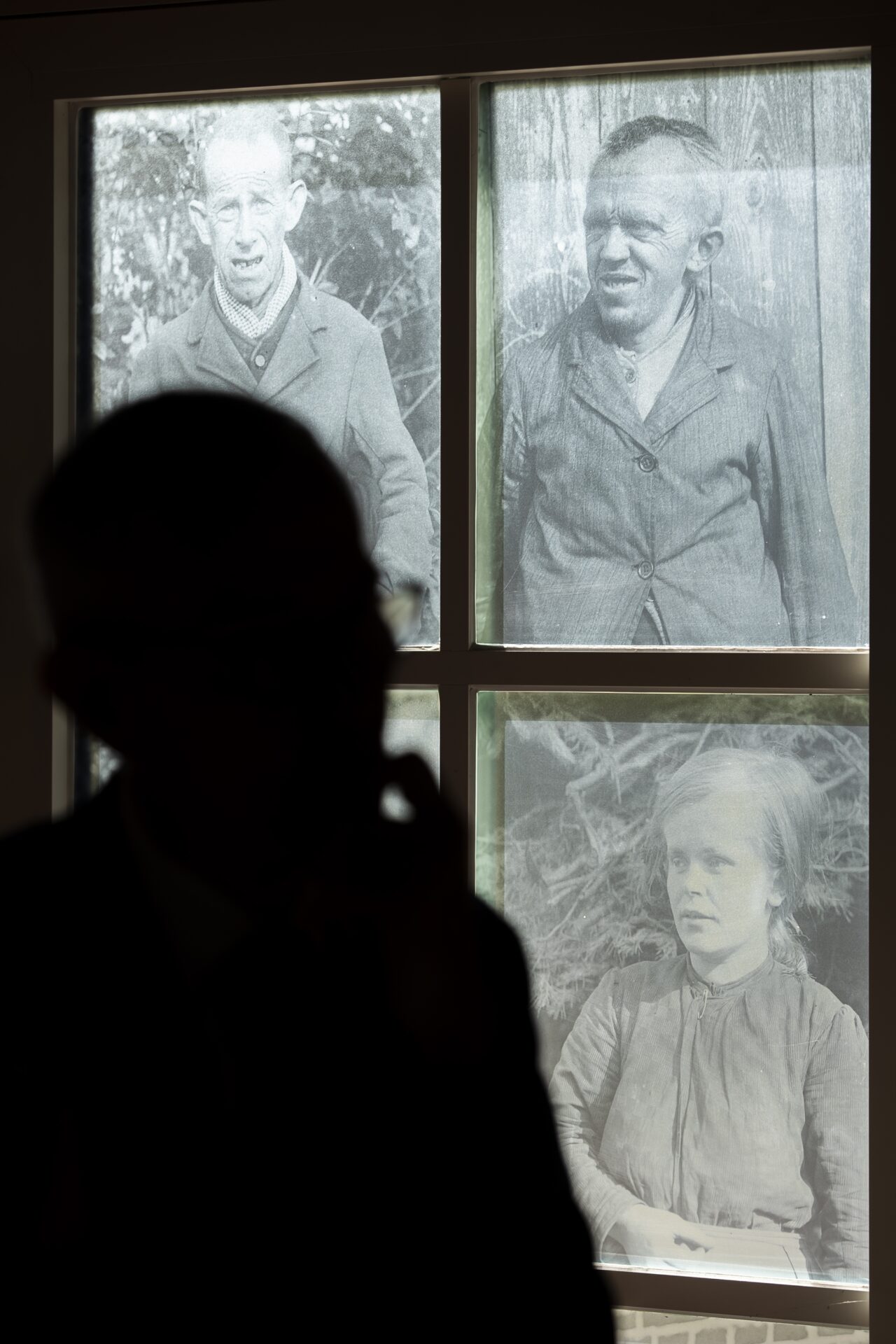
Illustration picture shows photographs of patients during and a visit to the Public Psychiatric Care Center in Geel, Monday 17 July 2023. Credit: Belga
“People with mental illnesses aren’t scary,” she says, simply. “That person standing by the stoplight all day waving at cars – that’s just Jan. The woman who’s always rocking back and forth, that’s just Marie. They’re our neighbours. Our family members. They’ve come here to live where they’re accepted.”
And people continue to come to Geel. Wouters recalls a recent pilgrim to the church who arrived from Lithuania just three months ago.
“She told me that to her, the science side of mental health care is critical, but that it’s only 50% – that without her religion, she could only heal halfway. I quite liked that – this belief and trust in science, with the other half of healing being spiritual.”
The church has a public email address on its website, and many who write to it don’t seem to realise the inbox is actually maintained. Wouters does it. She reads every desperate plea (some simply say HELP ME) from all around the world, from America to Japan. Wouters writes their first names and country, where given, into the church’s book of intentions. Once a week during mass, the entries are read aloud, and the congregation offers up prayers specifically for these people.
To answer the question as to whether pilgrims are still welcome at the church, Wouters has just three words: “Let them come.”
The official Capital-C Church line couches the legend, but in positivity: “While we are unable to historically ascertain all of the elements of this legend, we do know that Dymphna continues to inspire the townspeople of Geel and people from around the world even today.”
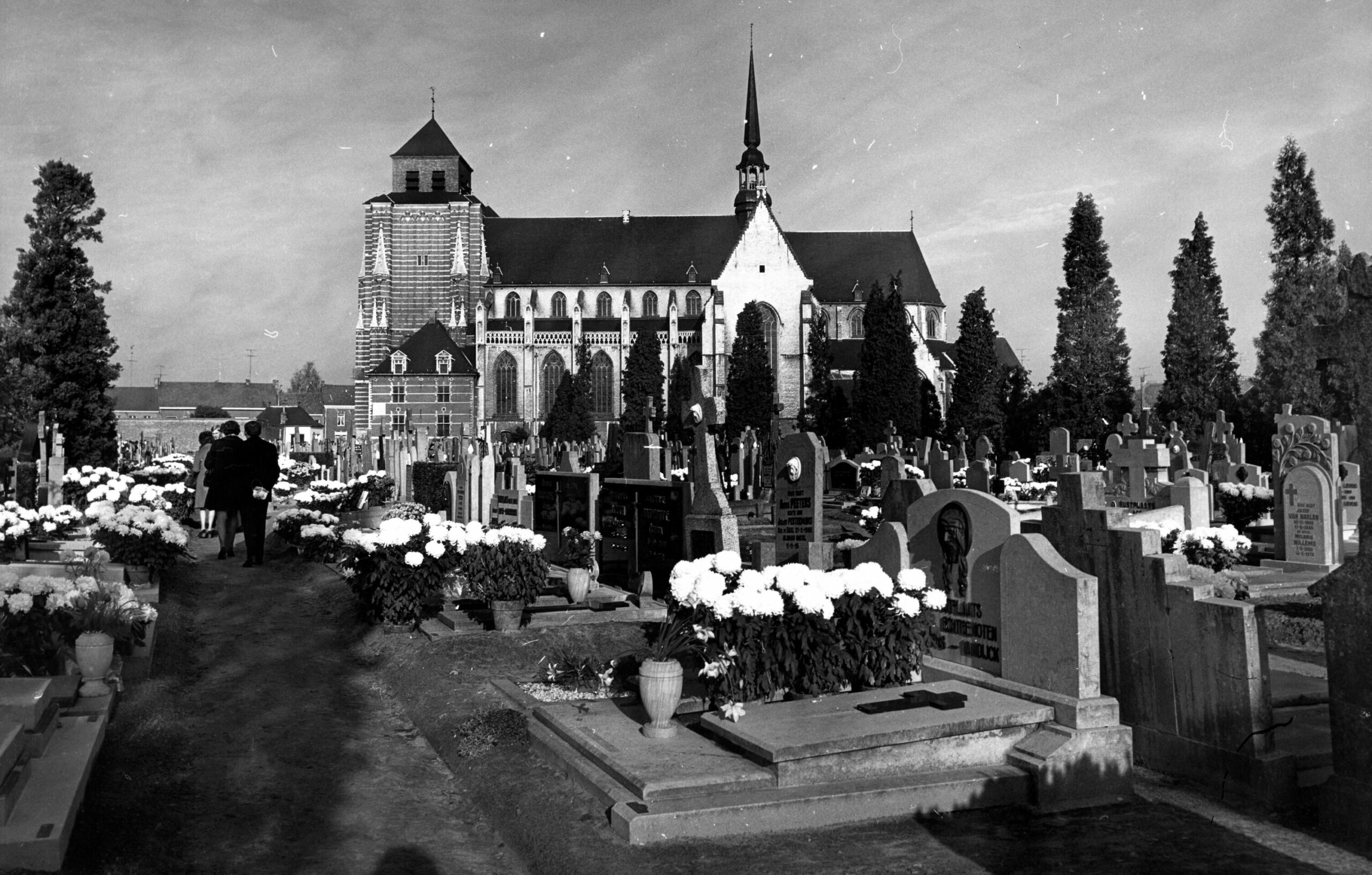
Undated file picture shows Saint Dymphna Church of Geel. Credit: Belga Archives
Bogaerts and Verbraeken are even more direct in distancing their work from the legend that precedes it.
“There’s nothing special about Geel,” Verbraeken repeats bluntly. “Nothing that would make it impossible to duplicate.”
Bogaerts agrees: “I think the legend, and religion, were a very important thing many, many years ago when it started – without the legend, we wouldn’t be sitting here talking today – but the legend itself plays no role in it anymore.”
“There’s a bit of tradition that makes it a little easier,” Verbraeken considers. “But not much – a little easier.”
For some lifelong residents like Wouters, there’s no need to pick a side.
“You do not need to be religious to understand that religion and science each have their place in the origin and continuation of this heartfelt and warm, human form of community building,” she says.
“And both elements – religion and science – do have an impact still nowadays on people who are searching for support and healing for their mental issues.”
In Geel, healing has been taking place for seven centuries. But to matter, it needs only touch a single lifetime.
