
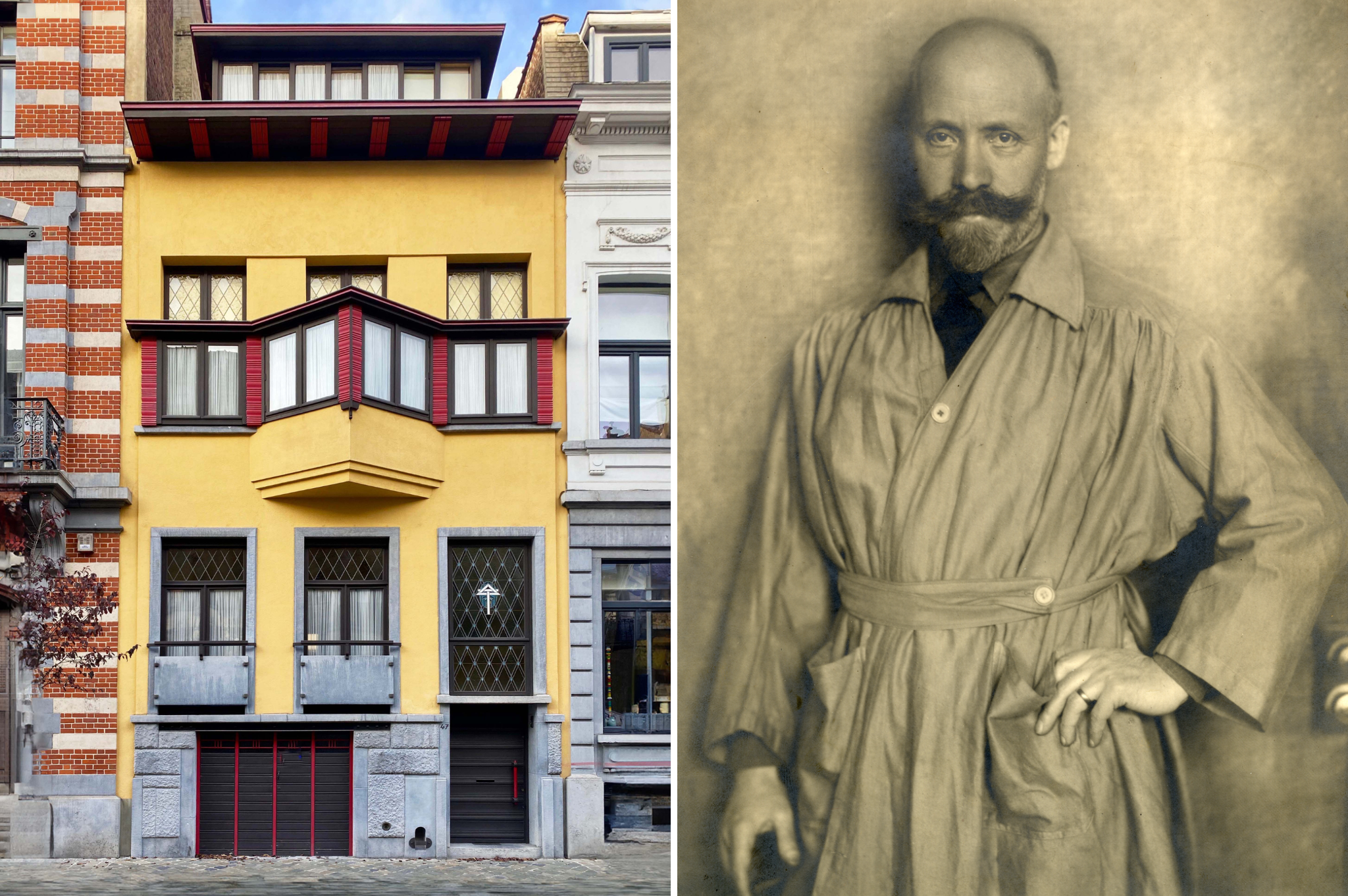
Antoine Pompe was a late starter and a late finisher as an architect. Born in 1873, he didn't sign his first solo work until 1910, when he was 37. When he died in 1980 aged 106, he was Belgium's oldest person.
His debut, an orthopaedic clinic in Saint-Gilles, was built for a friend, Doctor Van Neck, who gave Pompe carte blanche for the design. Its facade was an early model of rational design, with form following function.
Traversed horizontally by a band of glass bricks (giving both light and privacy to the first-floor gym) and vertically by shafts for the intake and expulsion of air, its facade seized the attention of both passers-by and architects. A protected monument since 1981, its listing says, “contemporaries viewed it, without the shadow of a doubt, as the historic stepping-off point of modern architecture in Belgium.”
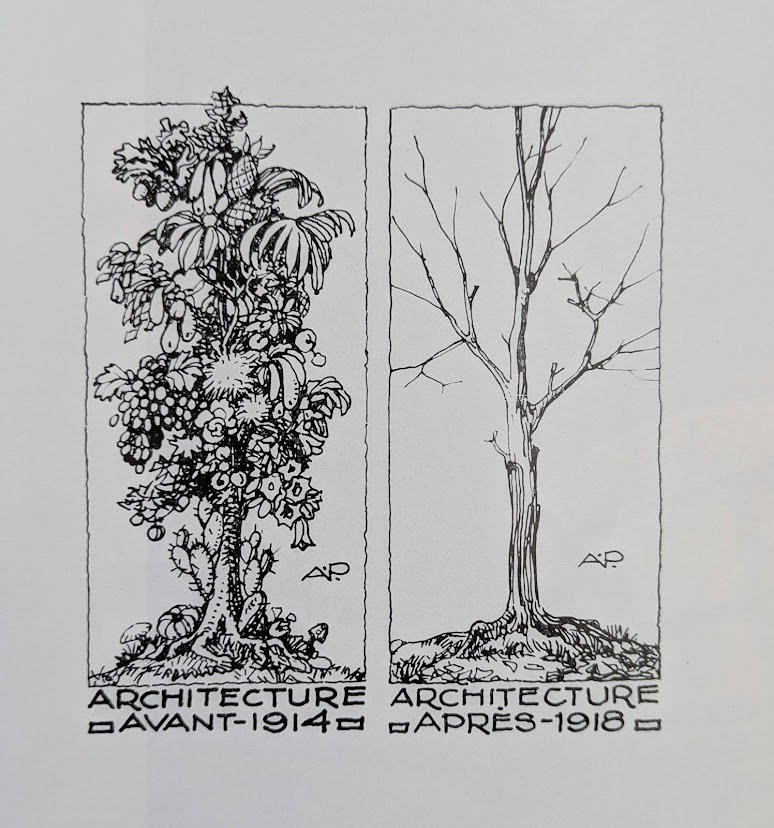
Yet this proto-modernist rejected the label. Regarding himself as the product of “the age of the horse and cart”, Pompe felt that modern architects, as personified by Le Corbusier, had put the cart before the horse. He called himself a “pseudo-modernist” in conflict with those who he accused of stripping buildings of not just decoration but personality, prizing function above any pleasure they might give to its inhabitants or passers-by.
He entered the profession via the artisan route of apprenticeships in the decorative arts and was incensed by what he saw as an elitist trend towards austere, unadorned geometry in architecture between the world wars. His arguments with the functionalists would bury his late-flowering career and occupy the rest of his life. But it was just the first round of the spat, and thanks to his extraordinary longevity, he stuck around long enough to savour a dose of vindication in the second.
Largely forgotten after the Second World War, Pompe’s rediscovery in the 1960s coincided with the rise of postmodernism, a movement anticipated by his own attachment in the 1920s to the value of an attractive outer shell for cutting-edge structures. That rediscovery was a key inspiration in the fightback against the functionalist tide that threatened to engulf the city known as Bruxellisation.
It would trigger the development of a campaigning heritage sector that sharpened the city’s identity in the minds of its inhabitants through exhibitions, books and tours promoting the quality of its prewar buildings.
Activists, both French and Dutch-speaking, used the power of the media to attack modernisation plans they disliked and demanded public consultations on alternative proposals. The principle of citizens getting a say in the construction of Brussels was a key element in the construction of a democratic identity for a bilingual region amid the federalisation of Belgium.
This would eventually lead to the creation in 1989 of the Brussels Capital Region with power over planning. And thanks in part to a chance discovery in a basement – a reminder of an architect of a forgotten age, forgotten himself, but not dead.
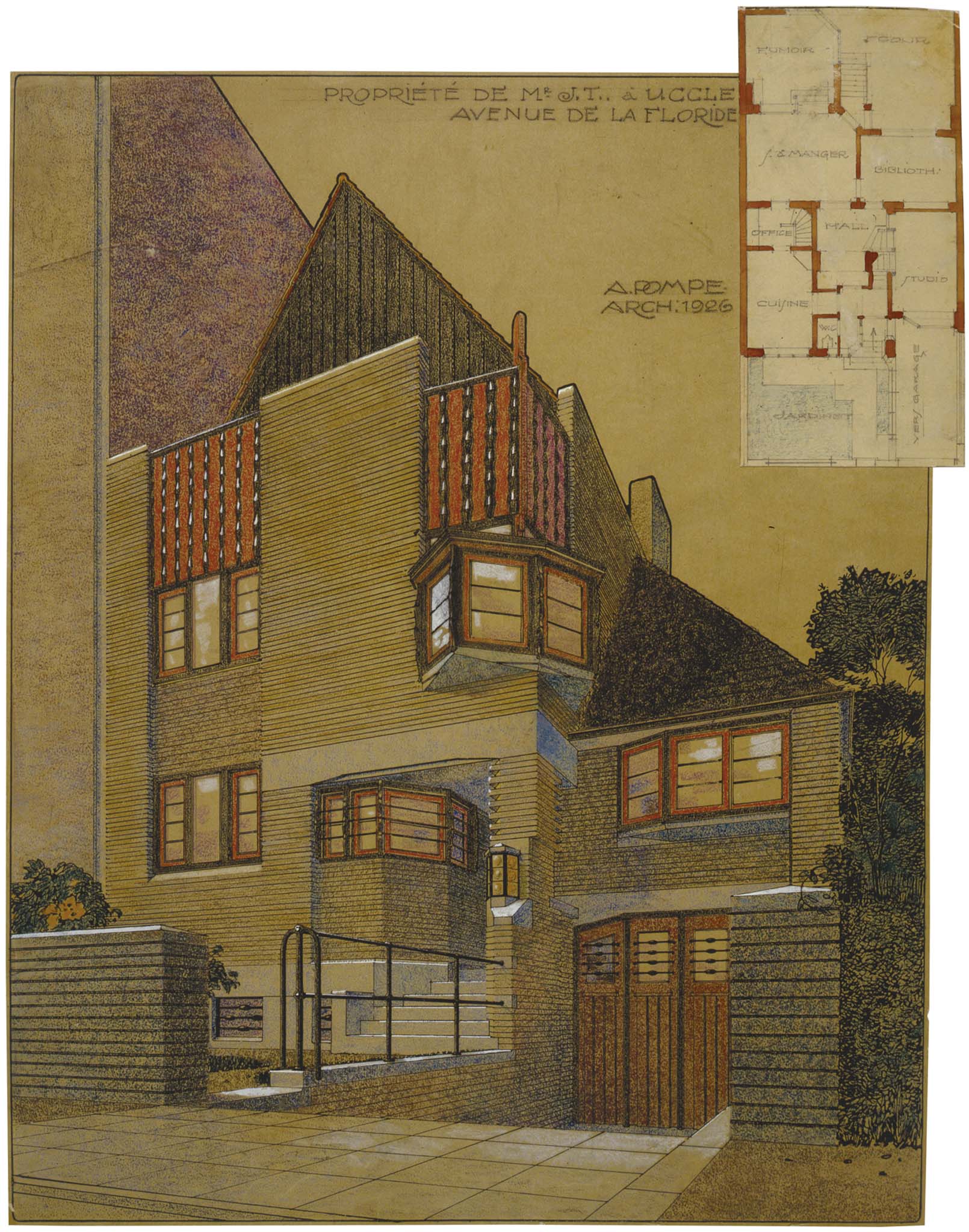
Antoine Pompe's design for a villa on Avenue des Florides in Uccle, 1926
Act One: Technology and tradition
Antoine Pompe’s journey as a designer began at age 13 when he enrolled at the Royal Academy of Fine Arts of Brussels. At 17, he began a three-year course at the Royal Arts and Crafts School in Munich, immersing himself in centuries of tradition in the applied arts. The experience left Pompe with a lifelong affection for design that was gemütlich, what Dutch-speakers call gezellig and is perhaps best rendered in English as cosy.
Returning to Belgium in 1893, the year that saw the creation of the first art nouveau houses by Victor Horta and Paul Hankar, Pompe would spend two further decades in successive carpentry and ironworks internships, learning the construction profession from top to bottom. At the office of Georges Hobé, another decorator turned architect, he met Fernand Bodson. The two men went into partnership in 1910, exploring the revolutionary possibilities of concrete architecture and developing garden cities together.
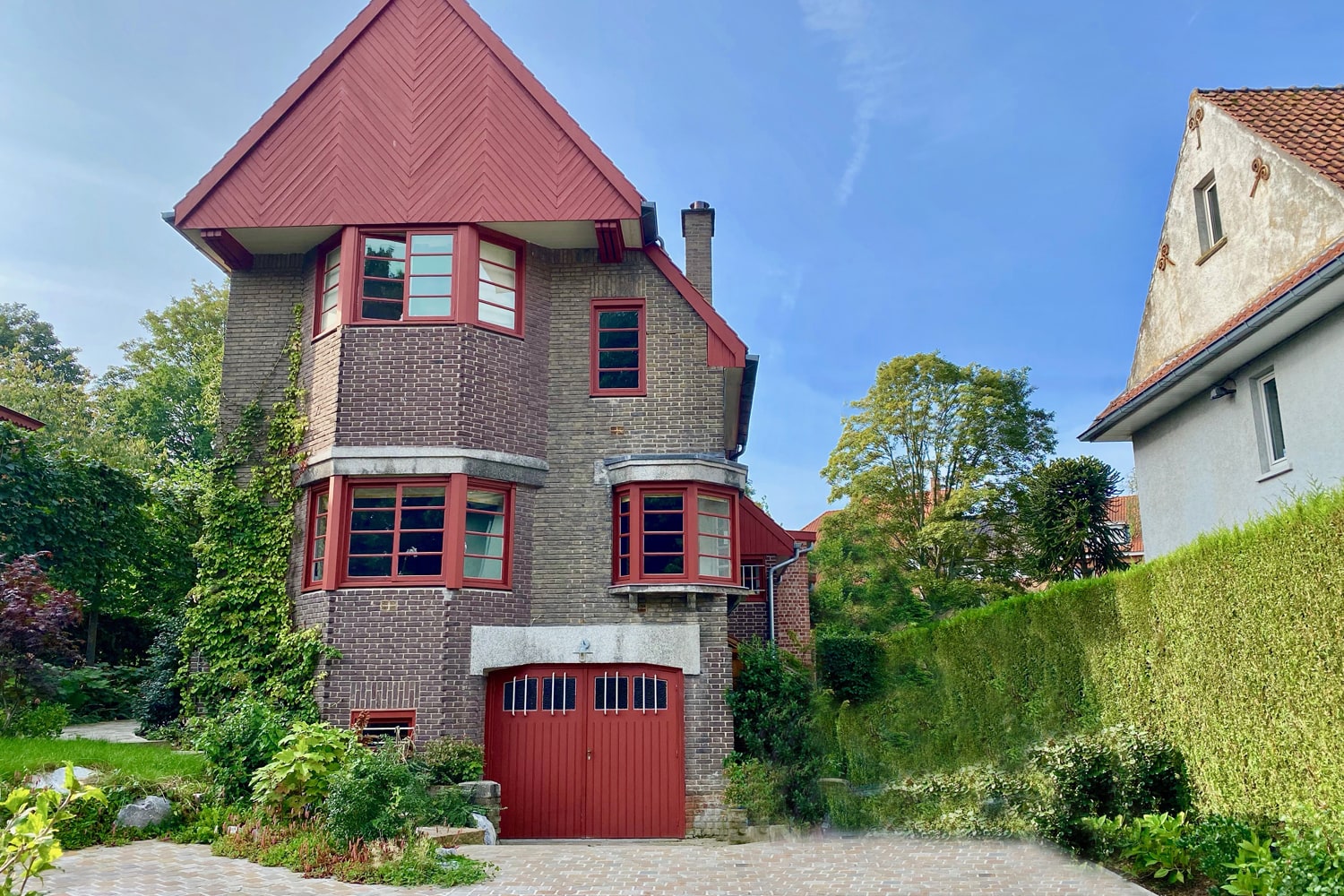
Prince Brabançons house by Antoine Pompe, 1926
Their “magisterial” design that year for a reinforced-concrete viaduct serving a future Central Station in Brussels marked the two men out as rising stars for the influential art critic Sander Pierron. Yet Pierron was disappointed by Pompe’s domestic projects presented at the same show: “banal, unoriginal copies” of English cottages. Such timid conventionality among young designers “must be stamped out” to allow Belgian architecture to progress to its next stage, Pierron insisted.
Unapologetic, perhaps his defining quality, Pompe used the enforced idleness of the German occupation to design (but not build) La Maison de Mes Rêves in 1917. A gabled villa, it had a fantasy English interior complete with inglenook cosy-corner – but bears no resemblance to his fêted clinic design of a few years earlier. Pompe believed the next stage of architecture should harness technology to produce functional designs for processes such as transport or healthcare but while homes should be better-built and better ventilated, they should deliver that gemütlich touch for the actual business of living.
He felt he had lived through an unprecedented crisis in design. The wholesale copying of ancient decoration that had marked his childhood was a “dictatorship of defunct styles… unique in history”. Yet as a response to this, he reviled the elimination of ornament to create what Le Corbusier called “machines for living”.
For Pompe, architects should be both technical experts and artists, serving function while injecting their personality into the materials they shape and putting heart before brain. Most of the critics didn’t understand, and neither did the important clients. ‘The House of My Dreams’ would remain a dream: in dispute with the profession, his career faltered a decade after its conception, and he would never have the money to build it.
Opening battle
Rural-feeling places on the fringe of large cities had been the traditional spot for fighting duels. At Kapelleveld, a slope of the Woluwe valley to the east of Brussels, knolls and dells gave way to one of Belgium’s largest garden cities in the 1920s.
Here, the diverging strands of Belgian modernism would take up their stance, with the bulk of the site allotted to Antoine Pompe and Bruges architect Huib Hoste. Hoste, who had spent the First World War in the Netherlands, where he fell under the spell of the geometrist purists of the De Stijl movement, would choose the right angle and the flat roof as his weapon, contrasting gleaming white hygienic rationality with nature.
Pompe, meanwhile deployed steep, pitched roofs, outsized gables and earth-toned dark brick redolent of the rural stronghold, the yeoman’s cottage and the secure London suburb, drawing deep from his armoury of references aimed at inspiring wellbeing.
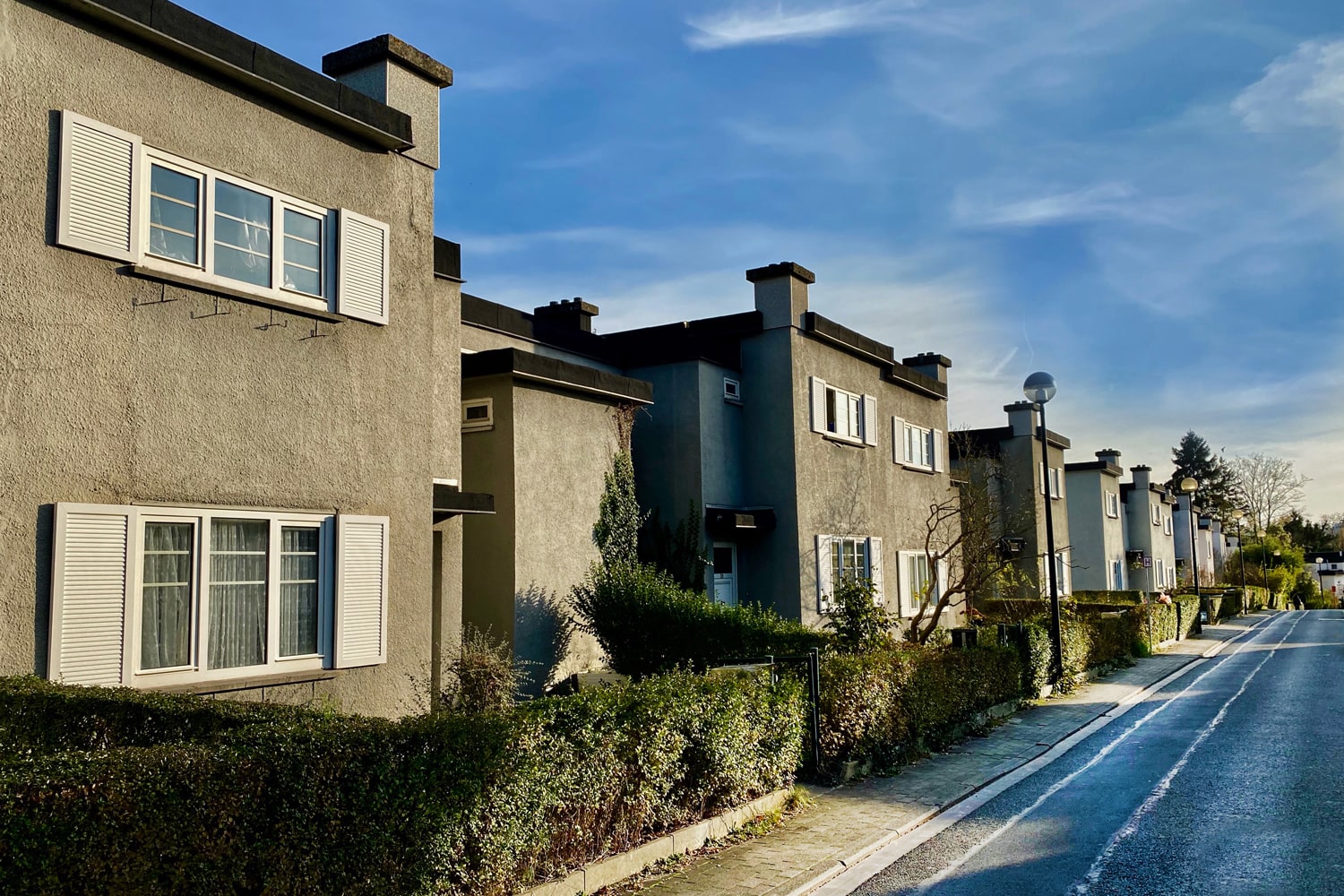
Garden city, Kapelleveld, in Woluwe Saint Lambert in Brussels, by Antoine Pompe
A tour of the battlefield today shows a remarkable state of preservation. Hoste’s cubes occupy the centre of Kapelleveld in streets at right angles to the central thoroughfare, their horizontality marked out by flat porches, roofs and chimney-tops trimmed in black. Flanking them are Pompe’s two districts with semi-detached houses sometimes in pairs, sometimes in groups of four.
Many facades have been reclad, and panels once picked out with bold chevrons, a signature of the architect, have been whitewashed. But the expressionist effect of the distended gables, the subtle prow form of the projecting towers rising high above the plunging roofline preserves much of Pompe’s alternative vision for modern architecture.
Kapelleveld, aimed at the modest and more numerous bourgeoisie, would be Pompe’s final large-scale undertaking. It led to no new orders of a public nature, the prerequisite for building up a large practice amid interwar austerity and the eclipse of the luxury rentier townhouse. During the project in 1925, he had demonstrated his versatility (while remaining true to his ethos of reason and sentiment) with a state-of-the-art annexe in a backstreet for a clinic in the Squares District, brutal and verging on brutalism.
A vast cube banded with raw, geometric concrete at its basement and on the lower rim of its jettied top floor, this modernist reimagining of the castle keep is a protected monument. It must be the most prestigious rear extension in Belgium. But in his writings, and well out of step with his peers, Pompe maintained the vision of modern domestic architecture he had delivered for Kapelleveld.
With no new major orders on the horizon, Pompe would rely on teaching for income, accepting a founding professorship at Henry Van De Velde’s new decorative arts school now known as La Cambre.
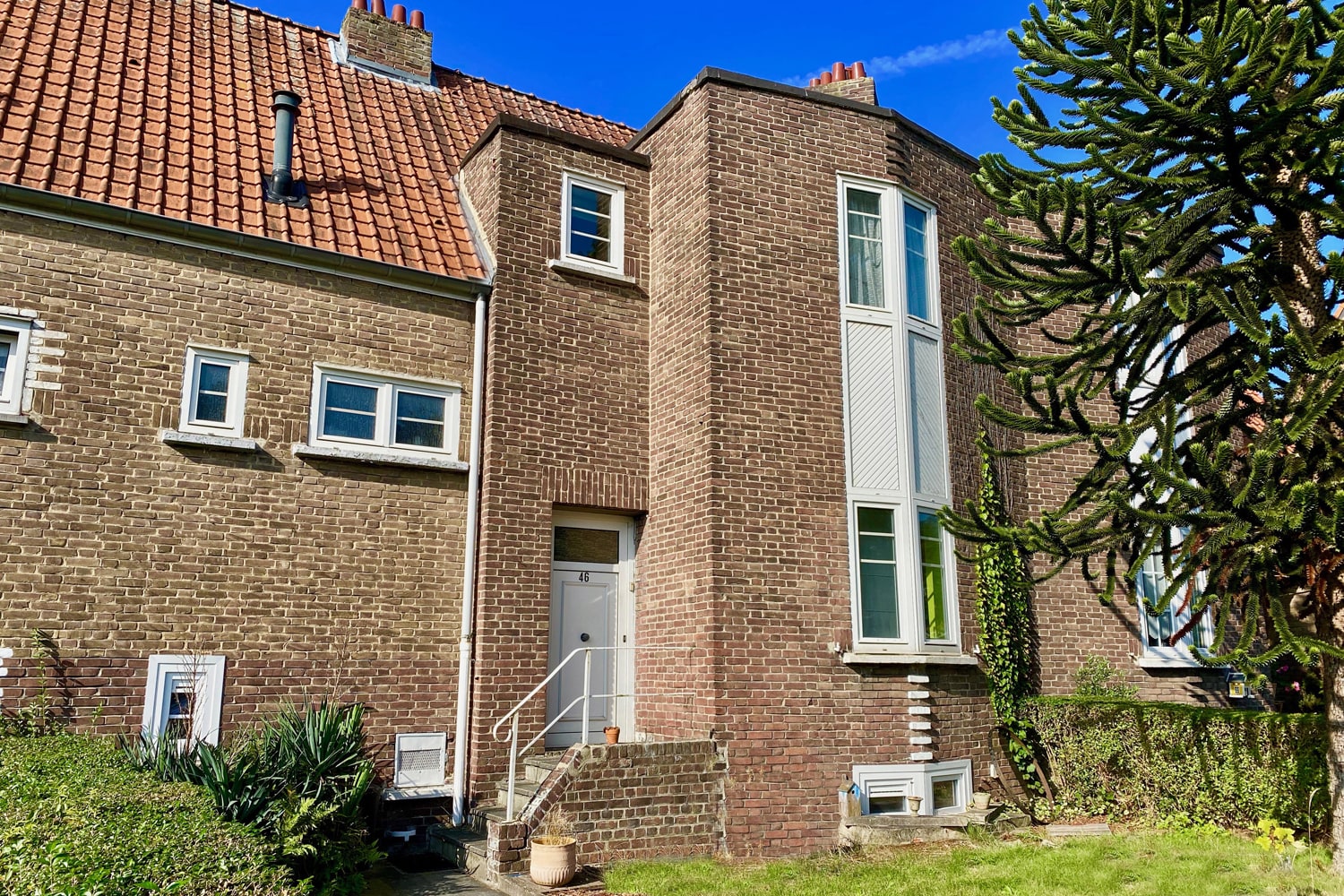
Another house in Kapelleveld in Woluwe Saint-Lambert in Brussels
Obscurity
In June 1928, the Congrès Internationaux d'Architecture Moderne (International Congresses of Modern Architecture - CIAM) was launched by Le Corbusier in Switzerland. Huib Hoste was a founding member alongside dozens of modernists from across the world. The lobbying juggernaut of CIAM would shape the homes, workplaces and wider infrastructure of postwar cities along functionalist lines for the coming three decades almost unopposed.
But Antoine Pompe opposed it. For him, architecture was an art to be placed alongside music, painting and sculpture “and art is a matter of sentiment” where monetary value could only be assessed by including its psychic contribution to wellbeing, to Gemütlichkeit. He mocked those detecting any artistry in the homes created through CIAM’s orthodoxy as believing in “techno-socioeconomic poetry”. His criticism would become even more radical after his forced retirement in 1939.
While the First World War saw him imagining his ideal home, the Second World War was spent seething about the wrong-headed idealism of his CIAM colleagues. Pompe wrote an angry, satirical essay, “The ‘Super-Man’ or The Man of Tomorrow’”, where he warns of the logical consequences of a defective vision of modernism (i.e. not his vision).
A modernist purist arrives in heaven and gives God notes on how to perfect the design of man himself. Pompe drew the resulting ‘Super-Man’ as a mutated Narcissus, a monstrous humanoid with webbed feet and a long tail, which gazes down a long trunk into its reflection in a puddle. Following the advice of friends, Pompe didn’t publish the work.
Busying himself with inventions (a hybrid bicycle on skates and a folding chair), Pompe would close his career as an architect in 1949 with a house in Ganshoren for the journalist son of his first client, Dr Van Neck, entering a long period of obscurity.
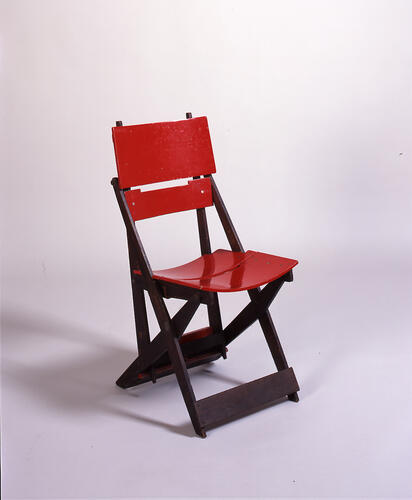
Antoine's Pomp design for a chair
Act Two: The Brussels compromise
In 1968, a young architect called Maurice Culot was back in Brussels after a long stay in the US, where he had interned at the Frank Lloyd Wright practice and then built himself a concrete house in the Arizona desert. He and his painter wife, Kris van de Giessen, rented a modernist artist's studio in Ixelles, built in 1930 by Fernand Bodson. In the basement, Culot found striking plans dated 1917 for a never-built Maison du Peuple for Liège. They were signed by Bodson and his business partner of the time, Antoine Pompe.
Culot, then completing his urbanism training at La Cambre where Pompe had taught in the 1930s, looked up the retired architect, by then 95, in the phone book and called him. The two began a friendship that would change Culot’s life: “I unearthed a forgotten chapter of the history of architecture in Belgium,” Culot wrote. It was a world of early modernist design that the young architect would champion, helping to redraw the landscape of heritage and architectural taste in Brussels.
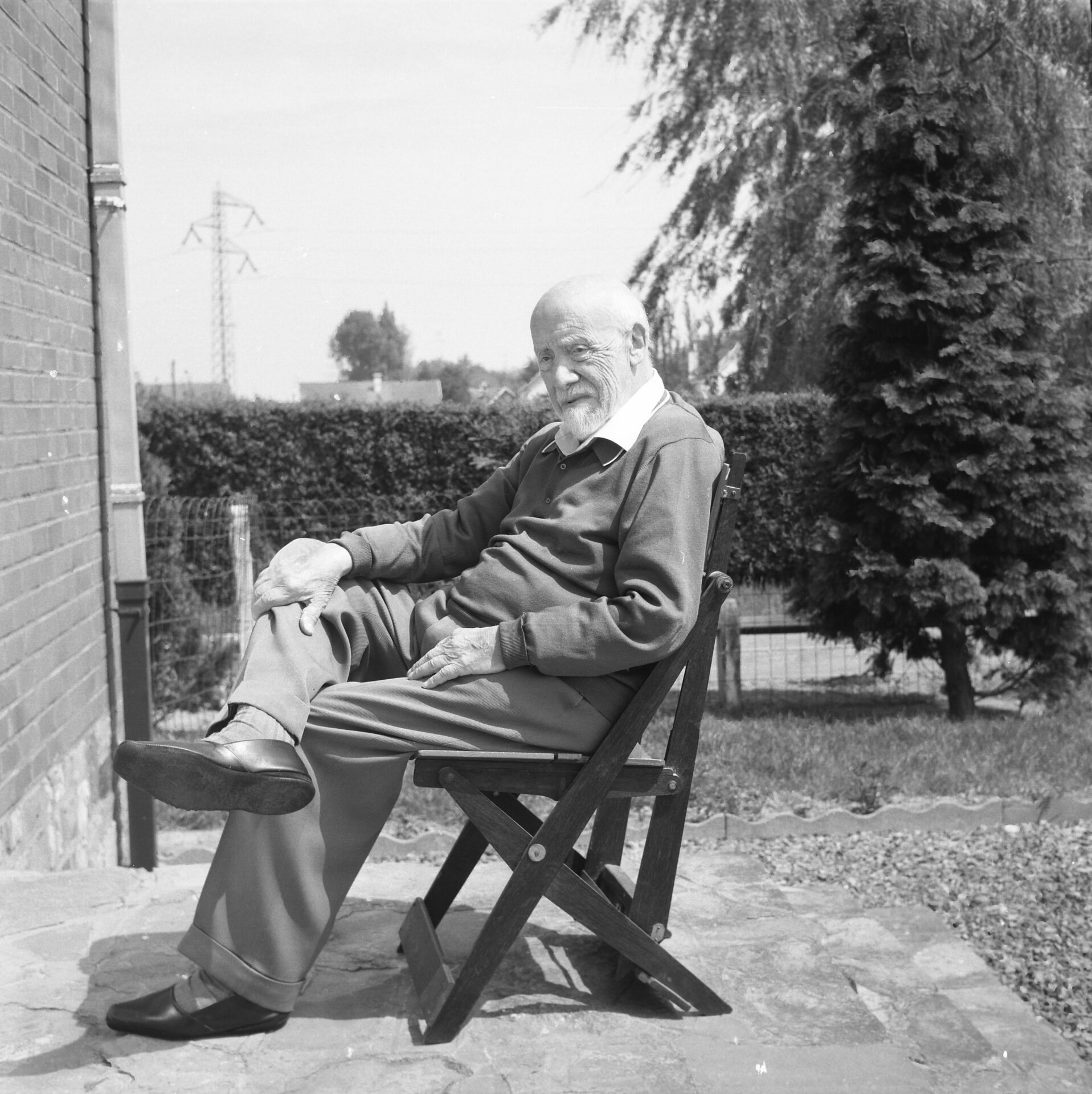
Antoine Pompe in his later years
The year 1968 was also marked by a new show at the Palais du Centenaire exhibition centre, presenting projects underway and planned for the radical transformation of Brussels, the culmination of a process now referred to as Brusselization. People would attend the Bruxelles 85 event and ask hostesses to be pointed to the maquette of their street to know if their home was to be razed. If they lived in the North Quarter, target of the notorious Manhattan project, it was likely it would.
Born in 1939, Culot was of the generation that, in its teens, had seen the city’s elegant boulevards torn up for the new road tunnels ahead of the 1958 Exposition, and in its mid-20s, the demolition of Horta’s Art Nouveau masterpiece, the Maison du Peuple. Incensed by the destructive manifesto of Bruxelles 85 and, along with classmate François Terlinden, Culot drew on his discussions with Pompe to organise an alternative exhibition to demonstrate the potential for a more human vision of modernity from that forgotten period.
Antoine Pompe et l’Effort Moderne en Belgique (The Push For Modernity) opened at the Ixelles Museum in 1969. Introducing the book of the show, the two men explained that it was to be "free of nostalgia or worship of the past, aims to be both a reference point from which to better judge the present and a stimulus to bring about what we lack today more than ever: a Public Spirit in architecture."
Older witnesses helped them resurrect that past of 1890-1940: Pierre Bourgeois, poet brother of architect Victor, and architect and writer Pierre Puttemans contributed chapters.
There were 44 mini portraits of often-neglected architects included in the exhibition, from productive names of the Art Nouveau period such as Georges Hobé, Ernest Blérot, Paul Hamesse and sgraffito specialist Paul Cauchie through modernists including Hoste and Victor Bourgeois (a CIAM member and admirer of Pompe nonetheless). Collectively, their work was an open-air museum to the excellence of early Belgian modernism, whose output was still scattered across the country, especially the capital, but was poorly documented and at constant risk of demolition.
Street fighting men
After the show ended, Culot and Terlinden were left with plans lent by elderly architects and families who wanted to know what to do with them. Inspired by the archive he’d seen at the FLW Foundation, Culot decided to create a new institution for Brussels architecture and gather even more.
The Archives d’Architecture Moderne (AAM) would “save the archives left by the architects of the late 19th and 20th centuries from destruction” and “be the keeper of the flame of the architecture of that period, making it accessible to non-specialised readers and inspiring new careers”.
Based initially at Culot’s rental house, it later moved next door to a former masonic lodge also by Bodson. AAM created a publishing house to promote its activities. Soon it would take on a third role as campaigner, recruiting students from the Cambre school to create counter-projects to those it regarded as vandalism.
Outrage at demolitions underway in Brussels since the run-up to the 1958 exhibition approached boiling point after the replacement of the Maison du Peuple by a spartan tower for the concrete company Blaton in 1965. Bruxelles 85 had laid out the plans of the Belgian state and the communes of Brussels to complete the conversion of the city for the convenience of fast car travel and office work.
Its opponents were growing in number but lacked focus. The 1968 protests in Paris against the top-down decision-making of an establishment that always knows best helped concentrate minds. Inspired by Pompe’s non-conformism, AAM prepared to take up arms against Brusselization.
A new battlefield
Four decades after Kapelleveld, a new clash between the forces of functionalism and of sentiment took place on another Brussels hillside, this time in the centre of the city. On May 8, 1969, a press conference was held at mythic café La Mort Subite to publicise opposition to the city's plans for the nearby Carrefour de l'Europe.
This site, 350m wide and 200m deep, stretched from the doors of Central Station to the entrance of the Galeries Saint Hubert. It had remained unbuilt for six decades since work on the north-south rail junction had devastated central Brussels, erasing the ancient Putterie quarter.
Long since given over to parking, the city aimed to enclose the cars in a vast flattened concrete box hammered into the slope with a public space on top of the plinth. This meant strollers leaving the Grand-Place would be faced with a high, blind wall they could skirt to go left to the cathedral or right to the Mont des Arts. A new fast road encircling the ancient core of Brussels would serve the site.
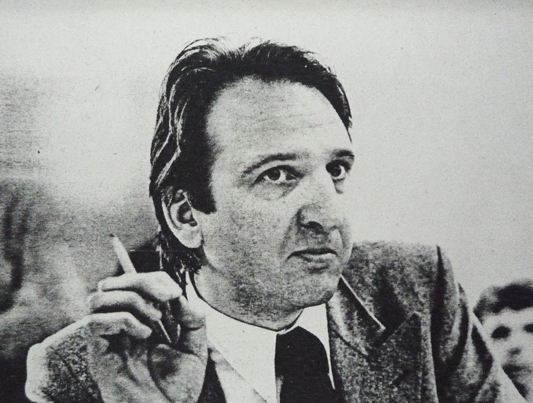
Belgian architect Maurice Culot in 1980
It was a new citizen pressure group called ARAU (Atelier de Recherche et d’Action Urbaines - The Urban Action and Research Workshop), founded by sociologist Rene Schoonbroodt, that faced the journalists, alerting them to this new threat to Brussels heritage. They were joined by AAM’s founder Maurice Culot, bringing name recognition thanks to the prize-winning Pompe exhibition and, as a qualified urbanist, professionalism.
Their performance won them an audience at the Brussels Hôtel de Ville with Paul Vanden Boeynants, a former Prime Minister known by his initials VDB and then in charge of planning in the city. Along with property developer Charly De Pauw, VDB was the driving force behind the infamous Manhattan Plan to destroy the North Quarter of Brussels, replacing it with autoroutes and towers raised on plinths. De Pauw, a parking specialist, was also behind the Carrefour de l’Europe proposals.
Eyeing them across his magnificent office, VDB told the two young men not to bother the press in future and come to him for a quiet word (decades later, Culot would recall the Frank Capra film It's a Wonderful Life in which the idealistic George Bailey saves Bedford Falls from the dystopian vision of aged and manipulative power broker Mr Potter as a key inspiration for his activism). They resolved to always bother the press in future.
After bemoaning the lack of positivity among the youth, VDB was impressed to be presented with ARAU’s alternative plan for Carrefour de l’Europe. This aimed to recreate the streets erased decades before with housing and shops in an architecture in sympathy with the neighbouring quarter of the Ilot Sacré, protected by the city since the 1950s.
The plans were halted pending a competition for a new scheme and, a novelty, a public consultation. What wasn’t a novelty was the additional two-decade wait until the city made a decision on the vacant site and the traditional Brussels compromise that emerged.
At the end of the 1920s, Pompe had been a lone voice against functionalism. By 1969, a crowd had assembled and, thanks in part to his rediscovery, its voices united in opposition to more concrete and faster roads. Pompe himself would play a cameo role in the debate, becoming something of a media star in his late 90s.
Newspapers would pick him up from his care home, poignantly called ‘Mon Rêve”, and photograph him in the Brusselized city, cutting a Professor Calculus figure in his antiquated hat and overcoat, cane in hand. The “nightmare” of central Brussels made him feel “like a man drunk”, he said. Residential towers were “the invention of the devil to punish humanity for its sins”.
Pyrrhic victory
Design by committee can be unsatisfactory and crowd-pleasing is hard. Widening the decision-making process to include that crowd resulted in a somewhat pyrrhic victory at the Carrefour de l’Europe, which was finally completed in the 1990s, and in questionable taste.
Now the largest postmodern campus in central Brussels, it is another open-air laboratory of what you do when you don't do modernism anymore, but you still need modern functions such as lifts, car parks and fire safety.
Ambiguous wording in the city’s redrawn masterplan allowed hotels to qualify as housing: three sit on the square at the entrance to the Galeries Saint Hubert in what Le Soir called a ‘neo-Spanish nothingness” style; a third is opposite the entrance to Central Station, a semi-circle with a lip-service classical frontage (and pierced with a mean, low and narrow pedestrian underpass marginally enlivened by a ceiling decorated with Smurfs and which is now the gateway to the old city for those arriving by train).
Just 30 (luxury) apartments were created, between Rue de la Montagne and Boulevard de l’Impératrice, and despite dutiful crow-step gables as a nod to the historic neighbourhood, their overall impact is that of the suburban North American retail development.
Schoonbroodt called the city’s conversion to an insistence on the reproduction of old architecture “simple good sense”, adding: “Imagine what contemporary architecture would have looked like.”
A tribune in Le Soir called the result “a Disneyland-style hymn to the glory of imitation,” but a reporter observed that tourists took snaps of the hotels under construction, taking them for ancient buildings under renovation.
Monuments
Eight of Pompe’s many buildings are now protected monuments, including his own home in Rue du Châtelain, where he had listened to the sound of German cannons during the First World War alongside his (German) mother-in-law and planned his dream home.
On the cusp of retirement in 1937 and with no money for such fantasies, he began converting the humdrum neoclassical box to suit his vision of modernism. Recycling and resizing its parts, Pompe sliced the defunct verticality of late 19th-century bourgeois aspiration into more rational layers, replacing wasteful high ceilings with horizontal spaces for intimacy, for Gemütlichkeit.
A recent addition to the list of Antoine Pompe monuments is the 1923 Vandevelde House on Avenue Jacques Sermon, in the shadow of the Koekelberg basilica and built for a coal entrepreneur. Injecting an avant-garde Belgian vision of recumbent English stockbroker Tudor ease within an otherwise vertical neighbourhood, it has been protected since 2015.
Pompe called this building the proud synthesis of his personal vision. Nestling like swallows’ nests beside the half-timbered bow window are carved busts of Martians he designed after reading War of the Worlds. H.G. Wells’ vision of aliens blasting a comfortable London suburb into rubble must have entranced Pompe. The Martian heads were later reproduced for his own sitting room in Ixelles.
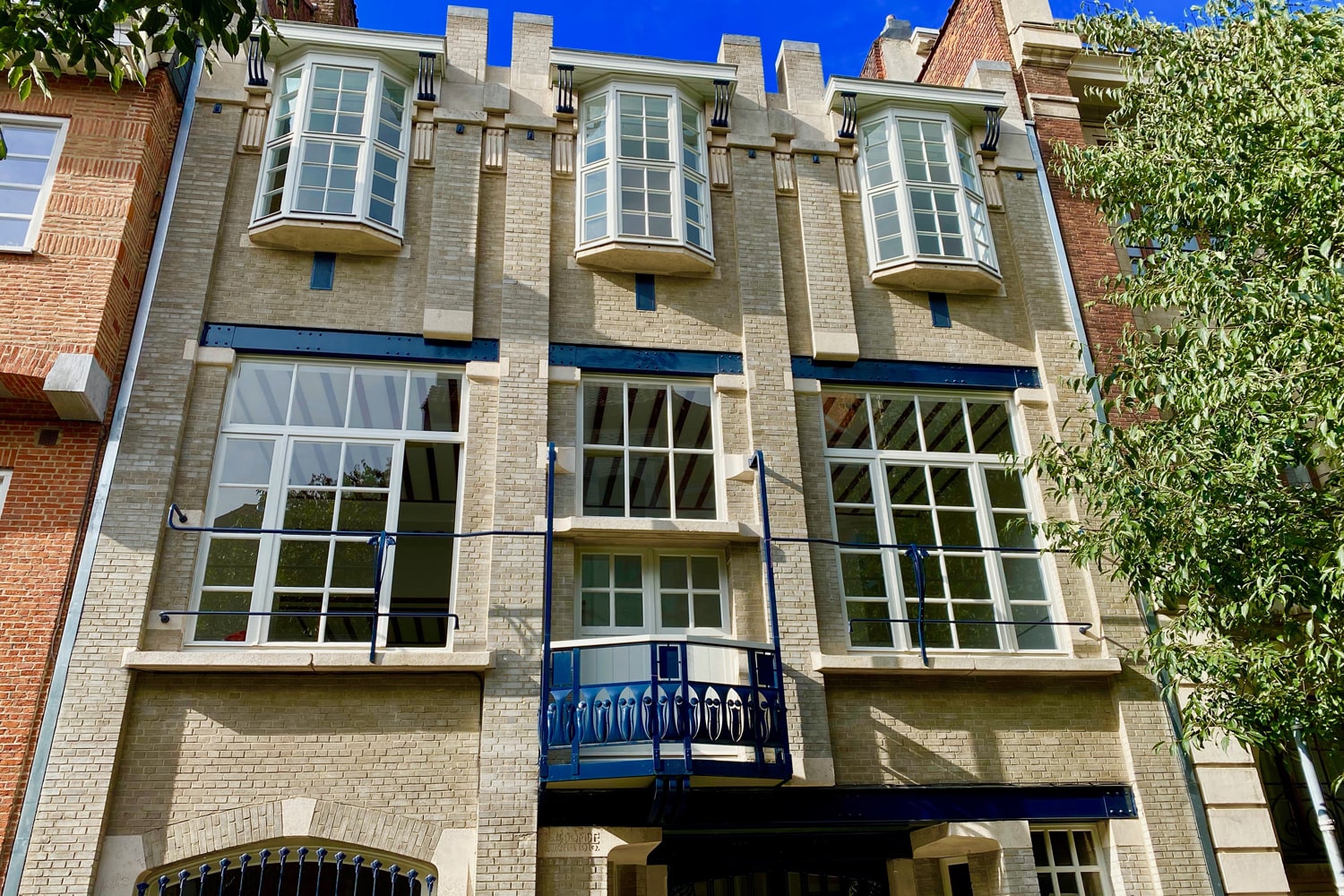
Clinique du Docteur Van Neck by Antoine Pompe
The most important Antoine Pompe monument, however, is the legacy of his rediscovery. His papers were the founding texts of AAM. The 1969 exhibition centred on his work was the spark that lit the fuse that would bring about the creation of ARAU, soon followed by the Inter-Environnement Bruxelles (IEB) federation of pressure groups and the principle of Brussels citizen participation, enshrined in 1989 by the creation of a directly elected parliament for the region.
Since 2016, AAM has been part of CIVA, located in a converted electricity plant between the Bodson house, once rented by Culot, and the home of Georges Hobé, at whose practice Pompe and Bodson met.
From a Brussels dialogue across time between a young activist and a nonagenarian architect, a world-class institution has emerged, broadening that dialogue out to plumb an ecosystem that encompasses architecture, urban landscapes and the global culture that inhabits them.
CIVA closed at the end of 2025 and will return later this year as Kanal Architecture, taking its new name from the Brussels modern art museum nearing completion at the former Citroen Belgium HQ from 1934, a vast beacon of Brussels rationalist modernism. The inauguration will be on November 28, unless one of those iconic Brussels delays intervenes.
Epitaph
In 1974, another exhibition opened at the Museum of Ixelles, this time dedicated to Pompe alone. A TV crew interviewed him as he toured his life’s work. By then aged 103, he let fly at his more famous peers, all safely in their graves.
Victor Horta was “an artist, a draughtsman but not what I'd call an architect,” and Henry Van de Velde, who had given him the job at La Cambre that saw him through to angry retirement, was “neither a draughtsman nor an architect”.
Paul Hankar, who had had the grace to die young, was spared. “He was my real master.” As the last man standing of his generation, Pompe, long silenced, was able to deliver his own epitaph: “I am a rational sentimentalist”. Gazing around at his designs gathered together, Pompe wiped away a tear and said, “I am satisfied with myself.”
