

A record number of children in Belgium were victims of grooming and online sexual exploitation last year, according to the Belgian child protection agency Child Focus. The group is calling for more protective EU legislation.
In the last three years, the cases of sexual abuse and exploitation more than doubled, with a total of 837 new cases opened in 2025, the agency noted in its annual report published on Monday.
“Digital developments offer enormous opportunities for children and young people. To connect, to find out about things and to relax. But there are also risks lurking around the corner,” warned Child Focus’ CEO Nel Broothaerts.
While the role of social media platforms remains a key issue for Child Focus, there is a growing concern regarding the use of artificial intelligence (AI) to generate child sexual abuse material (CSAM), according to Child Focus’ spokesperson Selyna Ayuso Ferrandiz.
Record number of grooming victims
Last year, the child protection agency said it opened a "grim record" number of grooming cases in Belgium.
Grooming refers to when an adult deliberately interacts with a minor for sexual purposes. This can involve attempts to establish a relationship of trust with a minor with the intention of sexually abusing them.
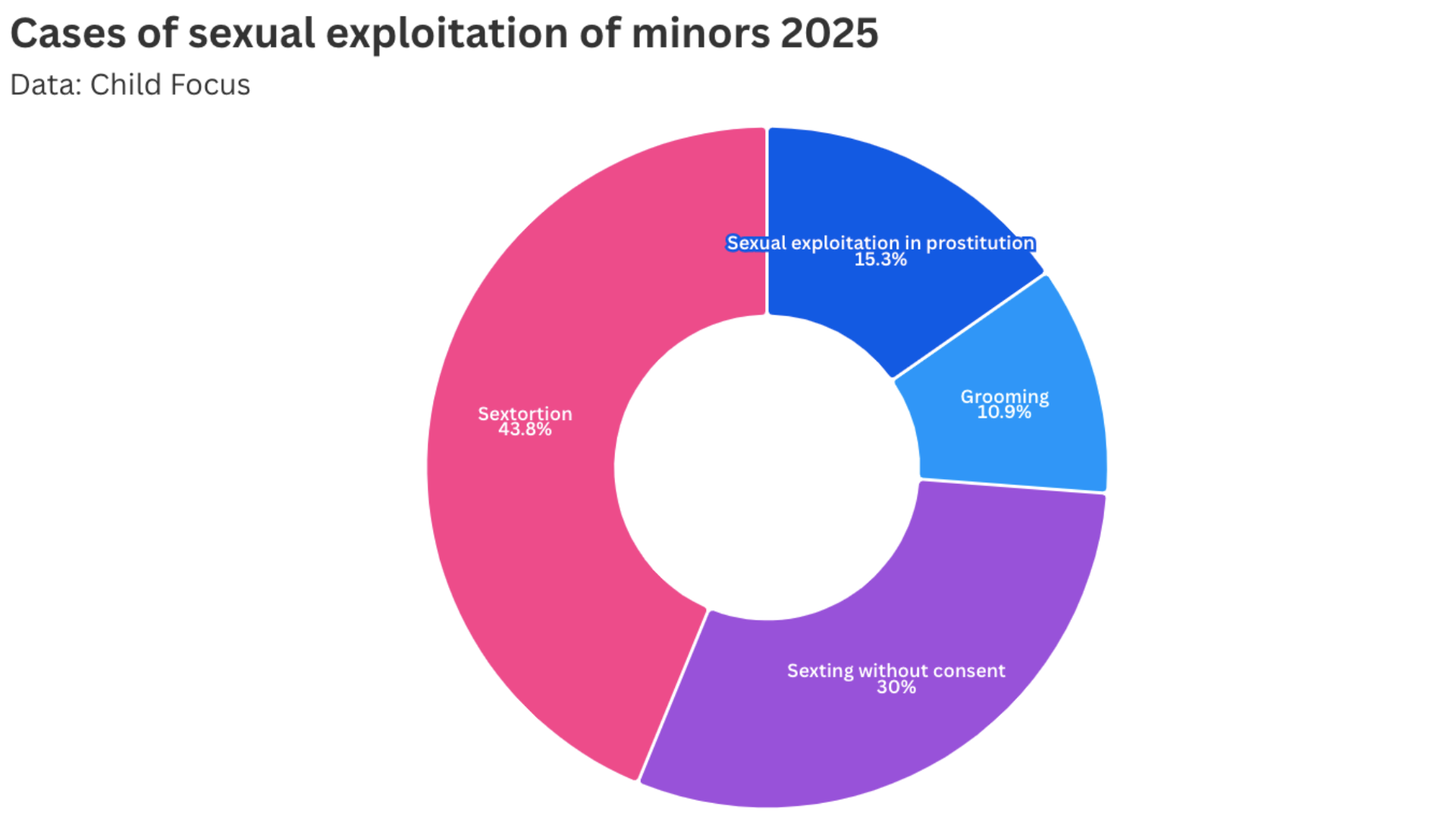
In 2025, 108 new grooming cases were opened by Child Focus, a sharp increase from the 43 cases registered in 2024. Victims of grooming last year were on average 13 years old, 74% of whom were girls.
Similarly, young girls were victims in 74% of non-consensual sexting cases in 2025. This is when intimate images are shared without the consent of the person in the image or when unwanted sexual images are received.
Child Focus received 296 new reports of non-consensual sexting in 2025, a 30% increase compared to 2024. The victims were 14 years old on average.
AI images to extort minors
Child Focus opened 27 cases last year related to the use of AI-generated explicit images.
While the fake images alone can impact victims as much as real images, in some cases, the AI-generated material is also used to extort money from victims or to pressure them to send intimate photos, Ferrandiz told The Brussels Times.
This type of extortion is referred to as "sextortion". In typical sextortion cases, victims are befriended by a perpetrator online, who then persuades them to send intimate images. The person then threatens to make the images public unless the victim pays them or sends them more child abuse content.
According to Ferrandiz, AI child abuse images are used not only to threaten victims, but also to create fake online profiles to more easily target minors.
Data: Child Focus 2025 report
Last year, Child Focus saw an “exponential growth” in sextortion cases, with 433 new victims reported, a 143% increase compared to 2024.
In 92% of the 2025 cases of financial sextortion, the victims were young boys, who on average were 15 years old. This surge in male victims of sextortion means that the majority of victims of online sexual exploitation cases last year were young boys.
Beyond the digital world, the agency warned of a 60% increase in sexual exploitation cases last year compared to 2024. This refers to when a minor is forced to perform a sexual act in exchange for something, such as money, accommodation, drugs or gifts. In the majority of these cases, victims lived in a care home.
Additionally, the report outlined that unaccompanied minors are particularly vulnerable to violence and exploitation. Last year, Child Focus had 359 cases of missing unaccompanied minors.
Accountability and helplines
Amid the rising online exploitation cases of minors in Belgium, Child Focus is advocating for tech giants to be held accountable and made responsible for protecting minors who use their platforms, including social media.
The Belgian agency noted that this can already be achieved if there is a “strict enforcement” of the existing EU Digital Services Act (DSA).
Additionally, Child Focus is calling for the development of the permanent Child Sexual Abuse (CSA) Regulation, to ensure the content minors can access online is tailored to their age and prevent child abuse material from being shared online.
The agency further urged members of the general public to report any image of child sexual abuse they encounter online via the Child Focus online platform.
The free emergency helpline 116 000 is also available to report sexual exploitation or a missing child case.
