
Belgians do not watch enough Belgian-made films, according to the head of the agency responsible for international promotion of films and TV programmes produced in Brussels and Wallonia.
While Belgium often enjoys a strong profile abroad thanks to home-grown award-winning film-makers such as the Dardenne brothers, Lukas Dhont and Michaël R. Roskam, it seems they are appreciated less by audiences in their own country than those elsewhere.
Speaking to The Brussels Times at the Cannes Film Festival market, Hervé Le Phuez, director of wbimages (Wallonie-Bruxelles Images), admits he cannot explain why local audiences are not flocking to see high quality films made on their doorstep.
“Every year we have the same discussion but it’s hard to say why people ignore locally-made films,” he says.
Figures published by the Brussels-based International Union of Cinemas (UNIC) prove his point. In 2025, Belgium-made films accounted for only 5.6% of the national box office. In contrast, the share of national films in Czechia, which has a similar population to Belgium, was 27%.
There are nuances behind the statistics, however. For example, French-made films, backed with hefty subsidies and bigger marketing budgets, are popular in French-speaking Belgium. The same can be said to some extent about Dutch-made films and audiences in Flanders. In general, the public also prefers Hollywood blockbusters to art-house movies.
“In Belgium, we mainly produce art-house movies and it’s difficult to get people to discover them. We would like to see more curiosity among Belgians to see their own movies,” says Le Phuez.
Michiel Blanchart’s 2024 thriller La nuit se traîne (Night Call), filmed in Brussels, bucked the trend and was especially popular with younger cinemagoers. “This was a big success. It was not a typical art-house movie so it attracted a different audience,” he adds.
New Belgian films generating a buzz
Le Phuez has high hopes for two new films set in the Second World War.
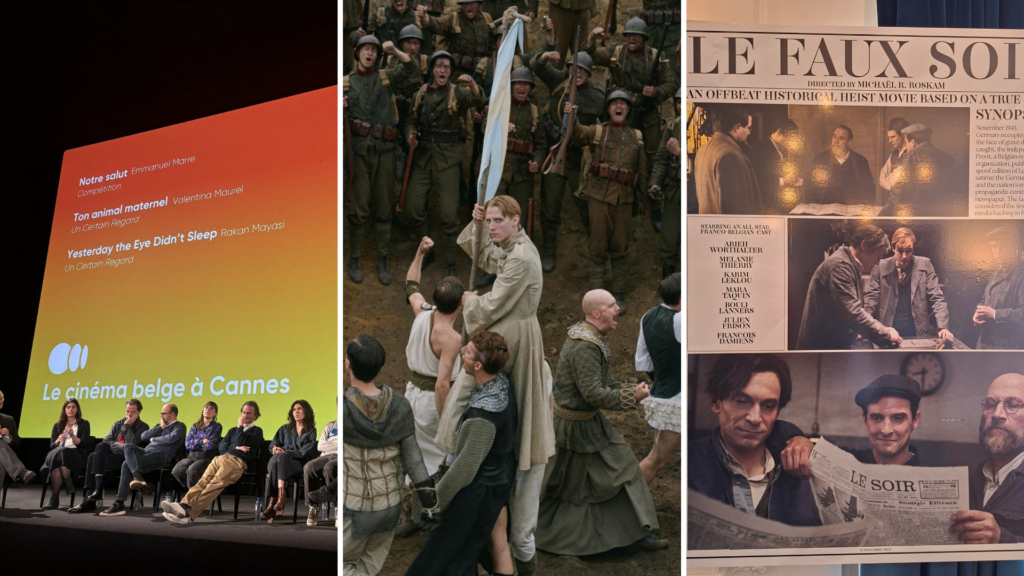
Notre Salut by Emmanuel Marre, which screened in the official competition at Cannes this week, is set in Vichy France and stars Uccle-born actress Sandrine Blancke. Le Faux Soir, the forthcoming film from Michaël R. Roskam, is set in Brussels in 1943. It tells the story of a group of Belgian Resistance fighters who produce a spoof edition of Le Soir to undermine the real newspaper, then subject to censorship and under German control during the Occupation.
Billed as “an offbeat historical heist movie based on a true story”, it features an all-star Franco-Belgian cast including Arieh Worthalter, Mélanie Thierry and Liège legend Bouli Lanners. Backed by Goodfellas, the renowned Paris-based film sales company, it is attracting significant interest at the festival.
Le Phuez’s counterpart, Jasper Nijsmans, head of promotion for Flanders Image, is similarly optimistic about several new titles.
Lukas Dhont’s “Coward”, set in Belgium during the First World War, receives its much anticipated Cannes premiere tonight (21 May) and is viewed as a top contender for the Palme d’Or.
But Nijsmans is already looking ahead to films that are in post-production, in particular Let Love In by Ghent’s Felix van Groeningen. “He’s directing it with his partner and co-scriptwriter Charlotte Vandermeersch, who is in the lead role, together with Luca Marinelli, who was the lead in van Groeningen’s last film, The Eight Mountains.”
Named after a Nick Cave song, Let Love In focuses on a couple forced to question everything they took for granted when a long-hidden affair comes to light.
“It’s actually a film about van Groeningen’s relationship with Vandermeersch, albeit semi-fictionalised. We have big expections for it and are looking for a good location for the world premiere,” adds Nijsmans.
Also attracting a lot of attention is Heysel 85 by Belgium-based Romanian director Teodora Ana Mihai. It takes place against the backdrop of the disaster at Belgium’s national football stadium in which 39 mostly Italian spectators lost their lives when a wall collapsed before the 1985 European Cup Final between Liverpool and Juventus.
“It’s a fictionalised account based on what happened,” says Nijsmans. “You don’t actually see the disaster but rather how events are unfolding in the catacombs under the stadium and the chain of events that ultimately lead to the decision to still play the match [which Juventus won 1-0].
“The film has done very well since it was screened, out of competition, at the Berlinale. So far, it has sold in more than 40 countries and it is still selling.”
In the film, Flemish actress Violet Braeckman portrays the mayor's daughter Marie and Hasselt-born Matteo Simoni plays a journalist, Luca. Heysel 85 is set to hit Belgian cinemas in November.
'Zapper Bolloré' campaign
Belgian film producer Jacques-Henri Bronckart has come out in support of a petition by 1,600 cinema industry figures against Vincent Bolloré, the controversial right-wing billionaire media magnate who owns France’s biggest film producer Canal+, TV channel CNews and radio station Europe 1.
The petition, whose signatories include actresses Juliette Binoche and Adèle Haenel, sparked a huge row at the festival when Maxime Saada, Canal+ chief executive, said the company would not work in future with anyone backing the so-called “Zapper Bolloré” campaign. Bronckart, who was present at a producers’ brunch where Saada made the threat, described the reaction as “rather bloody”.
Canal+ holds a major stake in France’s third-largest cinema chain UGC and plans to take full control by 2028. UGC has multiplex cinemas in Brussels, Antwerp, Mechelen, Turnhout, Aarschot and Lommel in Belgium.
