
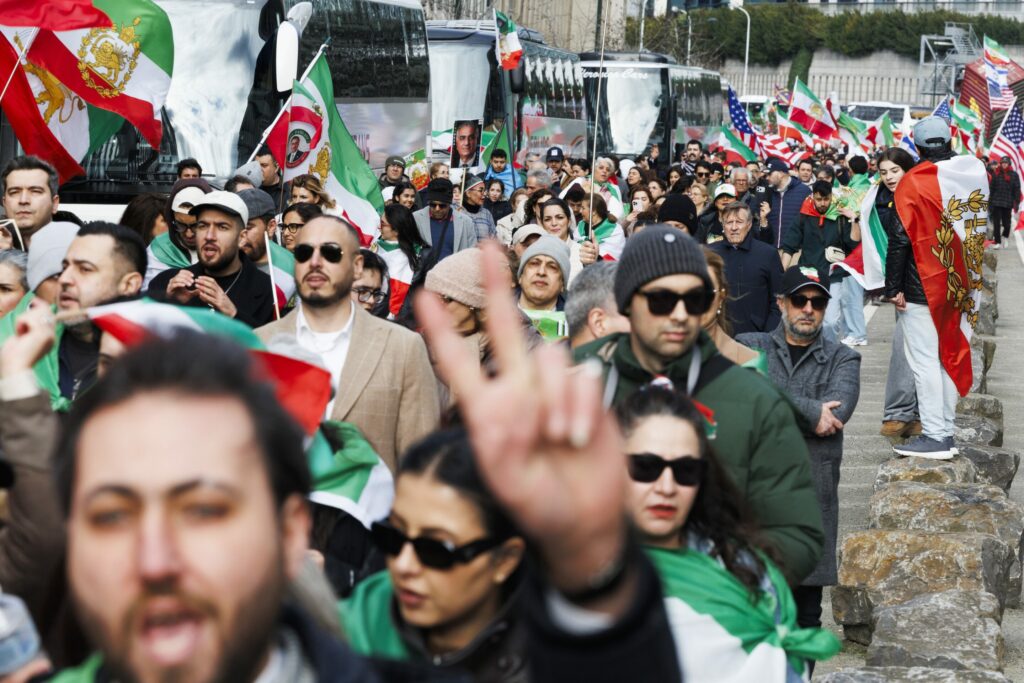
Belgium is doing far too little to stand up to the regime in Iran amid the largest mass murder of protestors in its history, according to a leading dissident based in Brussels.
Ali Bagheri, Secretary of the Iranian Youth Communities in Belgium, says Bart De Wever’s government has been “mostly silent” or too ready to appease the authoritarian leadership in Tehran.
The 36-year-old research engineer, who has lived in Belgium since 2015, told The Brussels Times that a spike in executions of political prisoners, predominantly young people who took part in widespread protests in December and January, is deeply concerning.
“We’re receiving news of executions every day. We’re talking about 19, 20 and 21 year olds. Others are on death row,” he said. “The regime has used the war with the US and Israel as a cover for this.”
According to Amnesty International, Iran executed at least 2,159 people last year, more than double the 2024 figure, and the death toll shows no sign of abating.
Bagheri said he had raised the surge in executions with Maxime Prévot, Belgium’s Deputy Prime Minister and Minister of Foreign Affairs, but it had taken quite some time before he received a reply. “It was a general condemnation but proposed no concrete action. As with other European countries, Belgium has been totally sidelined. Its silence is the policy of appeasement.”

Iranian dissident Ali Bagheri
Born and raised in Malayer, a small city 400km south-west of Tehran, Bagheri came to Belgium in 2015 to study for a doctorate at the University of Mons and works at Cenaero, an aeronautical engineering research centre in Charleroi.
His parents followed him to Belgium in 2018. “My aunts, uncles and cousins are still in Iran,” he added.
This morning, together with other young dissidents from Germany and the UK, Bagheri is holding a media conference at the Thon Hotel EU in Brussels to present the latest information about the spate of politically-motivated executions – and protest against the inaction of Belgium and other European governments.
Smuggled videos
They will show videos secretly smuggled out of Iranian prisons, including messages and footage from victims. A significant number were members of the People’s Mojahedin Organization of Iran (PMOI/MEK).
“Unfortunately, for decades, the policy towards Iran at national and EU level has been shaped by economic interests and a misguided strategic approach,” continued Bagheri.
“As a result, human rights have not been a central pillar in policy. This has been exploited by the regime and is ultimately detrimental for the Iranian people, their aspirations for human rights and democracy. The solution is neither appeasement nor foreign war, but rather regime change by the people.”
Maryam Rajavi, head of the democratic opposition, the National Council of Resistance of Iran (NCRI), has set out a 10-point action plan based on a rejection of both the Shah’s dictatorship and the mullahs’ theocracy.
“This provides for a free, democratic, secular, and non-nuclear Iran, separation of religion and state, gender equality, total freedom, and the abolition of the death penalty. This is the only way forward for us,” he said.
While strongly critical of Belgium and other national governments, Bagheri applauded the European Parliament for its tougher stance towards the regime.
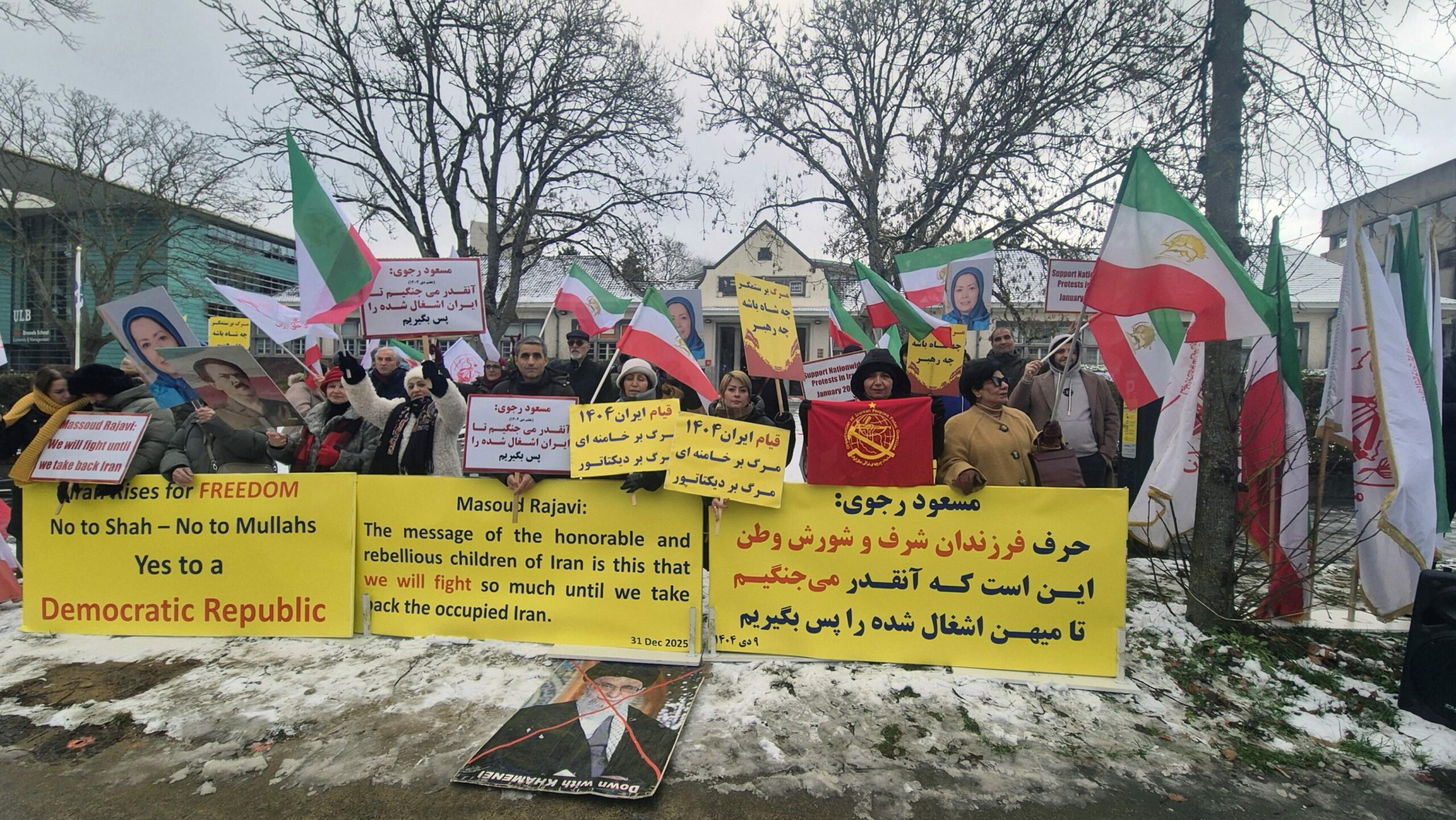
A demonstration held by the Iranian diaspora in solidarity with the national protests and strikes currently taking place in Iran, Saturday 03 January 2026 at the Iran embassy in Brussels. Credit : Belga/Timon Romboeur
In a resolution overwhelmingly adopted on 21 May, the assembly called for the EU to expand sanctions against Iranian officials responsible for repression, including the Islamic Revolutionary Guard Corps (IRGC) and entities linked to the Supreme Leader. IRGC members and their families should be banned from entering the EU, the MEPs said.
Condemning the use of the death penalty to stifle political mobilisation, they also called on European countries to close Iranian diplomatic missions and ensure safe and secure internet access for Iranians following shutdowns.
Tit-for-tat strikes
The US and Israel launched strikes on Iran on 28 February, during negotiations between Washington and Tehran. Seven weeks ago, on 8 April, a pause in fighting was agreed to allow further talks but Iranian and US forces have continued to carry out tit-for-tat strikes. While these are seen by experts as part of the negotiation process, they threaten a permanent breakdown in the fragile truce.
Iran controls the critical Strait of Hormuz, through which 20 per cent of the world’s oil and natural gas supplies are shipped, while US forces are blockading Iranian ports. At a cabinet meeting at the White House on Wednesday, President Trump said he was “not satisfied” with Iranian proposals to end the current impasse and reiterated his threat to “finish them off” if there was no breakthrough.
Bagheri, however, remains hopeful for the long-term.
“Amid all the uncertainty and global developments, the Iranian people will continue their struggle for freedom until they establish a democratic republic,” he declared.
On 20 June, the Iranian Youth Communities in Belgium, along with their counterparts in other European countries, will join what is expected to be a 200,000-strong demonstration in Paris.
