
Belgium will get a new motorway code in June 2027, with adjusted traffic rules and new traffic signs for the entire country. So, what is new?
Well, the country's current motorway code is about 50 years old. It has been amended more than 100 times, with numerous provisions that have now become outdated.
However, as people are no longer getting around the country in the same way they did half a century ago, this reform adapts to "new habits" and gives everyone "a fairer place" on public roads.
The measure is part of the new Motorway Code, which will take effect next year. It was announced in late 2023, and signed in June 2024 by the King and then-Federal Mobility Minister Georges Gilkinet (Ecolo).
Credit: Belga/Nicolas Maeterlinck
Originally, the new rules were supposed to take effect in autumn 2025, but implementation was postponed until 1 June 2027.
For almost 20 years, Belgium's three regions (Flanders, Wallonia and the Brussels-Capital Region) have been working together on the new federal traffic rules and signs that were proposed on Wednesday.
The new rules will come into force for pedestrians, cyclists, users of speed electric bikes and mopeds, as well as motorcycle and car drivers. There will also be new traffic signs.
Here is an overview of what will change next year.
Pedestrians
- When parking two-wheeled vehicles (bicycles, mopeds, motorcycles) on the footpath, there must always be 1.5 meters of free passage for pedestrians.
- Whether on or off the roadway, the distance between any moving vehicle and a pedestrian must be at least 1 metre, and 1.5 metres outside built-up areas.
- Crossing an intersection diagonally is allowed when the "square green for pedestrians" traffic sign applies.
- Groups of pedestrians travelling in the evening or at night can now choose between using lights (one at the front and one at the back of the group) or wearing a reflective vest for each member of the group.
Cyclists
- Cycling on the footpath is now allowed up to the age of 11 (previously it was 9 years old).
- The size of groups of cyclists has changed: a group of cyclists is now considered to have 10 or more members (compared to 15 previously) and a maximum of 100 members (compared to 150 previously). This is important because specific provisions apply to these groups, such as the possibility of driving on the roadway, for two people to drive next to each other, having signal transmitters and having an accompanying vehicle, among others.
Credit: Belga
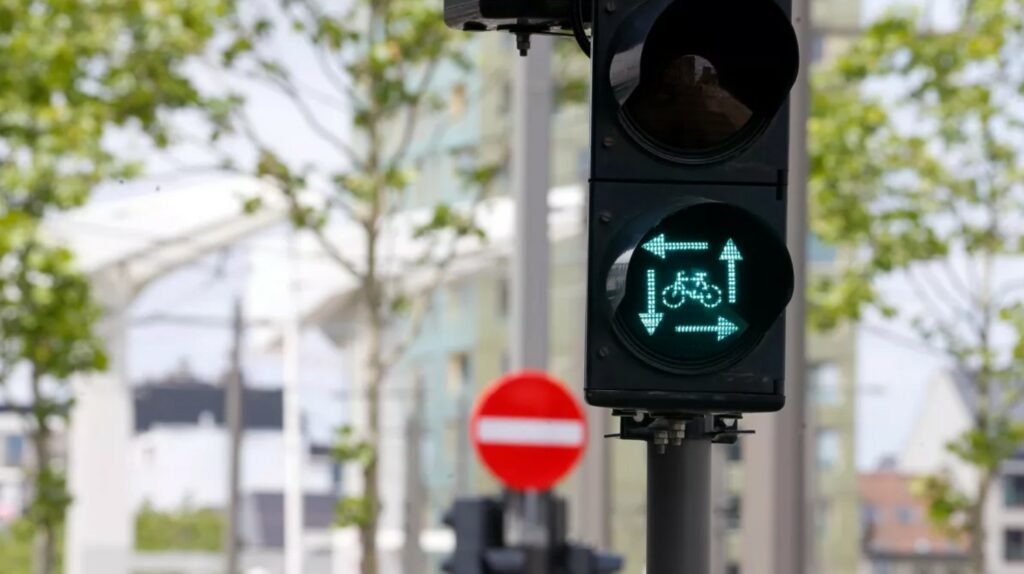
- Crossing an intersection diagonally is allowed when the "square green for cyclists" traffic sign (see image above) applies.
- Cyclists and other two-wheelers can now pass rows of slow-moving vehicles, such as cars stuck in a traffic jam.
- The list of equipment requirements for cyclists (lights, reflectors, brakes and bicycle bells) has been greatly simplified and standardised.
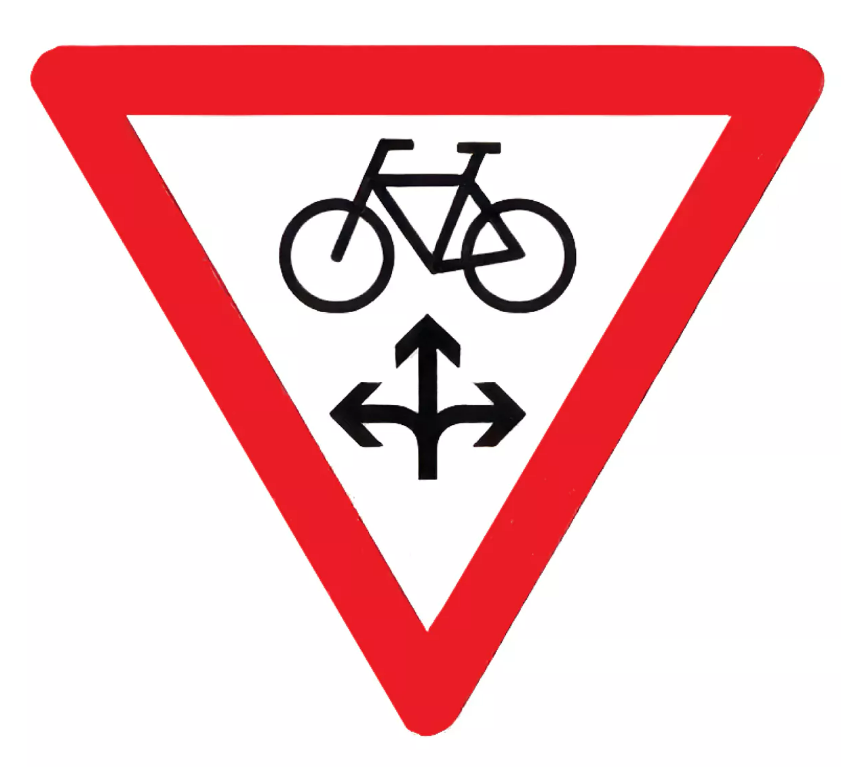
- When sign B22 is present (see image above), cyclists and electric bikes can now drive through red or orange lights to turn left (in addition to the option to turn right or go straight, provided they give way to other road users).
- When there is not enough space to create a cycling lane, but when traffic on the roadway can be dangerous, the road authority can allow bicycles on sidewalks. Pedestrians retain absolute priority on these shared sidewalks.
- A new traffic sign (see image below) will be introduced, indicating that use of the bicycling lane is optional: cyclists may use the bike path, but it is not mandatory.
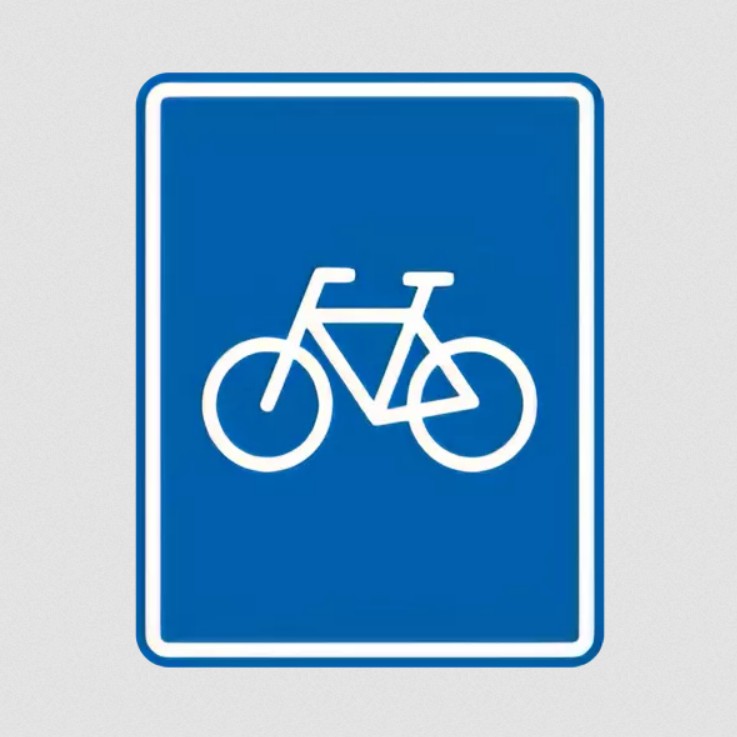
Credit: Mobility Ministry
Cars
- Both the driver and the (adult) passenger can now be fined if the passenger is not wearing a seat belt.
- In case of a vehicle breakdown or accident, turning on all indicators is mandatory, if it is possible. If this is not possible, an emergency warning triangle must be installed at a distance of 100m on motorways and other roadways. In any other situation, setting up the warning triangle is no longer mandatory.
- In poor visibility, the use of lights, including position and dipped headlights, will become mandatory (like fog lights) when visibility is impossible at a distance of less than 100 metres.
Motorcycles
- Traffic sign C35 (no overtaking, see image) now also applies to motorbikes.
- Motorcycles are now allowed to use the 'emergency lane,' which is the space that cars have to form between two lanes in case of traffic jams.
- Parking on the road must be in line with the carriageway; it is no longer allowed perpendicular.
- The road authority may choose to prohibit the parking of motorbikes on pavements in a zone.
Diversity and inclusion
To make sure that public roads become a "fairer" place for all road users, several other changes, such as gender-neutral traffic signs, will also be made.
Additionally, there will be a ban on parking and stopping (bicycles and scooters) on tactile paving for blind and visually impaired people and a ban on stopping in places reserved for disabled people. For people with reduced mobility, the minimum age for using motorised vehicles (including electric scooters) will be abolished.
The new code also introduces two new symbols: one for the "cargo bike" and one for "shared vehicles".
