
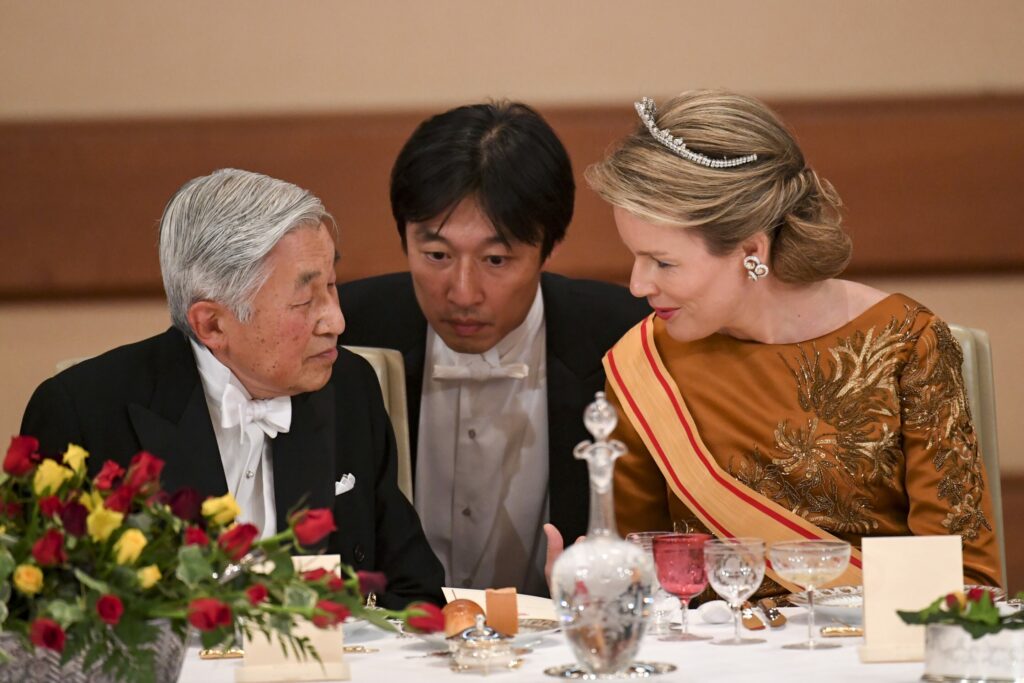
When Emperor Naruhito and Empress Masako arrive in Belgium later this month, the visit will be wrapped in all the pomp of a state occasion.
Yet behind the ceremonies, palace banquets and royal welcomes lies a more practical objective: deepening ties between two countries that increasingly see each other as partners in science, innovation and diplomacy.
The Japanese imperial couple will visit Belgium from 20 to 25 June, staying at the Royal Castle of Ciergnon and the King’s residence in Laeken Castle - with the official state visit taking place on 23 and 24 June. The trip marks the 160th anniversary of diplomatic relations between Belgium and Japan, which date back to the signing of a treaty of friendship and commerce in 1866.
A close royal relationship
The visit will also celebrate a remarkably close relationship between two royal families whose current heads share striking similarities.
Speaking in Brussels on Wednesday, Japan’s Ambassador to Belgium, Takeshi Osuga, noted how Naruhito and Philippe were born less than two months apart in 1960. Their eldest children – Princess Aiko of Japan and Belgium’s Princess Elisabeth – were also born within weeks of each other in 2001.
Both monarchs have developed a longstanding interest in water management and environmental issues. Naruhito, before ascending the Chrysanthemum Throne, became internationally known for his work on water policy and served as honorary president of the United Nations Secretary-General’s Advisory Board on Water and Sanitation. King Philippe later chaired the same body.
Those shared interests help explain why one of the centrepieces of the visit will be a trip to Namur, where water management will feature prominently in discussions.
The personal connection between the two royal houses stretches back decades. Naruhito first visited Belgium in 1976 as a teenager accompanying his father, the future Emperor Akihito. The Ambassador said the upcoming visit will be his ninth trip to Belgium.
Those links have been reinforced by moments of both celebration and mourning. In 1993, then-Emperor Akihito attended the funeral of King Baudouin in Brussels, a gesture that reflected the closeness between the two royal houses.
Nearly a decade later, in 2002, then-Prince Philippe and Princess Mathilde travelled to Japan during the FIFA World Cup, watching Belgium draw 2–2 with the host nation in Saitama and meeting Crown Prince Naruhito and Crown Princess Masako. What was then a meeting between heirs to their respective thrones would later become a friendship between two reigning monarchs.
Growing economic cooperation
While the royal symbolism will dominate headlines, the programme also reflects the growing economic and technological relationship between the two countries.
After visiting Namur, the Emperor and Empress will travel to Leuven to tour IMEC, Europe’s leading semiconductor and microelectronics research centre. The choice is no accident. More than 100 Japanese researchers currently work at IMEC, making it one of the most important hubs for Japan-Europe technological cooperation.
That relationship has taken on fresh significance in recent years. As Europe and Japan seek to reduce strategic vulnerabilities and strengthen trusted supply chains, cooperation in areas such as semiconductors, research, clean technologies and advanced manufacturing has moved up the agenda.
The inclusion of IMEC on the programme underlines how economic diplomacy is now increasingly intertwined with scientific and technological collaboration.
It also comes against a backdrop of growing economic ties. Japan is among Belgium's leading Asian trading partners and one of its largest investors. Japanese companies have maintained a presence in Belgium for decades, attracted by the country's position at the heart of Europe, while Belgian firms have built strong footholds in Japan, particularly in pharmaceuticals, chemicals and high-tech industries.
The imperial couple will also visit the University Library of KU Leuven, which houses thousands of Japanese works donated after the destruction of the original library during the First World War.
Officially, the visit is about celebrating 160 years of friendship. The state banquet at Laeken Castle, the visit the federal parliament, meeting Prime Minister Bart De Wever, and balcony appearance at Brussels City Hall will provide the photographs.
But the visits to IMEC, KU Leuven and Namur hint at what Belgium and Japan increasingly want their relationship to be about: innovation, knowledge and cooperation in a changing world.
