
The Brussels Government took a first step in significantly simplifying and modernising its administration last week, approving the "first and most important" part of the upcoming reform.
For years, politicians and citizens alike have denounced the Belgian capital's "institutional lasagna": the many levels of authorities layered on top of each other in the capital. Anchoring it in the regional government's coalition agreement, the government vowed to finally do something about it.
"With this decision, we are taking a historic step for Brussels," said Dirk De Smedt (Anders), Brussels Minister for Budget and Finance, who is also responsible for Civil Service Affairs.
"For years, there has been talk of greater cooperation, less fragmentation and a more efficient government. Today, we are turning those words into action," he said. "This reform should ensure that our administrations can focus as much as possible on their core tasks and that taxpayers' money is spent more efficiently."
Doing what Brussels is supposed to do
The Brussels Government's coalition agreement stated that administrative simplification should deliver tangible benefits for citizens, businesses and entrepreneurs: less paperwork and the elimination of unnecessary or redundant procedures.
The reform is based on four main pillars (detailed in the coalition agreement). The first, called 'Pillar 1', was approved on second reading by the Brussels Government on Friday.
It forms the foundation of the wider reform of the Brussels public administration and brings together numerous support services – HR, IT, procurement, accounting and facilities management – into a single shared structure that supports all Brussels administrations.
According to the government, this should simplify processes, ensure resources are used more efficiently and avoid duplication of effort.
"Brussels needs less fragmentation, more cooperation and a government that does what it is supposed to do. Today we are taking a decisive step in this direction and putting our own house in order," said De Smedt.
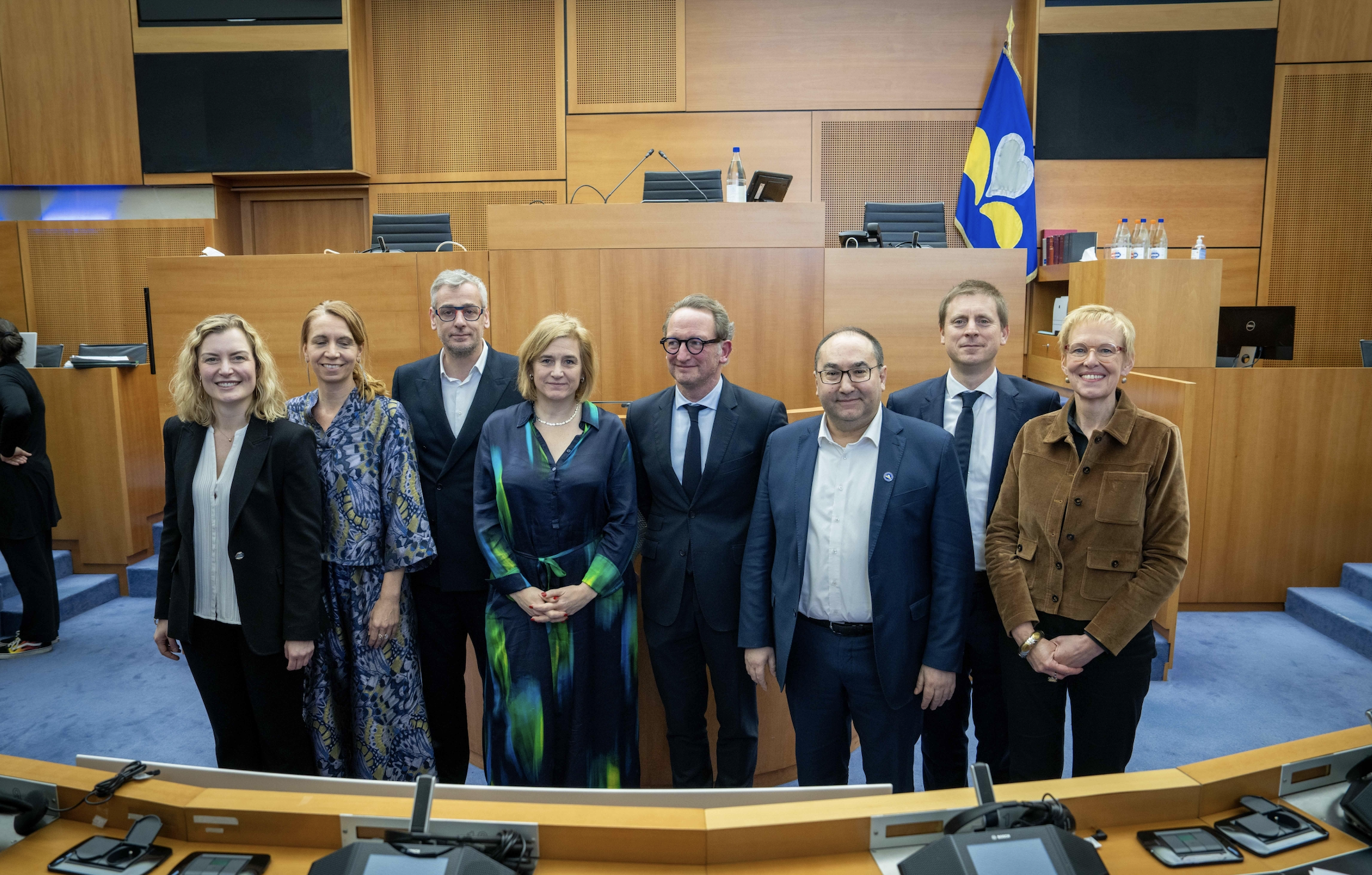
The new Brussels Region Minister team, with L-R: Audrey Henry, Ans Persoons, Dirk De Smedt, Elke Van den Brandt, Minister-President Boris Dillies, Ahmed Laaouej, Laurent Hublet and Karine Lalieux. Credit: Belga
With the approval of this reform, the next phase, 'Pillar 2', is also coming into view. This second step comprises the different directorates of the Brussels Regional Public Service and will manage all so-called "core functions" that are currently spread across various independent entities.
Over the coming months, the government will continue to work on the practical implementation so that the new structure can be definitively established this summer.
According to the coalition agreement, the priority in 2026 will be to implement Pillars 1 and 2, in order to create "as many synergies as possible" and achieve savings in support services. The reform of Pillar 3 is scheduled to begin in 2027, quickly followed by Pillar 4.
De Smedt stressed that the entire reform is not merely an organisational change, but also forms an essential part of the path towards a balanced budget by 2029.
The multi-year plan outlined by the Brussels Government is hoping to bring serious gains in efficiency as well as structural savings, he stressed. "Anyone who wants to restore Brussels' finances sustainably must also dare to reform."
