
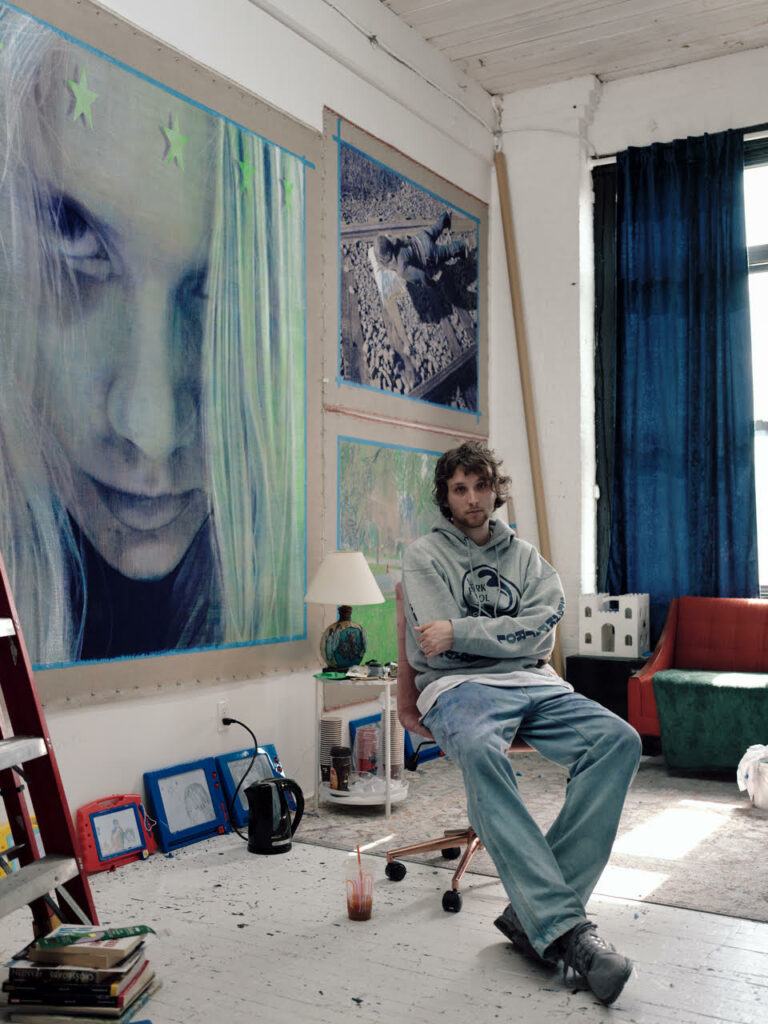
There are more obvious places than Brussels for the European debut of Ronan Day-Lewis.
The 28-year-old New Yorker arrives with a growing reputation in both film and visual art. His feature-film debut, Anemone, was released last year. His paintings have been shown in New York, Los Angeles and Hong Kong. His surname alone ensures a certain degree of attention.
Yet it is in Nino Mier’s townhouse gallery next to the Sablon, rather than in London, Paris or Berlin, that Day-Lewis has chosen to unveil his first solo exhibition in Europe. The result is Recent History, a haunting collection of paintings, installation and video work that opened this week at Nino Mier Gallery's Brussels space.
"Brussels felt like a really exciting opportunity," Day-Lewis told The Brussels Times ahead of the opening. Having previously visited the city only briefly for the exhibition of his friend, Asher Liftin in the same space, he was drawn both by the chance to exhibit in Europe and by the character of the gallery itself.
Unlike the neutral empty spaces favoured by many contemporary galleries, Nino Mier’s house retains fireplaces, wooden floors and the traces of domestic life. "It has a white-cube element, but it also has this domestic feeling," he says. "I was thinking about the exhibition almost like a memory palace."
Credit: Ronan Day-Lewis
Familiar and unsettling
Memory is the organising principle of Recent History. Day-Lewis assembled a vast archive of photographs scavenged from early-2000s Flickr uploads and other forgotten corners of the internet. The images were not his own. Most belonged to strangers.
"I would just download images that I felt drawn to," he explains. "I didn't try to rationalise it at first." Only later did patterns emerge. Certain visual archetypes repeated themselves. A narrative began to take shape. What started as a loose collection of unrelated snapshots slowly evolved into a coherent, if elusive, story.
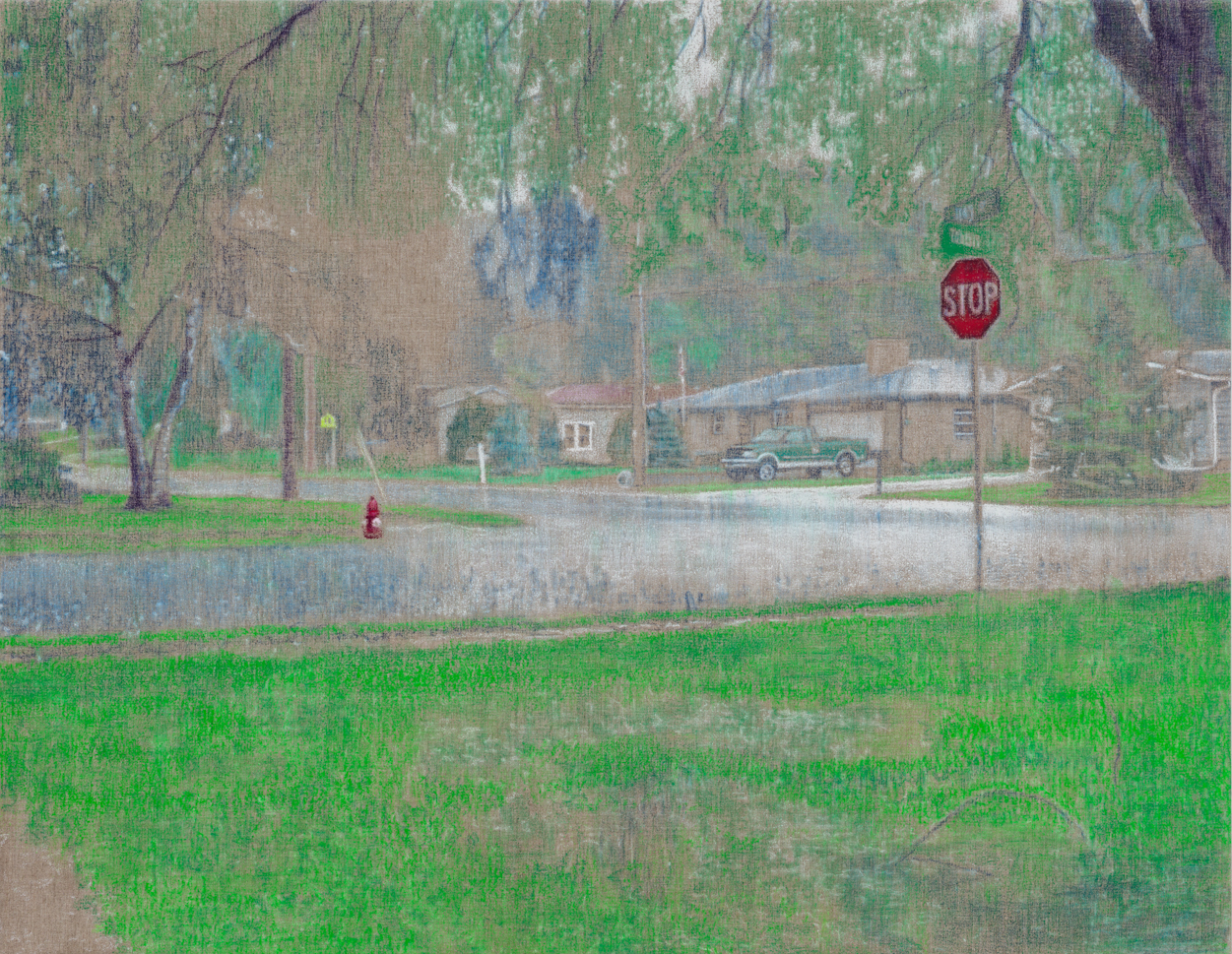
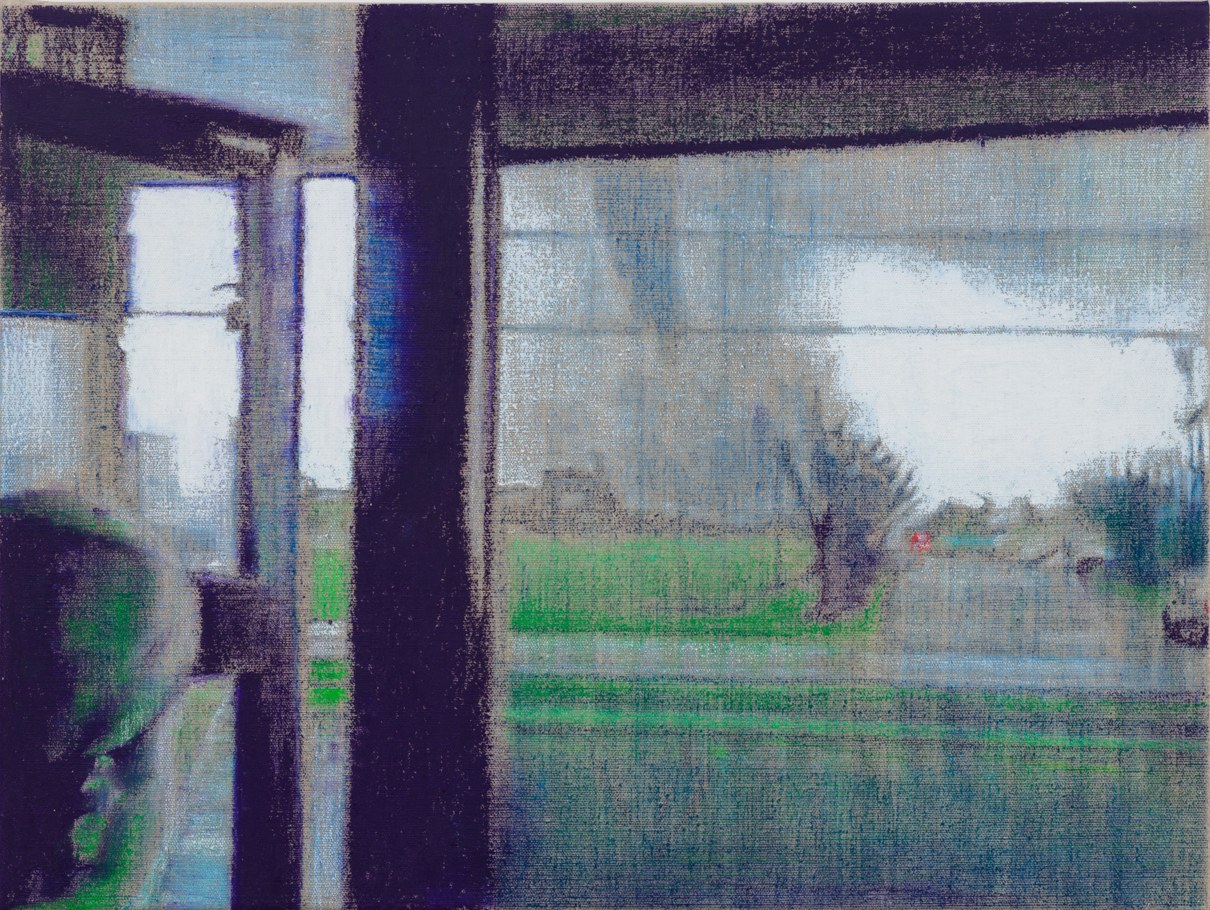
The resulting paintings feel both familiar and unsettling. Suburban streets after rain. Teenagers in cars. Anonymous bedrooms. Electricity pylons. Sports stands. Camcorders. Railway tracks. The imagery evokes a distinctly American landscape, yet one filtered through recollection, distortion and dream.
Related News
- 'A museum of life stories': Inside a hidden Brussels gem
- Behind the gate: The last refuge of Brussels’ working artists
- 'Saviours of the Aegidium': Forgotten Brussels palace rescued by Georgian dissident
Many of the works possess an eerie photographic quality despite being painstakingly created using oil pastels on linen. Day-Lewis works almost exclusively in the medium, attracted by what he describes as its distinctive glow and texture.
"A lot of what comes through as style in my work comes out of the material," he says. "It creates a kind of surface and a kind of texture and glow that I've been really obsessed with."
Throughout the exhibition, luminous green stars appear repeatedly. They float above faces, inhabit landscapes and puncture otherwise realistic scenes. Their meaning remains deliberately open.
Day-Lewis says he’s keen to hear other people's interpretations of what it means. For him, it began in one of the paintings, “And it spread and infected the others in the body of work.”
"I started to think of it as a visual representation of the way the past is infected by memory," he says. "Or infected by the disturbance of observation, since I was poring over other people's memories in terms of their Flickr uploads.”
That idea runs through the entire exhibition. The paintings are not records of actual events but reconstructions of fragments. Individual photographs have been extracted from their original context and woven into a new fictional narrative. The gallery describes the project as a "collective memory bank" built from disparate experiences and internet archaeology.
Credit: Ronan Day-Lewis
A filmmaker, as well as a painter
Film also plays an important role. A central video installation, created in collaboration with musician Liam McCay, better known as Sign Crushes Motorist, extends the exhibition's atmosphere of nostalgia and unease.
For Day-Lewis, painting offers a creative experience very different from filmmaking. While cinema depends on collaboration, crews and logistics, painting remains an intensely private pursuit.
“There’s a lot of overlap in that they're both focused on image. But then, it's almost the opposite in terms of the execution, because film is obviously so collaborative," he says. "Painting is solitary. Monk-like."
The exhibition arrives at a moment when Day-Lewis is becoming increasingly visible as both an artist and filmmaker.
Inevitably, questions arise about his extraordinary family background. The son of actor Daniel Day-Lewis and filmmaker Rebecca Miller (not to mention grandson of playwright Arthur Miller and UK Poet Laureate Cecil Day-Lewis), the nepo baby label frequently accompanies discussions of his career.
“I'm used to it at this point, and I think that on the film side of things, that's completely fair,” he says. “No matter how many films I make, that will always be a part of who I am as a filmmaker.” Indeed, his father co-wrote the Anemone screenplay and came out of retirement to star in it, alongside Sean Bean and Samantha Morton.
Painting, however, occupies a different place in his life. "I've built my career independently of my parents," he says. "It's great to have that aspect of myself that's really private, and that's my own.”
Nonetheless, both his parents were in town for the opening, quietly supporting their son.
During his week in Brussels, Day-Lewis spent most of his time putting the finishing touches on the exhibition rather than sightseeing. Yet he says he has been struck by the city's atmosphere.
"It's got a really great energy," he says. "I really love the architecture, and the people here have a really great way about them."
For now, Brussels serves as the unlikely setting for a body of work concerned with memory, disappearance and the strange afterlife of images. It is an exhibition built from forgotten photographs uploaded by strangers decades ago and transformed into something dreamlike, melancholy and oddly moving.
In an era when billions of images vanish into the endless churn of the internet, Day-Lewis has found a way to give some of them a second life.
Recent History runs at Nino Mier Gallery, Rue Ernest Allard 25, Brussels, until July 18.
