
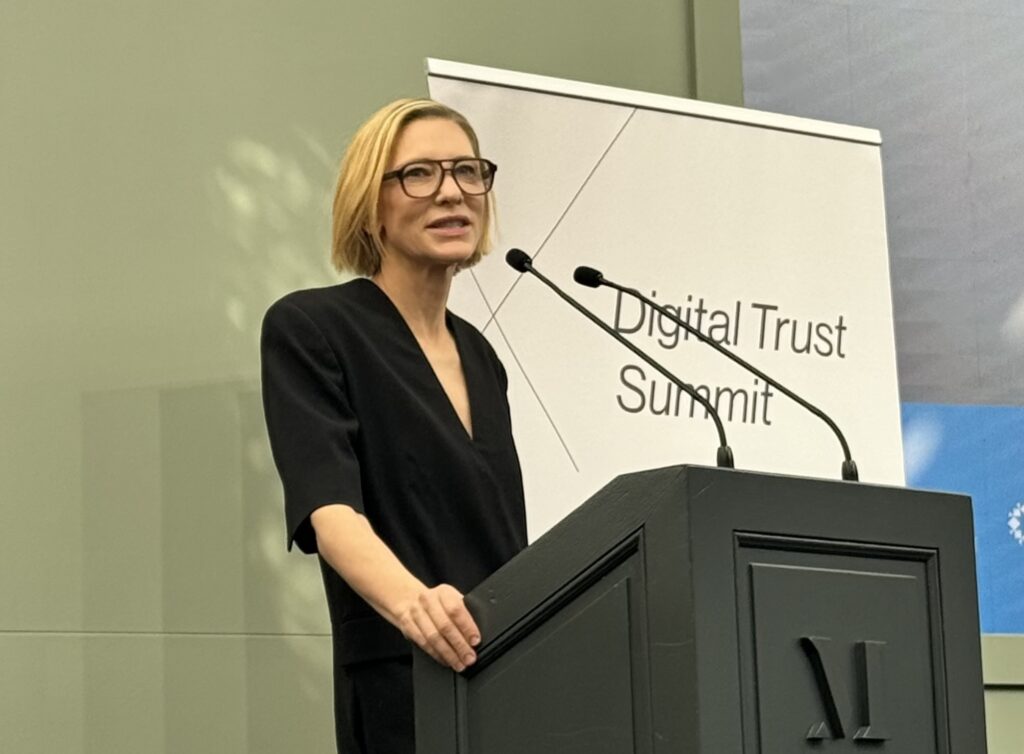
Oscar-winning actor Cate Blanchett brought Hollywood star power to a Brussels AI conference on Wednesday, urging technology companies, policymakers and creators to work together as she promoted a new tool designed to let people control how artificial intelligence uses their identity.
"Your identity is your intellectual property in the age of AI," she said, as she championed the Human Consent Registry, which allows individuals to register whether their name, image, voice, likeness and other personal attributes can be used by artificial intelligence systems.
The tool, developed by the non-profit organisation RSL Media, lets users choose one of three options – permitted, permitted with conditions, or prohibited – to create a machine-readable framework that AI developers can consult before using personal data.
Growing concerns about generative AI
The initiative comes amid growing concern over the ability of generative AI systems to replicate voices, create realistic images and produce content based on copyrighted material or personal likenesses without explicit permission.
Blanchett, who co-founded RSL Media, said the registry was intended to provide a practical solution to a problem affecting far more than actors and public figures.
The actor, who also appeared at the European Parliament on Tuesday, has become one of the most prominent voices in the entertainment industry's campaign for stronger protections against unauthorised AI use. Earlier this year, she joined more than 800 artists, including Scarlett Johansson and Guillermo del Toro, in signing an open letter accusing major AI companies of exploiting creative works without permission.
Addressing the Digital Trust Summit on AI, Blanchett argued that many technology companies want to respect consent but lack a simple way to determine what permissions exist.
"It actually makes things quicker," she said. "Within 30 minutes, sometimes three minutes, sometimes three seconds, whether you have the rights or not, then you can move forward."
Rather than slowing innovation, she said, clearer consent mechanisms could reduce legal disputes and help companies develop products with greater certainty.
"This is not tech-phobic," Blanchett added. "It's for everybody, and it's a global standard."
The project has attracted support from policymakers involved in shaping Europe's AI rules.
A 'Wild West'?
Eva Maydell, the Bulgarian MEP who is one of the chief negotiators on the EU's landmark AI Act, said discussions need to bring together groups that often operate separately. "These conversations should not happen in silos or in isolation," Maydell told the conference.
Describing herself as "a digital optimist", Maydell said AI had enormous potential but warned that every technological revolution creates new challenges.
"The main question we wonder about is how to ensure that artificial intelligence strengthens human creation," she said.
The Brussels launch also received backing from Hollywood director Steven Soderbergh, whose films include Traffic, Erin Brockovich and Ocean's 11.
Speaking alongside Blanchett, Soderbergh said the project emerged at a time when both technology companies and creative professionals were searching for guidance on how to navigate AI's rapid expansion.
"The Wild West aspect of it was really getting to people," he said. "There is a lot of emotion around the technology conversations lately."
Soderbergh, who directed Blanchett in last year’s spy thriller Black Bag, said he hoped the registry would become an industry standard, comparing it to other voluntary systems developed by creative industries when legislation struggled to keep pace with technological change.
"Everybody is looking for guidance here," the director said. "This seems like a simple way to address an issue that everybody would like to see resolved."
EU AI regulation
The launch comes as Europe seeks to establish itself as a global leader in AI regulation. The EU's AI Act, which entered into force last year, remains the world's most comprehensive legal framework governing artificial intelligence.
Supporters of the Human Consent Registry hope it can complement those rules by providing a practical mechanism that individuals can use immediately. Participation is voluntary, and in most jurisdictions there is currently no legal requirement for firms to consult such registries before using publicly available data.
Blanchett nevertheless said the industry is moving towards greater transparency and accountability. "We all have the same interest," she said. "Speak to us, work with us."
