
The severe humanitarian situation in Gaza has been overshadowed by the conflict with Iran and gone under the radar since the talks on the transition to the second phase of US President Donald Trump’s peace plan stalled over non-implementation of the disarmament of Hamas.
The ceasefire based on his 20-point plan entered into force in October 2025. The full entry of humanitarian aid and relief was supposed to start immediately as determined in the agreement, and at a minimum in consistence with a previous agreement from January 2025. However, the delivery of basic aid remains restricted and insufficient.
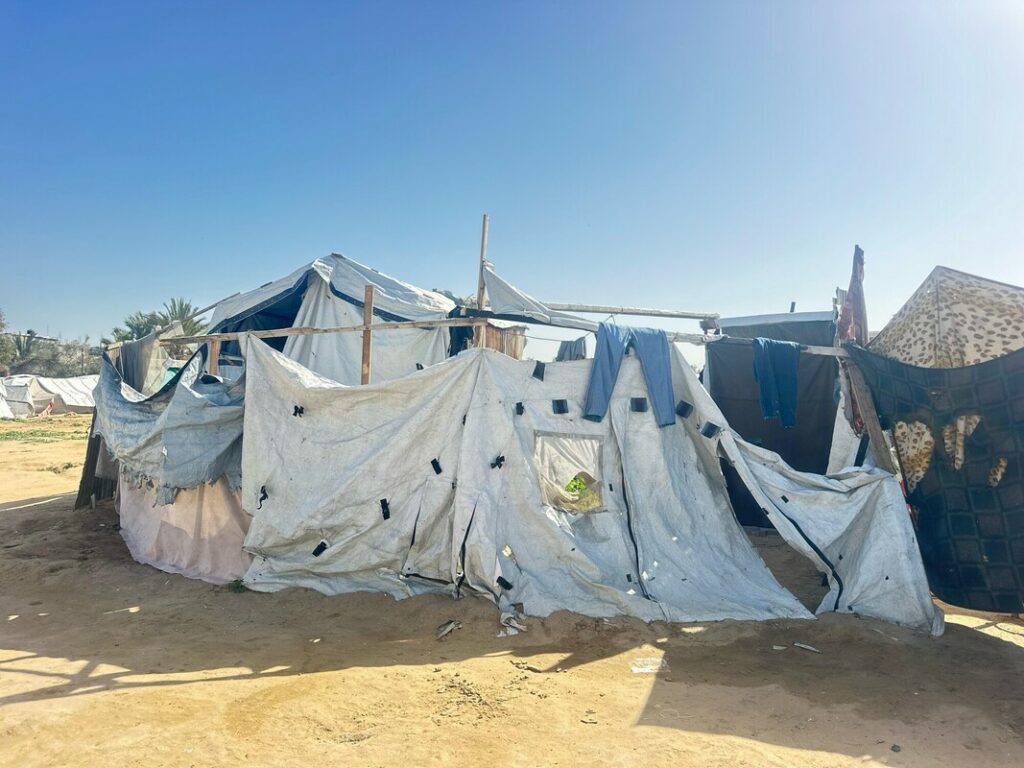
According to a new report by the Norwegian Refugee Council (NCR), Israel’s destruction of homes in Gaza and restrictions on shelter materials have trapped displaced families in dangerously hot tents and makeshift shelters during the summer heat waves.
Across Gaza, around 170,000 households, equivalent to nearly one million people, live in tents. Another 5,000 households sleep outdoors, while 52,000 households live in overcrowded shelters, according to the Shelter Cluster of NCR and its partners.
The war left Gaza devastated, destroyed most of the buildings there and displaced families several times. According to the ceasefire deal, Israel controls close to 60% of the Gaza Strip pending disarmament of Hamas.
The already dire humanitarian situation would worsen if Israel’s far-right government would make true of its threats to resume the war and occupy up to 70% of the Gaza Strip.
This month, 850,000 people still lack emergency shelter items such as plastic sheeting, plywood, and rope. These figures point to a shelter crisis driven not by weather, but by destruction, displacement, and blocked relief, according to NCR.
Summer heat will only sharpen the risks families face, with daytime temperatures reaching 34.5°C in the warmest month and the number of hot days with temperature recording 35°C or higher expected to increase.
Families need proper tents and basic shelter materials, including tarpaulins, shade nets, plastic sheeting and basic repair supplies. These materials will not rebuild Gaza, but they can make the difference between a tent that traps heat, smoke, dust and disease, and a shelter that gives a family shade, airflow, privacy and a measure of protection, NCR says.
Skills cannot replace materials
“It is an outrage that families in Gaza, after months of displacement and loss, now face summer heat in makeshift tents because Israel continues to restrict shelter materials,” said Jan Egeland, NCR’s Secretary General.
As a former diplomat, he has served as state secretary in Norway’s ministry of foreign affairs and UN Undersecretary for Humanitarian Affairs and Emergency Relief Coordinator.
“The Shelter Cluster and its partners have the expertise and capacity to help Palestinians secure safer and more dignified shelter,” he said. “But skills cannot replace materials. Israel must allow shelter supplies into Gaza now so our partners can help families protect themselves from heat, exposure and further harm.”
Jehan Salim, Shelter Cluster Coordinator, told The Brussels Times that the Shelter Cluster is part of the humanitarian coordination system used in emergencies. ”Our role is to coordinate partners, identify gaps, agree on technical standards based on local context.”
Members include UN agencies, international NGOs, local NGOs and other humanitarian partners working on shelter and household assistance. “While many partners have the capacity to implement activities on the ground, only a limited number are currently able to facilitate the importation of shelter materials into Gaza,” Salim said.
The European Commission’s Directorate-General for European Civil Protection and Humanitarian Aid Operations (DG ECHO) is not an operational agency and is therefore not a Shelter Cluster member. But the Shelter Cluster engages with a range of donors, including ECHO, to provide evidence on shelter needs, response gaps and operational constraints in Gaza.
Asked on what grounds Israel is banning the supply of emergency shelters, he replied that the Shelter Cluster raises access issues through the humanitarian coordination system and with relevant counterparts such as the UN Office for the Coordination of Humanitarian Affairs (OCHA) and the Civil Military Coordination Center (CMCC). The latter was established in southern Israel as part of the Trump plan.
A spokesperson of COGAT, an Israeli body which is coordinating government activities in the (occupied) territories, said that over a million tents have been supplied into the Gaza Strip since the ceasefire.
He did not address the need of emergency shelters but admitted that Israel has limited the supply of some equipment which it claims can be used by Hamas to produce weapons.
Not one single solution
The Shelter Cluster is not proposing one single solution to replace all tents, Salim added, but emergency shelter kits and improved emergency shelters are one important option within the wider shelter response.
“Gaza requires a diversified shelter response due its complex context, limitation of space and access of materials. Tents remain necessary for immediate emergency response, but they are not a dignified or sustainable solution for prolonged displacement, particularly during extreme summer heat, winter conditions, overcrowding and protection concerns,” he said.
At the same time, Salim stressed that the response should not focus only on displaced families living in tents. “Our current multisource damage assessment report indicates that approximately 60,000 housing units may be repairable, allowing families to return to their homes if the necessary materials become available."
For families whose homes are destroyed or beyond repair, damage assessments indicate shelter needs at a much larger scale, potentially reaching around 200,000 households requiring some form of temporary shelter solution.
However, this must be considered alongside the limited availability of land, ongoing displacement, and restrictions on the entry of shelter materials.
The cost and timeline depend largely on funding, access to shelter materials, availability of land, and operational access.
A recent report, The 2026 Rapid Damage and Needs Assessment (RDNA), estimated that approximately US$3.7 billion is required over the first three years to support housing and shelter recovery in Gaza.
The Norwegian Refugee Council declined to comment on whether EU sanctions against extremist Israeli ministers who are responsible for limiting humanitarian and emergency aid into Gaza would be useful.
“As humanitarian agencies, we are not in a position to comment on sanction policies. However, we have called for accountability from all parties in accordance with commitments set out in the ceasefire agreement,” they said.
“Israel has agreed to allowing a constant flow of humanitarian aid into Gaza as part of the ceasefire agreement. In reality, actions have fallen far short of meeting this commitment. We believe that diplomatic pressure must applied to push Israel to let aid into Gaza in unrestricted quantities.”
At the recent summit in Brussels, the European Council expressed its grave concern over the deteriorating situation in Gaza and the West Bank, including the persistent and devastating humanitarian crisis in Gaza.
“It calls on Israel to allow immediate, unimpeded access and sustained distribution of humanitarian assistance at scale into and throughout Gaza, including via the Cyprus Maritime Corridor to supplement land routes, and to enable the UN and its agencies, and humanitarian organisations, to work independently and impartially to save lives and reduce suffering.”
