
The Belgian capital’s strategy in tackling drug-related violence has been called into question after it was revealed that 63% of shootings happen outside designated ‘drug hotspots’.
Brussels MP Benjamin Dalle questioned the Brussels Minister-President on the region’s anti-drug violence strategy. He called for adapting the regional strategy to combat drug trafficking, SudInfo reported on Monday.
In 2024, the Brussels Region designated 15 hotspots, including Clémenceau, the Northern District and Brussels-Midi, after a spike in drug-related shootings committed with weapons of war such as Kalashnikovs.
The strategy focused police activity on specific areas known for street drug sales, with local task forces coordinating security, prevention, and neighbourhood life. The number of hotspots was even raised to 18 in 2025.
Over 150 shootings
However, since then, drug-related shootings in Brussels have not gone down. According to figures released by the Minister-President, 160 shootings have been recorded since 3 October 2024.
Over half of these took place outside hotspot areas. In 2026, this proportion rose to as high as 63%, compared with 46 per cent in 2025.
Whilst the Clemenceau hotspot remains a key priority area, its share of shootings has fallen from 26% in 2025 to 17% this year.
Some may claim this as a victory for the strategy; however, the rising number of shootings means critics believe the violence is simply displaced elsewhere.
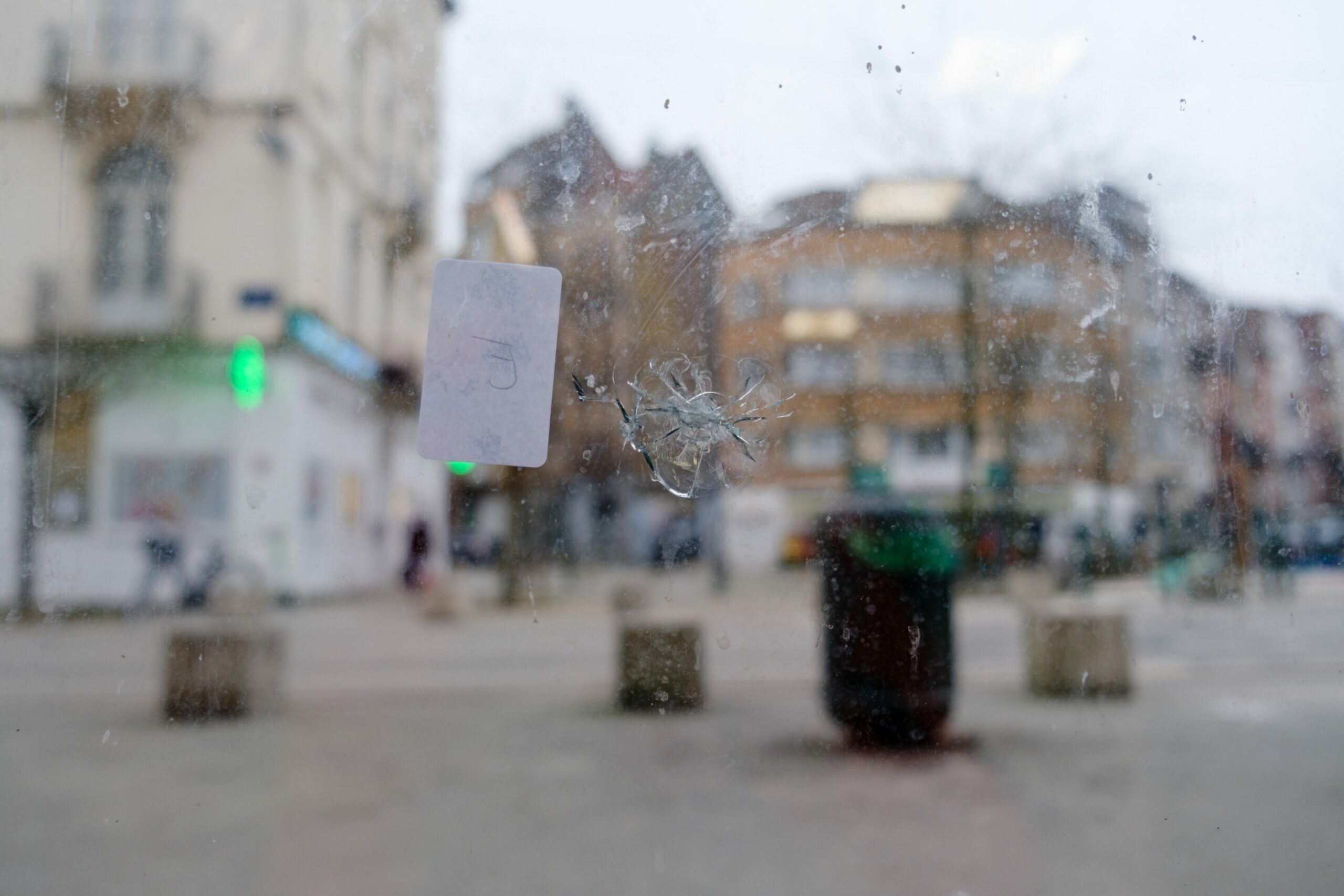
A bullet hole pictured at the site of a shooting at the crossing of the Rue de Merode/ Rue Pierre Decoster, in Forest, Brussels, on Tuesday 11 March 2025. Credit: Belga
This year, there have already been at least 35 incidents in 2026, with two more shootings reported on Sunday night in the Brussels municipality of Anderlecht.
It also comes after the spate of suspected drug-related bombings in Saint-Gilles last month.
Flemish Christian democrat MP Dalle further argued that the violence is simply taking place outside of hotspots. This indicates that the problem is not being solved, he told the Minister-President.
“It is encouraging that the new Minister-President and the new Brussels government have finally carried out an in-depth assessment of the hotspot approach. This is a significant step forward compared with the Vervoort government.”
Yet Dalle stressed that these figures show that the current strategy is no longer sufficient, adding: “This assessment also clearly highlights the limitations of the current strategy.”
'Waterbed effect'
During the session, the Brussels Minister-President Dilliès was forced to admit that the region had not carried out impact assessments of the waterbed effect, where the issue is solved in one place and reappears elsewhere.
"If the violence moves, the strategy must also be able to move more rapidly," Dalle stressed when addressing Dilliès.
For his solutions, the CD&V MP called for prevention policies to be better integrated, for strengthened coordination between the different levels of power, and for specialist contact points to be designated within the Brussels administrations.
He also sees a central role for the future Brussels drug 'czar' or commissioner, which was confirmed to be officially on the cards after a recruitment process was launched earlier this month.
Finally, the question of funds and resources, given the financial problems of the Brussels Region, remains unresolved. The Minister-President indicates that a decision on additional funding is expected in the coming weeks.
"Local stakeholders are on the front line every day. If we expect them to implement this strategy, they must also know what support they can count on," concludes Dalle.
However, the Brussels Government is under pressure to cut public spending, putting it in a tricky bind of having to balance urgent security questions with pressing economic considerations.
