
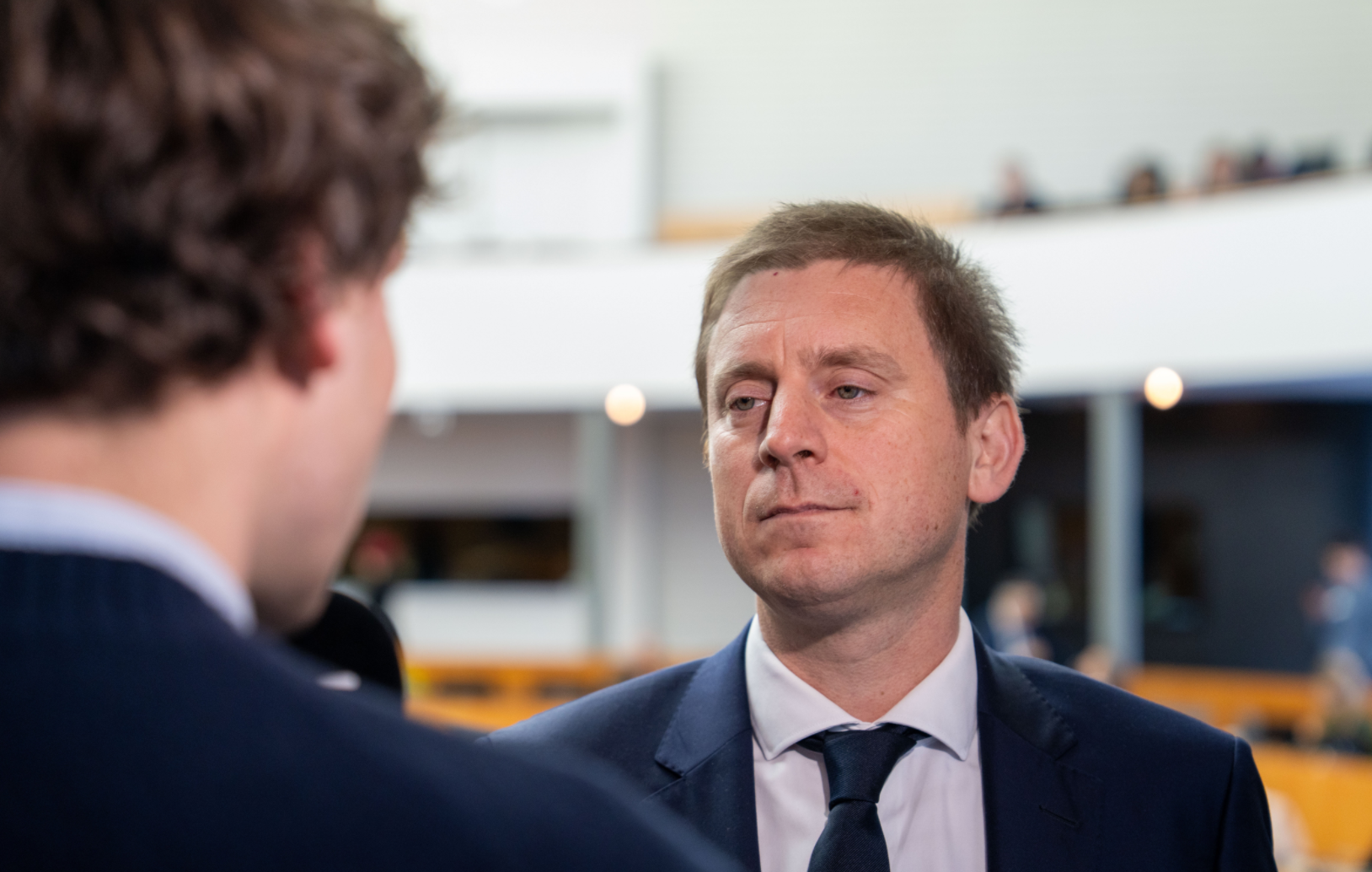
Laurent Hublet, the Brussels Capital-Region's Minister for Economy, Employment and Technology, has presented his roadmap for growth. In an interview with The Brussels Times, he explains why he wants to reindustrialise, the constraints he faces, and where the city's non-Belgian community fits in.
If producing economic plans delivered growth, Europe would be in safer economic territory. Hublet (Les Engagés) appears to have received that memo as he distinguishes his economic vision, Brussels All.In.
"It's not a plan. It's a roadmap. And I think it's an important distinction because often we have this habit to make very, very big plans," he says.
"I don't have the luxury to do that because we have a short mandate and so I'm calling it a roadmap because for me what is important is the direction and the priorities."
Focusing on a direction and priorities adds up for the business engineering and philosophy graduate. Once an advisor to former Deputy Prime Minister Alexander De Croo (Open VLD) and founder of the tech hub Be Central, Hublet stresses that his main decision factor will be "what is most impactful and the best decision for the Brussels people".
His credentials and focus have won him plaudits from the business community, including Thierry Geerts, CEO of business group BECI, who relayed to The Brussels Times that businesses feel "now we have a real minister of the economy, having been an entrepreneur himself". The previous Brussels government had a junior minister for economic transition.
Given the focus and the business credentials, will his economic roadmap work?
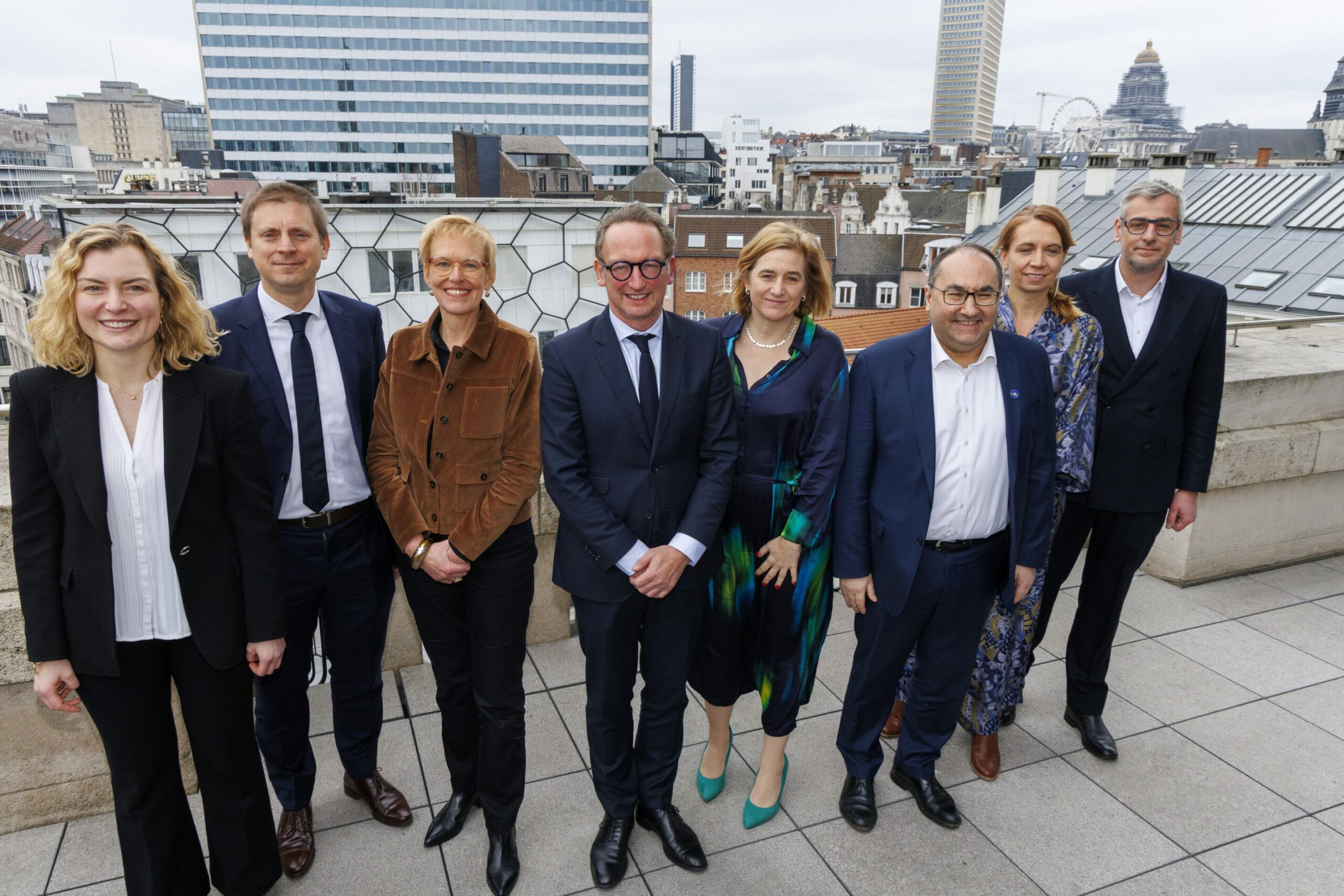
The new Brussels Region Minister team, from left to right: Audrey Henry, Laurent Hublet, Karine Lalieux, Minister-President Boris Dillies, Elke Van den Brandt, Ahmed Laaouej, Ans Persoons and Dirk De Smedt poses for the photographer after the oath ceremony at a plenary session of the Brussels parliament in Brussels, Saturday 14 February 2026. Credit: Belga/Nicolas Maeterlinck
The capital's economic issues
Brussels has some deep economic problems. 2025 saw growth of 0.4% – mainly off the back of construction and real estate development, while IT services, previously a stand out performer, declined.
This is according to the city's statistics agency, IBSA, which is downbeat on the prospects for 2026. "The outlook for 2026 is uncertain: tensions in the Middle East are likely to raise energy prices and inflation. This would weigh on business costs and household budgets."
Part of the reason for 2025's weak performance was the Audi factory closure in February, which had an outsized impact on the Brussels economy. The closure took with it 3,414 jobs as well as GDP and export earnings.
Geerts offered some optimism in reading the figures differently, "the economy of Brussels absorbed the shock of the closing of the Audi plant in one year," he noted, even with the closure there was still overall growth.
"The Brussels Region has a very diversified economy and because of that it's more stable – less peaks, less crises – than other economies," he told The Brussels Times.
Worrying employment figures
Despite this, there is no escaping the employment figures. "The Brussels labour market deteriorated in 2025," IBSA reported in their Spring 2026 update, which tracks the activity of VAT registered businesses.
2025 was the first year in over a decade that the number of employees in Brussels declined for four quarters in a row. Temporary employment is back to levels last seen in 2021, during the middle of the Covid-19 pandemic. And unemployment continues to rise.
All of this happened as Brussels languished without a new post-election government. In February 2026, an agreement was finally reached, 613 days after the election. The dire set of economic and job figures became Hublet's inheritance as the new Minister for Employment, the Economy, and the Digital Economy.
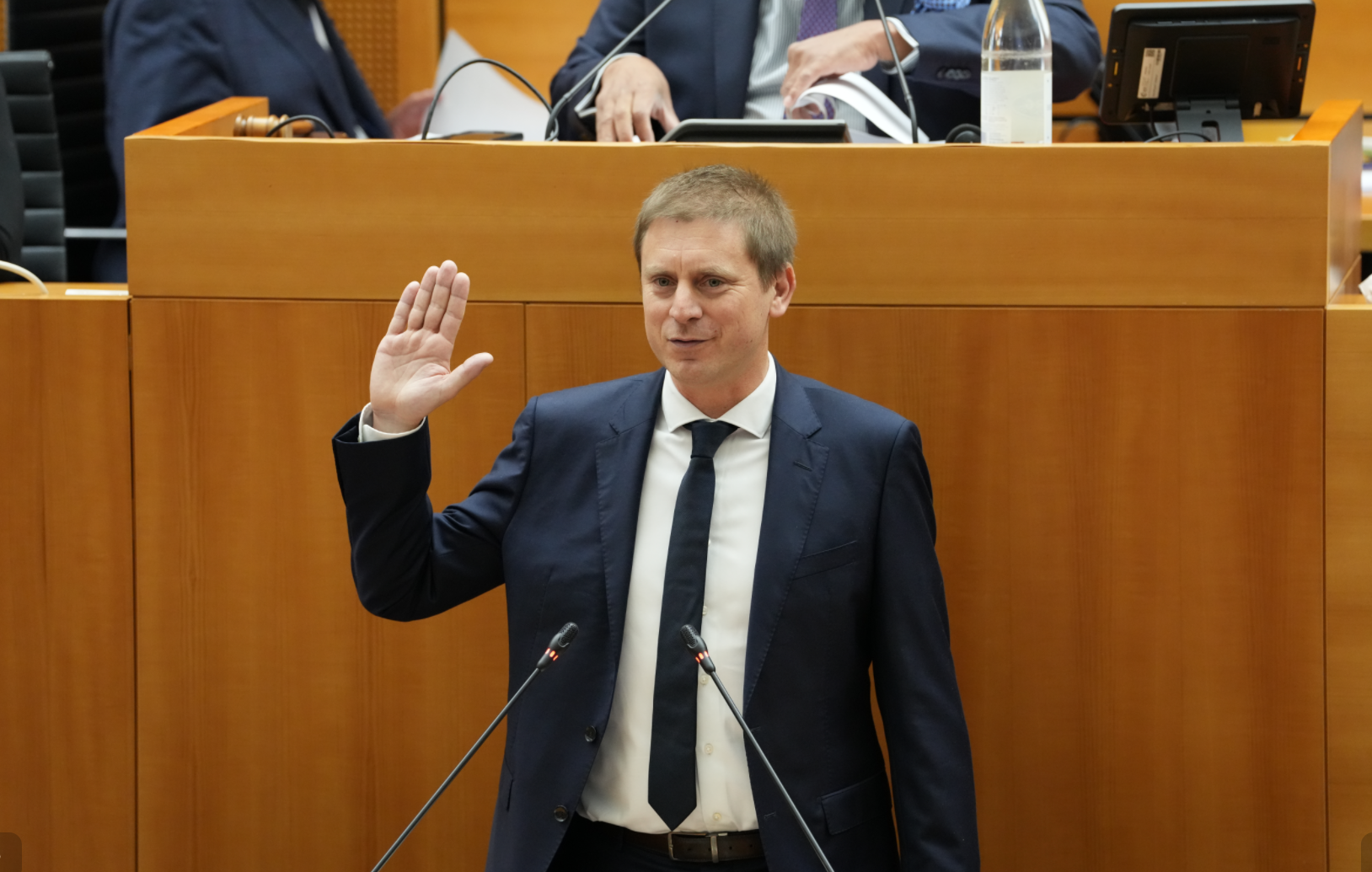
Brussels region Minister Laurent Hublet takes the oath during a plenary session of the Brussels parliament in Brussels, Saturday 14 February 2026. Credit Marius Burgelman/Belga
'Jobs don't fall out of the sky'
Despite the difficult government formation, Hublet insists there is unity behind what is important.
"Overall, in the current Brussels government, we are very united behind the objective of increasing the employment rate to 70% because it's a very important social and economic objective."
The coalition agreement committed the government to reaching this target by 2030.
This employment target, the equivalent of an extra 50,000 more people in employment according to the roadmap, is one of the key measures for the government.
Achieving it will be a challenge. The last time Brussels came anywhere close was the third quarter of 2023, when at 68.2% it briefly edged above Wallonia, before falling back again two quarters later.
For Brussels, improving the employment rate brings a crucial benefit. "We need it to improve our fiscal situation, we need it to improve our social situation," argues Hublet, "it really unites the whole government."
Doubling economic growth?
The parties in the Brussels government have committed to balancing Brussels' finances by 2029.
To achieve the growth in jobs, the roadmap targets the doubling of economic growth from 0.7 to 1.5% a year, and commits to doubling the share of manufacturing in Brussels' GDP.
"If we can bring back manufacturing activity," argues Hublet, "this is also an opportunity for us to stay ahead of the curve in terms of innovation."
Maintaining the commitment to reducing greenhouse gas emissions, and positioning Brussels within the top 10 European capitals for start-ups and innovation, round out the economic performance indicators included in the roadmap that are intended to drive job growth.
To achieve his ambition, he will need to encourage companies to start or grow in Brussels. As he plainly notes - "we need to bring back more activities. Jobs don't fall out of the sky."
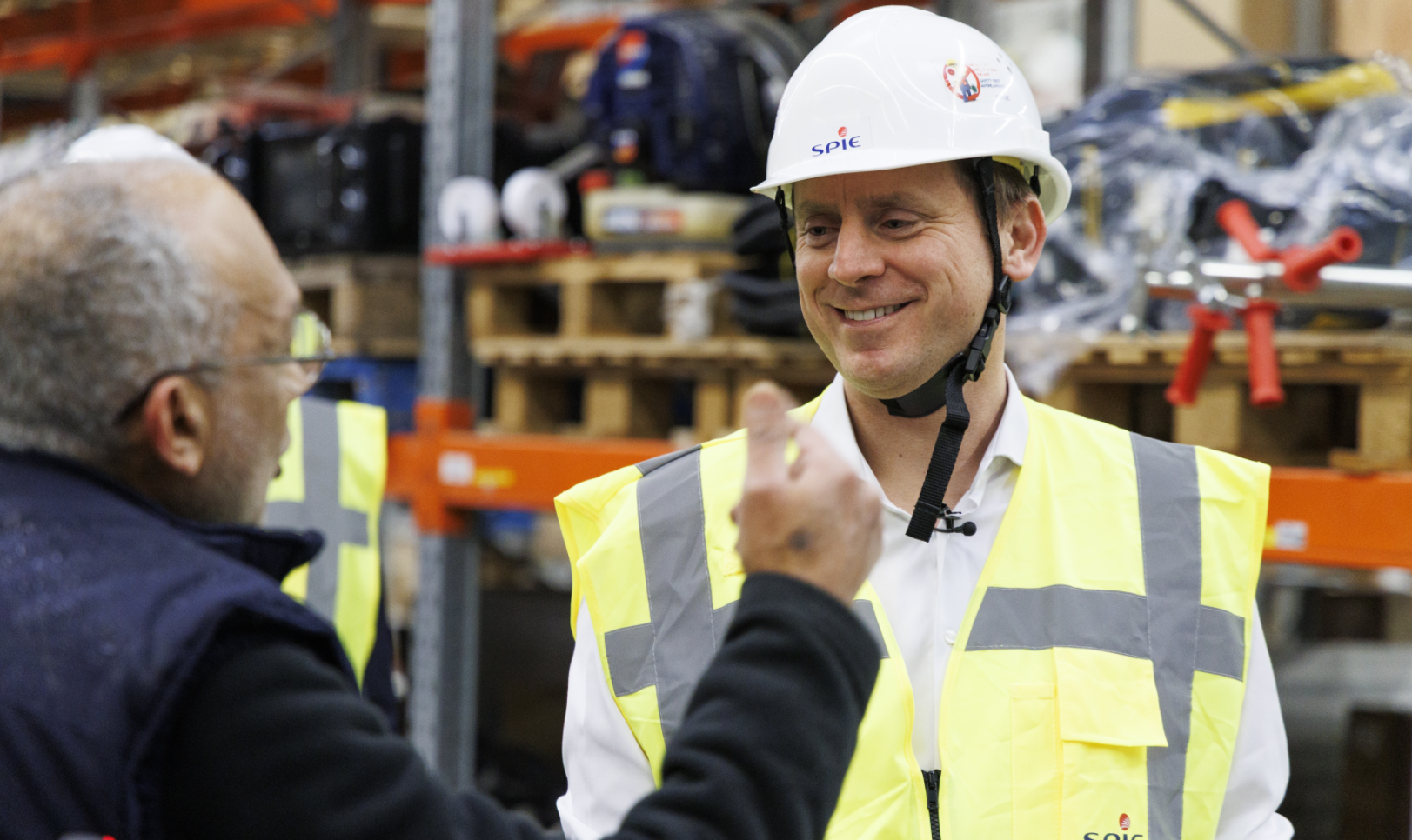
Brussels region Minister Laurent Hublet pictured during a visit to the SPIE company, in Anderlecht, on Monday 16 February 2026. SPIE, Europe's leading independent multi-technical services provider, is one of the largest employers in the Brussels Region. Credit: Nicolas Maeterlinkck/Belga
Non-Belgian talent
While more jobs are welcome, Hublet will need to address the mismatch between the non-Belgian talent coming in and the jobs available in Brussels.
Young people in particular report being overqualified for jobs, not having their degrees recognised by local employers, and facing the expectation of being able to speak French, Dutch as well as English to even get a foot in the door.
"We know that almost one out of two job seekers in Brussels actually has a degree, but this degree is not recognised officially. This is one of my priorities, is to make sure the degrees that Brussels talent has, that they are recognised, for example, nurses, people who are willing to launch a self-employed activity. So these are the elements where we know we need to do better," Hublet told The Brussels Times.
Language is an issue as well, he admits. "We have a very demanding job market because even for quite junior positions, people are expected to speak three languages, and that's why, for example, we've implemented compulsory language tests for job seekers [...] those who fail the test, they have to undertake to go through language training."
This focus on jobs, in part, explains why one of the first stops after launching his roadmap was to meet with businesses and federations within BECI.
"On a lot of points, it was a question of: we agree, good vision, clear message, but let's get back to the detail of how this will be practically executed," said Geerts on the mood from the meeting.
Navigating Brussels' governance complexity
Brussels' governance complexity will be a major blocker for Hublet, as he seeks to turn his vision into formal plans backed by the Council of Ministers. The BECI CEO explained that the minister will be operating in a system where "complexity exists to keep lots of people happy". Simplifying and getting any focus would take time and political capital, both are in short supply.
Hublet is aware of this complexity and the need to collaborate to get anything done. "Brussels is a special animal, institutionally speaking, so we have to work well with the federal government, we have to work well with Europe, and we have to work well with the private sector. Because Brussels wins if it collaborates with all these instances."
As a result of this complexity, Hublet's roadmap seems to tack more closely to iteration, rather than promising the moon.
Much of the plan carries forward previous ideas. "Basically there are not so many new things, the political equilibrium in this government is very fragile, so even if he is the Minister of Economy of Brussels, he can't change things drastically," Philippe Ledent, an economist from ING Brussels, explained to The Brussels Times.
All.In also leans heavily on Brussels' history and the need for the city to remember what it is in order to return to economic glory. "We are not New York. We are not Manchester. We are Brussels. [...] We shouldn't be willing to be something else than who we are," countered Hublet when asked to pick a city as a model for the future.
Expanding on his focus on reindustrialisation, he explains: "We have a long history of industrial activity, a bit like Manchester or some US cities. And we need that activity. [...] Not everyone in Brussels will be able to be a PhD in AI working around the Commission."
Some of the roadmap's simplicity will be realpolitik, with a government that also contains ministers from the previous administration. Ripping up and starting again isn't an option.
Ledent goes further on a core practical challenge. "Let's not forget there is no money, it is an austerity government," he says. "It is hard to be ambitious when all spending will have to be revised or reduced. In such a difficult budget context and difficult political equilibrium, the only thing you can say is to improve the image of Brussels and try to attract new players."
What is left is what everyone can agree on – pride of place, more jobs and fixing Brussels-Midi station. "A common denominator is that everyone agrees that the image given by the train station needs to be improved," explained Ledent.
Here Hublet has singled out London St. Pancras as the exemplar, where augmenting an already central transport hub, into an economic hub has turned a "dodgy" area of London into a growth engine.
Hublet clearly sees Brussels-Midi as central, for jobs, decarbonisation, and attracting innovative businesses.
"We could and we should do so much better with Midi station because it is one of our two main entry gates to Brussels and in the future it is going to become the number one entry gate."
"The expectation is that with the liberalisation of international rail travel, the traffic is going to increase massively especially between London, Amsterdam and Paris, and we are right in the middle. So we know this is strategic infrastructure."
Businesses seem to agree. "There is no reason that neighbourhood can't become St. Pancras but it will take time," says Geerts.

Illustration picture taken during a visit to the Brussels-Midi railway station to inspect the the deployment of soldiers in train and metro stations, Friday 03 April 2026. Credit: Belga / Nicolas Maeterlinck
2035 target
All.In sets a target of 2035 for complete redevelopment, recognising the fragmented governance that sits at the root of so many of the city's problems.
Redevelopment will require buy-in from "three local authorities, the Region, SNCB, Infrabel, and the Federal Government," as well as coordination between operators, according to the roadmap.
Both Geerts and Ledent also warn that Brussels' slow building permits scheme would need to change.
In the interim, Hublet reiterates some areas where progress will take place in the coming years: "The tracks between the Petite Ceinture [ring road] and the station, there's going to be new buildings coming in, so it's going to be gradual transformation that should lead us to a complete revamp of the neighbourhood."
These new buildings relate to an expected plan in September from Brussels Secretary of State for Urban Regeneration, Ans Persoons (Vooruit). "We want to breathe new life into the area around Brussels-Midi, making it more vibrant and attractive," she said in June.
Hublet's vision is centred around the idea of everyone being 'All In', a distinction he insists extends to Brussels' non-Belgian population.
"My plan is called All In, and this is true for every person in Brussels, including the expats. We are all in the same boat, and I think it's very important for the expat community to claim its place in Brussels. Half of the people living in this city, they were not Belgian-born, they are all in, and they should be."
However, for all their importance, non-Belgians living in the city have no democratic way to contribute to the direction of the Region, including its economic strategy. His office confirmed plans to translate the roadmap to English, and for expanded engagement.
Will Brussels be stronger in five years? Ledent sees a reason to be positive. "Let's keep being optimistic, let's at least give them a chance to change the mood and to develop the region. I don't see why it will not work, but it is clear it will be difficult because there is no extra money and they need to reduce spending. And anything that could be done needs at least five years to make an impact."
