
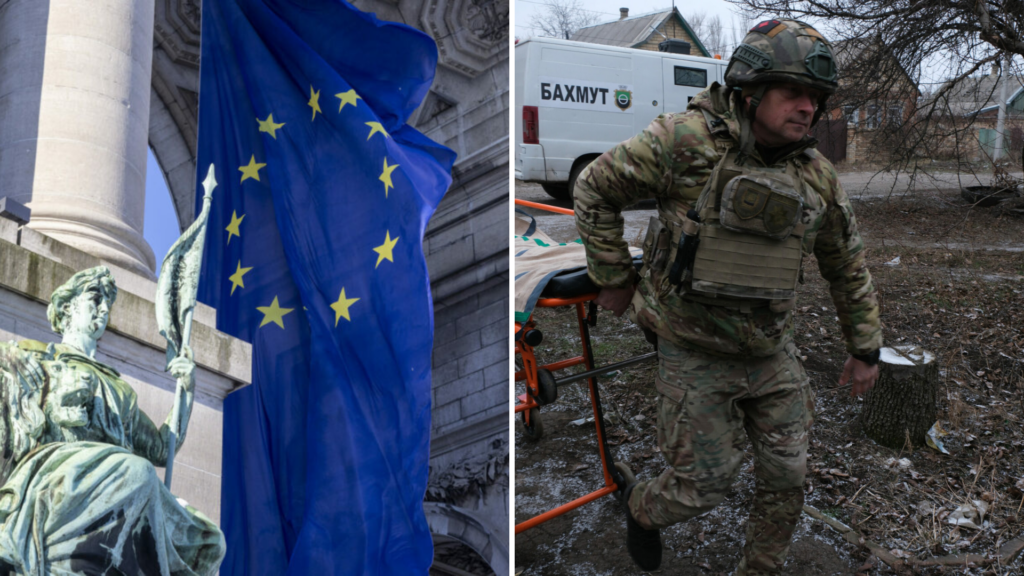
When 150 citizens from across Europe were recently invited to participate in a debate on how best the continent could prepare itself for future crises, they came up with recommendations for everything from cyber attacks, to floods, health emergencies, and even a dedicated EU Preparedness Week.
But surprisingly – at a time when war continues to rage in mainland Europe following Russia's full-scale invasion of Ukraine – scant mention was made of the subject of conflict (or to use the Commission’s preferred term, “geopolitical crises”).
Preparing citizens for the worst
As Europe finds itself dealing with multiple threats and facing an array of worrying scenarios, the European Commission’s decision to release the EU Preparedness Union Strategy late last year may be considered timely.
Designed to encourage greater cooperation amongst Member States in the face of health, climate and energy challenges, as well as geopolitical crises, it aims, to enhance the EU’s civilian and military preparedness by fostering an “all-hazard, whole-of-society” approach.
In this sense, it takes inspiration from the so-called Nordic model of preparedness, an approach that merges military and civilian resources to optimise defence.
According to the Commission, six out of 10 Europeans do not feel prepared for disasters. This polling prompted a decision to devote the next EU Citizens' Panel to the issue of Preparedness.
A total of 120 European citizens, randomly selected from all 27 Member States convened at Commission headquarters in Brussels. Some participants said they were fearful that the initiative was a scam – but this did not put them off attending.
They spent a total of three weekends (two in person, one online) thrashing out how ordinary Europeans and their governments might best prepare for future crises.
A glaring omission?
In her opening speech, Hadja Lahbib, the Belgian Commissioner responsible for equality, preparedness and crisis management, mentioned the case of Finland as “a real eye-opener”.
Acknowledging the fact that it “shares the longest border with Russia”, the Commissioner told the audience how impressed she was by the calm confidence of the Finns “because they know what to do if a crisis happens”. Clearly the crisis she was referring to here was war – yet on the final list of citizen recommendations, the key issue of military security was conspicuously absent.
Instead, many of the final 20 recommendations delivered by participants to Maciej Popowski, Director-General for European Civil Protection and Humanitarian Aid Operations, read very much like the kind of Commission-speak that sends so many non-eurocrats running: "Accessible Differentiated Multi-Channel Warning Systems" was one, "Standardised and Universal Visual and Auditory Signal Identification" another. I could go on.
In a closed door meeting with the press, some members of the "Knowledge Committee" (comprised of external experts) acknowledged the sparse discussion of war and military conscription by participants.
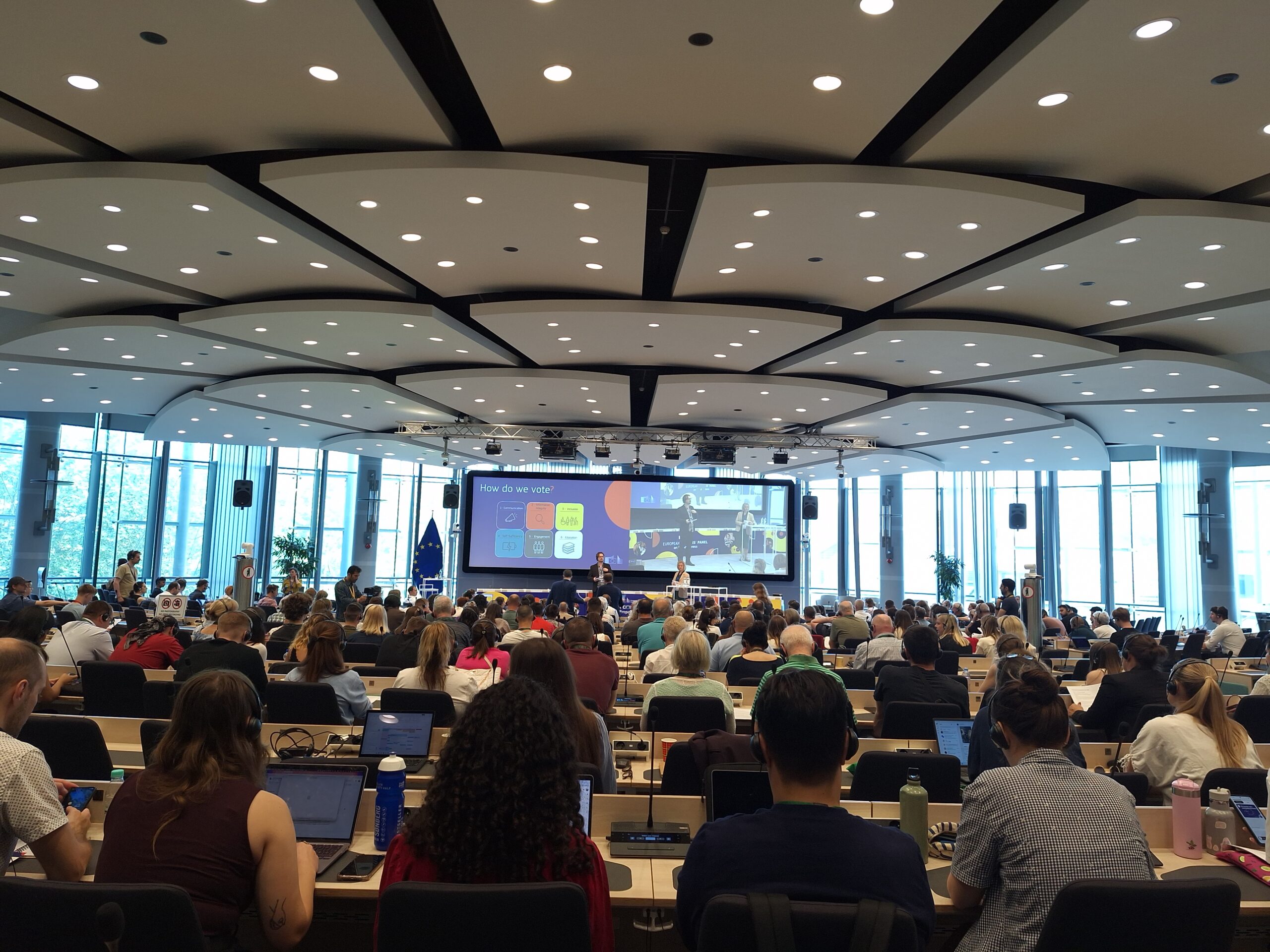
The EU Citizens' Panel. Credit: Souwie Buis
Attitudes towards defence
Citizens agreed on the need for increased defence budgets, one expert told us, but “the talk has been very little about war and conscription and military service - surprisingly little.” When asked to elaborate on this, she refused to be drawn further, saying only that it was perhaps because the issue of war was “out of scope” to avoid it “taking all focus”.
Another expert raised the issue of the NATO-linked Host Nation Support (HNS) framework which requires large amounts of pre-planning and co-ordination between civil and military authorities across member states. He admitted his surprise at how little discussion there had been on how the civil sector might assist the military in the event of war.
On the virtual panel, open to all European citizens, the possibility of a European army was raised. The proposal gained 54 votes in favour and 43 against, with 40 neutral votes. Yet the idea that Europe should be capable of defending itself without relying exclusively on NATO got just one vote.
Similarly, a proposal for the re-introduction of civil and military service got exactly zero responses. Luca Paiusco, who put forward the proposal, explained that after several years of volunteering, he sees “a disconnect between young people and the whole social world”, and believes that “both military and civil service can bring young people closer to the real problems of society”.
The composition of this Citizens' Panel on Preparedness was deliberately skewed toward young people, with 16 to 29 year olds making up one third of participants.
Luna, 29, and others in her group came up with the idea of an EU-wide digital platform for volunteering, but discussions of how much, if anything, such people should receive for their efforts were as far as it went. Mandatory civilian service or conscription were not included.
Assessing the results
What are we to make of this? The strongest levels of support both online and offline were reserved for preparedness education, building societal resilience against cyber threats and disinformation and greater digital, food and energy independence.
Speaking to participants at the final event, feedback was largely positive. Marten from Belgium whose group worked on elements of digital and cyber security preparedness, admitted that his conversations with those in his working group had “humbled” him and that he had “had to reconsider a lot of [his] positions”.
Paco from Spain, meanwhile, put it like this: “Look, I think the mere fact that they [the Commission] allows us citizens to participate is a sign that democracy is alive. And for that reason alone, the European Union deserves applause.”
Yet he also admitted that differences were many, describing those between his country and others like Finland and Austria as “brutal”.
To observe participants in their working groups was to see the European project blossoming in real time. Even those who were initially skeptical were brought round eventually. Aidan from Ireland admitted that, “as the weeks progressed, I kind of warmed to it”. He spoke of the “genuine love for the European Union and for the betterment of the European Union” that he saw amongst his fellow participants.
The question, therefore, is why this golden opportunity was not used to greater effect. Why were practicalities rather than politics prioritised so that an opportunity for frank discussion about issues that affect all European citizens became an almost exclusively technical exercise?
But it remained an almost exclusively technical exercise, and there was a striking lack of frank discussion on the realities of conflict and how it might affect European citizens in the 21st century.
As Christina Andersson of the Swedish Civil Contingencies Agency and member of the Knowledge Committee explained, “Sweden is quite unique in how openly we communicate the threat of war to our citizens and in our commitment to transparency. Many countries express both surprise at and interest in this approach."
In keeping with the Nordic model, why not make greater use of these panels to allow the citizens of Europe an opportunity to grapple with some of the really tough issues with which we are faced and trust them to find a way through the moral maze and emerge, fair and faithful to our values, on the other side?
