
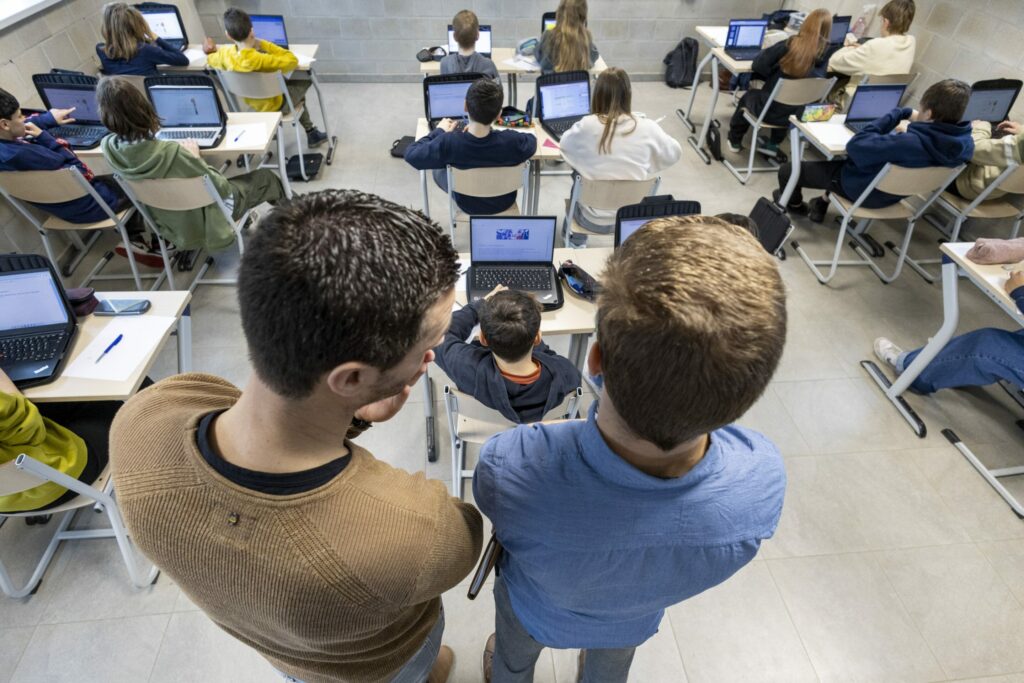
As an increasing number of French-speaking and international pupils are signing up for Dutch-speaking schools in Brussels, Flemish Education Minister Zuhal Demir (N-VA) wants to ensure Dutch-speaking Belgians can still get a place.
Currently, 65% of places in the first year of Dutch-language secondary education (pupils aged 12 to 18) in the Brussels-Capital Region are reserved for Dutch speakers. With more non-Dutch speakers enrolling in the system, however, Demir is considering increasing this percentage.
"With all due respect, Dutch-language education in Brussels is primarily intended for the Flemish people living in Brussels," said Demir in the Education Committee last week.
According to her party colleague Griet Vanryckeghem (N-VA), some Flemish parents are finding that there are no longer any places available for their children in Dutch-language schools in Brussels. Demir stressed that this is "of course, not the intention".
"In Flanders, it is simple: everyone attends Flemish-language schools there. In Wallonia, everyone attends French-language schools. But in Brussels, the two education systems meet, and people can choose in which one to enrol their children," Demir's spokesperson, Olivier Van Raemdonck, told The Brussels Times.
Growing popularity
While in most cases, Dutch-speaking Brussels residents attend Dutch-speaking schools and French-speaking residents attend French-speaking schools, there are plenty of exceptions in the Belgian capital.
"There are children from international families, whether their parents work for the European institutions or are asylum seekers," Van Raemdonck said. "Everyone is welcome, of course, but we also want to ensure that the children of Dutch-speaking families do not miss out."
Belgium's Dutch-speaking education system is historically seen as better than its French-speaking counterpart, and consistently ranks much higher in international reports. As a result, plenty of parents opt to send their children to the Dutch-speaking system.
"The Dutch-speaking system risks being overburdened," Van Raemdonck said. "And while we are definitely not against popularity, a child from a Dutch-speaking family in the City of Brussels or Schaerbeek should not have to commute to Vilvoorde simply because there is no place available in Brussels."
That, he stressed, would be "unacceptable". As a result, the government will be reviewing the so-called "priority rule" for Dutch speakers to assess whether 65% is still sufficient, and whether proper checks are being carried out to ensure that at least one parent is proficient in Dutch.
Credit: Jeswin Thomas/Unsplash
How to qualify
To qualify for priority, at least one parent must speak sufficient Dutch. In practical terms, this means that this parent must hold a Dutch-language qualification of level B2 or higher.
Demir wishes to examine whether this level is being properly monitored and whether the 65% quota is still sufficient. A data and legal analysis will be carried out to see what is possible.
In the committee, Demir also spoke about the Flemish Government’s investments in Brussels’ education system.
Since 2010, €125 million has already been invested, she said. This has created 5,600 places in primary education and nearly 2,000 places in secondary education.
Yet, there are still not enough places: a further 1,900 places need to be added in secondary education over the coming years. According to Demir, by 2030–2031 there will be a surplus of around 1,300 places.
This, however, does not mean that parents will always be able to choose where their children go to school from 2030. "There will always be popular and less popular schools. Not everyone will be able to go to their first choice," said the minister.
The aim is for this review to be discussed in Parliament this autumn.
