
Belgium's complex state structure might soon become even more complicated, as Georges-Louis Bouchez, the leader of the Francophone liberal MR party, is calling for the "French-speaking federalisation" of the powers of the regions.
This does not mean that Bouchez wants a fully Francophone Belgium, but that he wants to rejig certain powers between the regions and communities on the French-speaking part of the country.
"I am a strong advocate of the French-speaking federalisation of powers, meaning to assign more powers to the French Community rather than to the Walloon and Brussels regions," he said in an interview with UCM Magazine, a monthly publication for the self-employed and SME owners.
These powers, Bouchez said, would concern "foreign trade, everything to do with the international image, even issues relating to economic development".
How would that work?
Let's start at the beginning. While Belgium was formed as a unitary state in 1830, it evolved into a federal structure with three regions and three communities, each with its own autonomous powers.
As a federal nation, Belgium is divided into different smaller "states". As such, power is not centralised in one overarching government but distributed over smaller semi-autonomous entities.
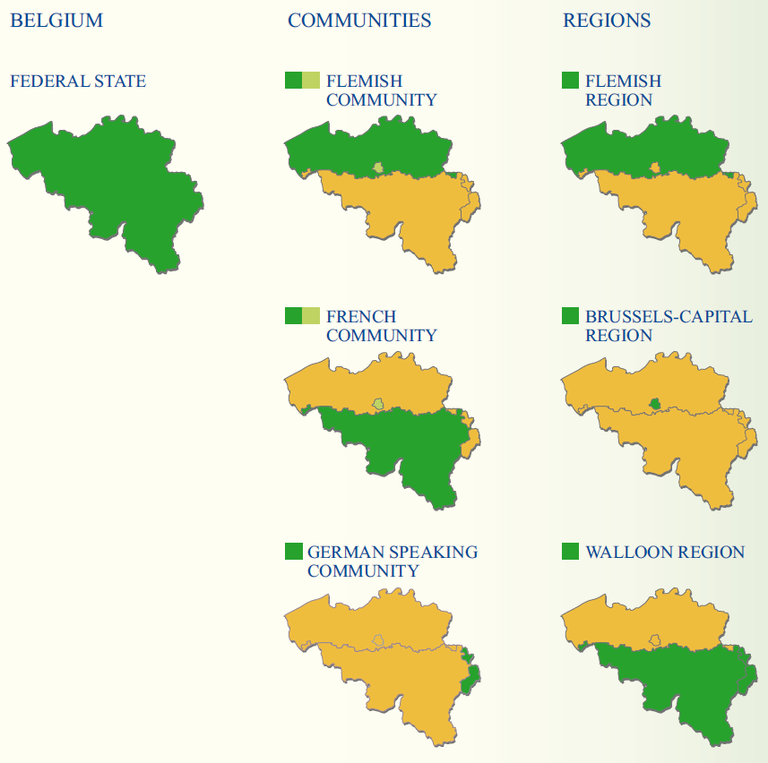
For Flanders, it was important to make its own decisions about language and culture, while Wallonia wanted more sway over its own economy. This resulted in a (re)distribution of powers in 1980 – a true compromis à la belge that meant the country was divided in two separate ways.
Geographically, these two lines of division separate the Germanic and Latin cultures, effectively cutting Belgium in half at the language border.
Credit: Wikipedia
The first division largely comes down to language differences and is the reason the three communities were created. In addition to linguistic matters, the communities also deal with everything related to persons and more broadly, everything cultural (meaning, the bonds that unite population groups).
These governments make decisions on the so-called "soft" matters within their territory: education, health and welfare, culture, languages and sports.
The second line of division was historically inspired by economic interests. The different territories sought more autonomy, resulting in the creation of three regions to deal with so-called "hard" matters: economy, employment, urban planning, mobility, infrastructure, environment and housing.
While the regions were created mostly according to geographical locations, the communities are language-based. (That is also why the German-speaking municipalities of Belgium are part of the Walloon Region, but not of the French-speaking Community.)
Normally, this would result in Belgium, with its nearly 12 million inhabitants, having seven governments: one for each of the three regions, one for each of the three communities and a federal one.
In Flanders, however, the Flemish Region and the Flemish Community decided to merge their parliaments and governments as soon as they were created – turning them into a single entity, usually simply referred to by the umbrella term "Flanders."
'Brussels hinterland'
In French-speaking Belgium, such a merger did not happen. Powers remain divided between the Walloon Government and the French-speaking Community Government (also known as the Federation Wallonie-Bruxelles – FWB).
Especially for the latter, this often complicates matters, as the FWB's powers extend not only to Wallonia but also to most of Brussels.
Now, Bouchez has proposed to change this by taking away certain powers from the Brussels and Walloon governments and giving them to the French-speaking Community.
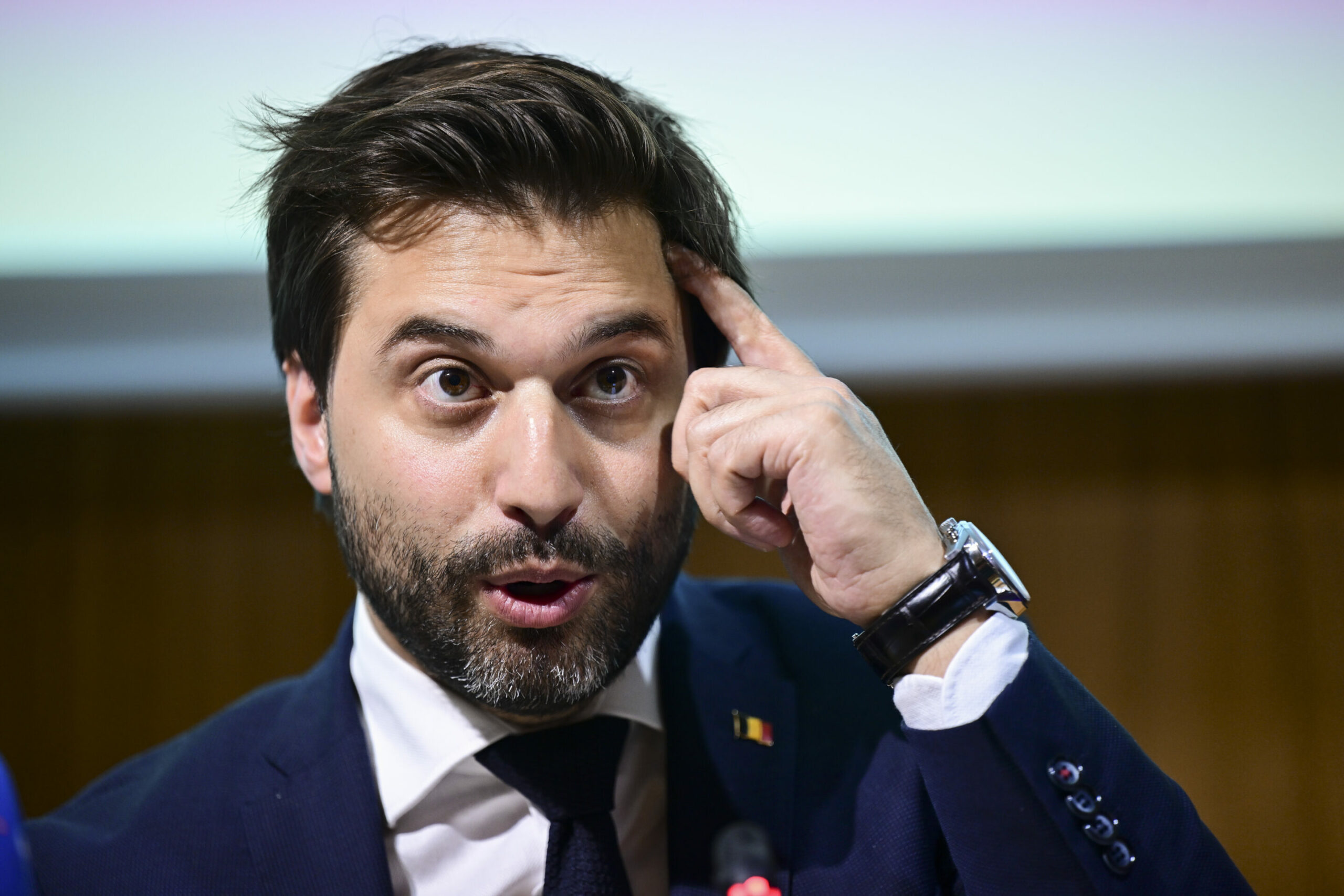
MR leader Georges-Louis Bouchez. Credit: Belga / Laurie Dieffembacq
According to Bouchez, a large part of Wallonia is "nothing more than Brussels' hinterland" in economic terms. Conversely, he said, Brussels is "ultimately nothing more than the economic showcase for a Wallonia that still has room and capacity to offer."
Additionally, Bouchez stressed, half of Brussels’ GDP comes from commuters.
"I think the greatest advantage for the French-speaking community in this country is that Brussels is overwhelmingly French-speaking, and this is not being utilised sufficiently," he said. "Walloon politicians must realise that Brussels is the driving force behind economic development."
At the moment, the Walloon government and the French-speaking Community government consist of the same parties: MR and centrists Les Engagés. In their policy statements, they emphasised their aim to "modernise the Francophone space" in Belgium and to slim down the two governments as much as possible.
Political fiction
Bouchez told UCM that "discreet meetings" had taken place between his MR party and Les Engagés.
However, to actually implement such a reform, a two-thirds majority is required – something which the two of them together do not have. This means that the opposition parties (socialist PS, green Ecolo and radical leftist PTB) must also be persuaded.
"We must first ensure that we have something substantial to offer them, and only then can we enter into discussions," Bouchez said.
What's more, because this reform would also affect Brussels, the Dutch-speaking community would also need to be persuaded. Not only is Brussels a bilingual region with a parity-based administration, but it is officially also the capital of Flanders.
However, it seems very unlikely that Flanders would be willing to compromise on some of these "hard" powers – something that would upset the carefully constructed balance between the two sides of the country.
Therefore, some are calling Bouchez's proposal "political fiction".
During the previous parliamentary term, when the socialists were still the largest party in French-speaking Belgium, PS leader Paul Magnette wanted to take the opposite approach: he sought further regionalisation of powers to establish an institutional system based on four regions. That project never came to anything.
