
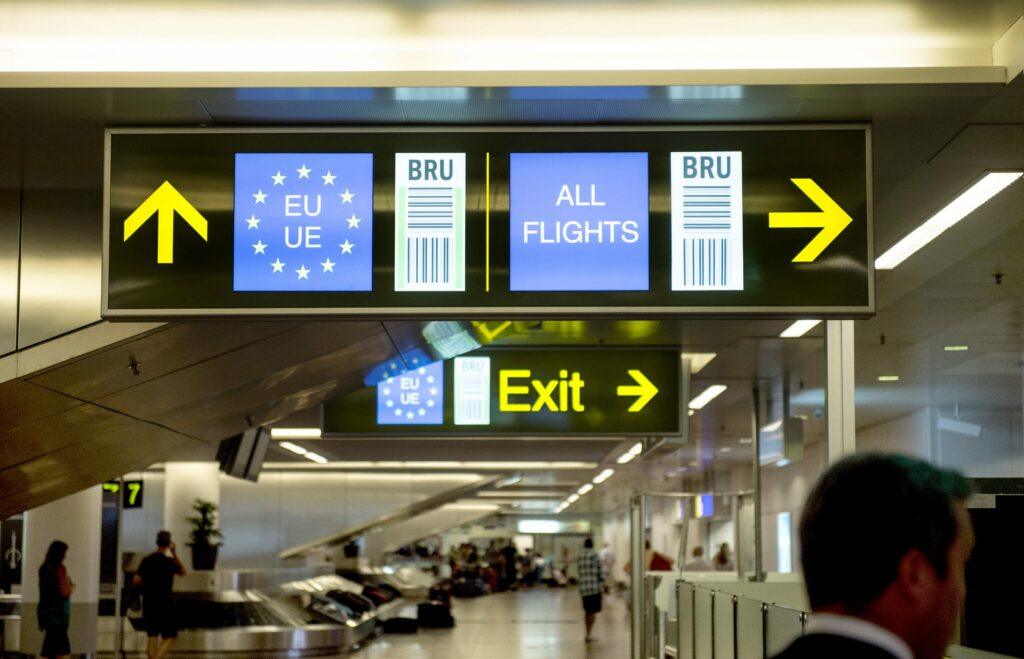
The EU’s new Entry-Exit System (EES) for non-EU citizens has created chaos this summer at airports around Europe with hours-long queues, while the European Commission claims that Member States said they were ready for the system.
The industry organisation Airports Council International (ACI) recently sounded the alarm about an unsustainable situation at border controls, with queues of up to five hours and planes being forced to take off half-empty from Europe.
As previously reported, the EES was launched last October and progressively rolled out over the following months to give the Member States more time to adjust until it was fully implemented in April this year.
The EES is an IT system that digitally records the entries and exits of non-EU nationals travelling to 29 European countries (EU Member States, except Cyprus and Ireland, but including Iceland, Liechtenstein, Norway and Switzerland) for short stays. It applies to non-EU nationals travelling to a European country with a short-stay visa, or who do not need a visa to stay for a maximum of 90 days in any 180-day period.
Under the system, travellers from third countries are required to provide data, including biometric information, such as fingerprints and facial scans, as well as their passport and other travel information, such as arrival and departure dates and places.
The Brussels Times reported in June that passengers at Brussels Airport faced hours-long queues as a result of the new European border control system. Non-EU passengers arriving at the airport in Zaventem spent up to four hours waiting at passport control, while those departing the country faced queues of up to one hour at border control.
Already back in January, a Brussels Airport spokesperson told The Brussels Times that the rollout of the EES had contributed to border control queues of up to three hours for arriving passengers, increasing the need for staff at passport control.
At the press conference following the official opening of the Irish EU Presidency last Friday, European Commission President Ursula von der Leyen was asked about the delays at the airports because of the EES. The system had not changed the legal system but increased transparency, she replied, adding that there was still a lot of work to do to solve the technical problems.
A Commission spokesperson was more optimistic when asked the same question at the Commission’s press conference on Monday, saying that the system had already proven its value by preventing 1,000 people who would pose a security risk from entering Europe. In practice, the system works well in most of the 1,500 border controls that apply it, the spokesperson added.
Any lingering problems were the responsibility of the Member States, according to the spokesperson. Member States had reported to the Commission that they were ready for the roll-out of the system, but apparently had not solved structural problems linked to space for the new equipment (self-scanners at the airports) and staffing.
He disclosed that the system has an inbuilt flexibility which the national authorities can avail of. If the situation requires it, they can temporarily suspend the biometric information, but they would still have to carry out the security checks as before.
Asked about the use of the mobile app "Travel to Europe", which is already used by Sweden and, to some extent Portugal, the spokesperson told The Brussels Times that the app is very good and shows good results. However, it is not widely used because its adoption is strictly voluntary for individual EU Member States, meaning most countries have not yet integrated it into their border systems.
"In Sweden, we don ot use self-scanning machines, but you do it at home on the couch using the app," explained Louise Wahlberg in an interview in Swedish daily Dagens Nyheter. She was project manager for the introduction of the app and is a member of the Commission's Smart Borders Committee.
"You register information from the travel document and take a facial image that is sent to, for example, Arlanda airport. When you arrive at the manual check-in at Arlanda, you scan the travel document and the information is then entered into the system," she said. "By using the app, you have saved 20 to 25 seconds per traveller."
That time reduction is apparently crucial. "Sweden and a couple of other countries were the first to test the app when it was launched. And then the other Member States have not caught on. The other EU countries have also had technical problems and difficulties getting the service kiosks to work. We gave up on the kiosks and just focused on the new digital way of registering through the app."
