
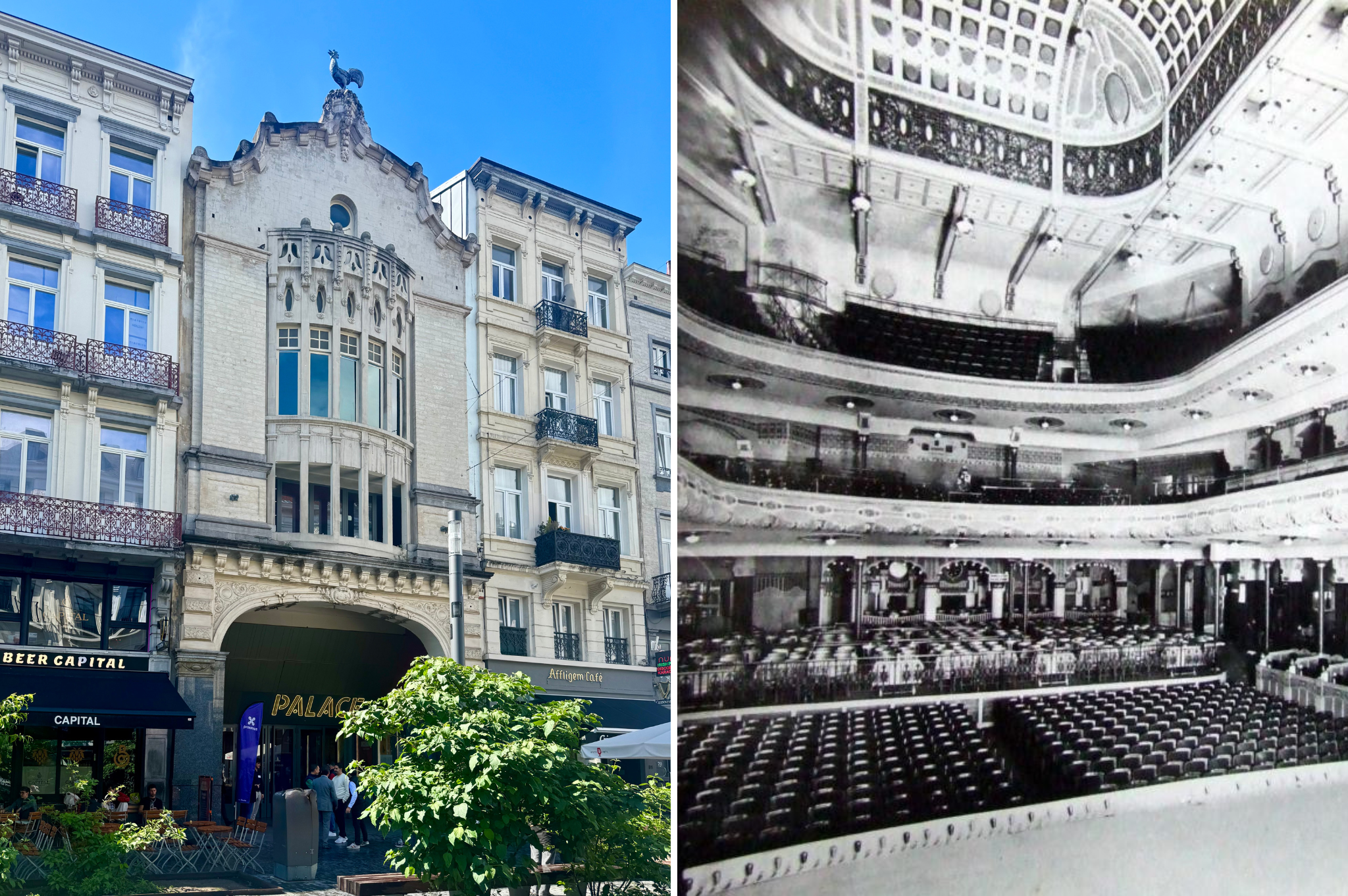
The Palace cinema is a puzzle of a building. One of the most affordable and comfortable places to see a film in Brussels, it is both the most modern cinema in the city and a protected monument of the Art Nouveau period. There are three entrances: one on Boulevard Anspach at number 85, one through a brasserie to the rear and another punched through an old house on a side street. These lead to a light-filled, jagged atrium that stretches from basement to roof, where the visual note is raw concrete rather than Art Nouveau.
At least six architects have transformed the site over the past century-and-a-half. Alain Richard, who has spent the last 20 years studying its secrets, is responsible for this new minimalist version, where he removed more than he built. Here, cinemagoers lining up for tickets can see the concrete undersides of the seats they are about to occupy. But this is no brutalist affectation: the exposed concrete pillars are vintage artefacts. Patting them, Richard says, “this was put there by Paul Hamesse in 1913, and this is from 1950.”
The changes made the Palace an open book. The cinema tells stories from across Europe and the world, but even without switching on a projector, it tells the story of its neighbourhood, the historic core of Brussels, ready to be decoded. For Richard, it is “a space that is above all a void with walls that tell the story of a century: there were little houses here once, with their feet in the river.”
The island
The site of the Palace cinema was once the eastern bank of the Grande-Île, which was once at the core of Brussels. The largest of the islands formed by loops in the vanished Senne river, it was long thought to be the origin of the city where a stronghold was built amid flood plains carpeted with the iris flowers that would become the symbol of the Brussels region. The river was covered over between 1866 and 1871, mostly for reasons of public health. In its place, mostly for profit-seeking reasons, a wide boulevard was ordained, stretching over 2km north to south.
Corruption, incompetence and overreach plunged the downtown scheme and the city into a financial morass. It scaled back plans for a grid pattern covering the demolished zone of the island, leaving deep, shapeless blocks behind the arrow-straight new boulevard in need of quick development. In November 1880, it sold a sprawling 1,385m2 plot in the shape of three unequal lobes, resembling the drooping petals of the iris, to investors planning a Brussels version of the prestigious Hôtel Drouot auction house in Paris. Buried mid-block, the sunless core of the site was useless for housing but its first architect, Albert Dumont, made a virtue of the shortcoming, lighting up a cavernous sales room with a glass roof. At the edges of the plot, he threw up a sober, narrow, classical entry facade at 85 Boulevard Anspach and two wider ones on the side streets, Borgval and Rue Van Praet.
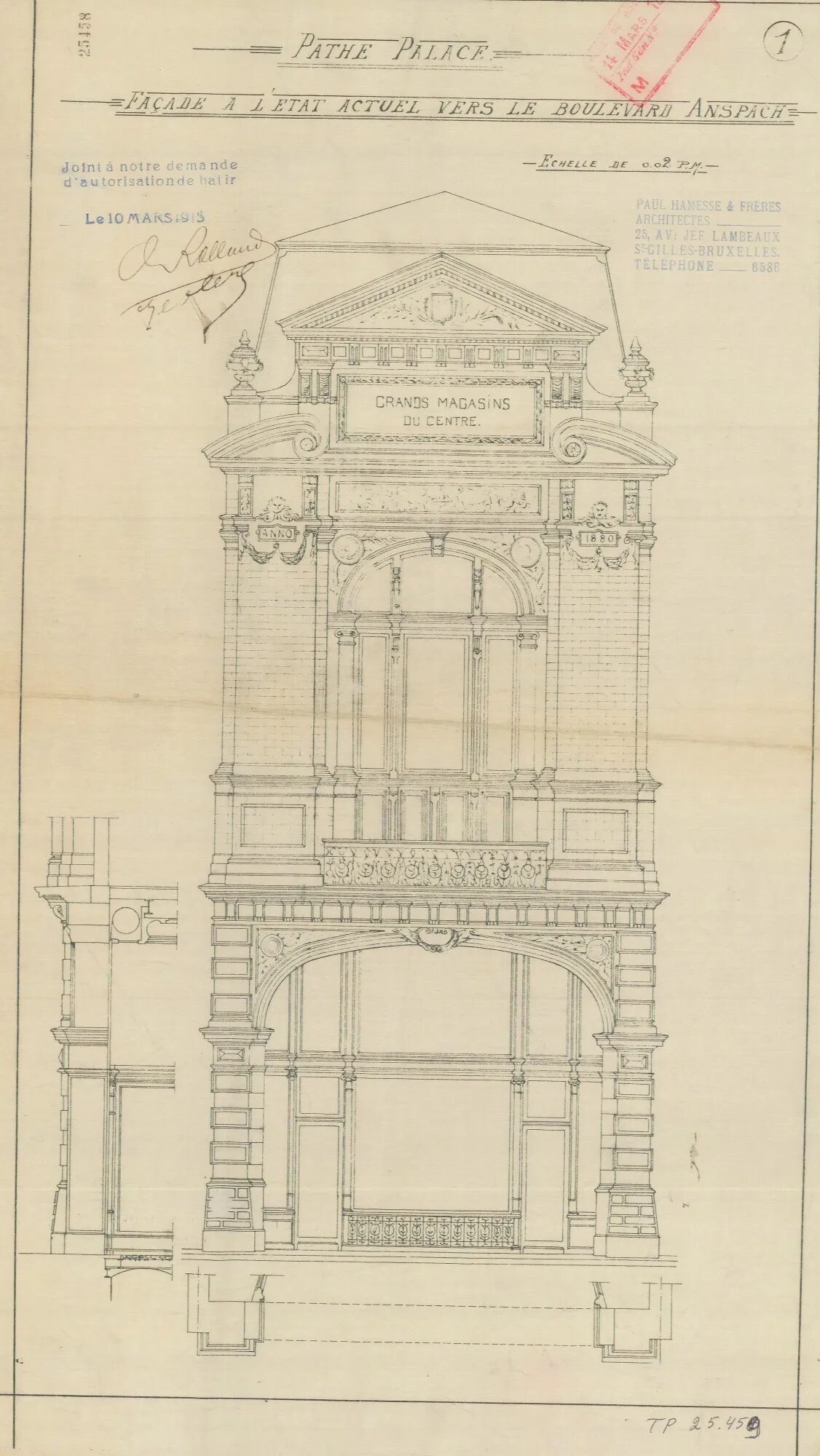
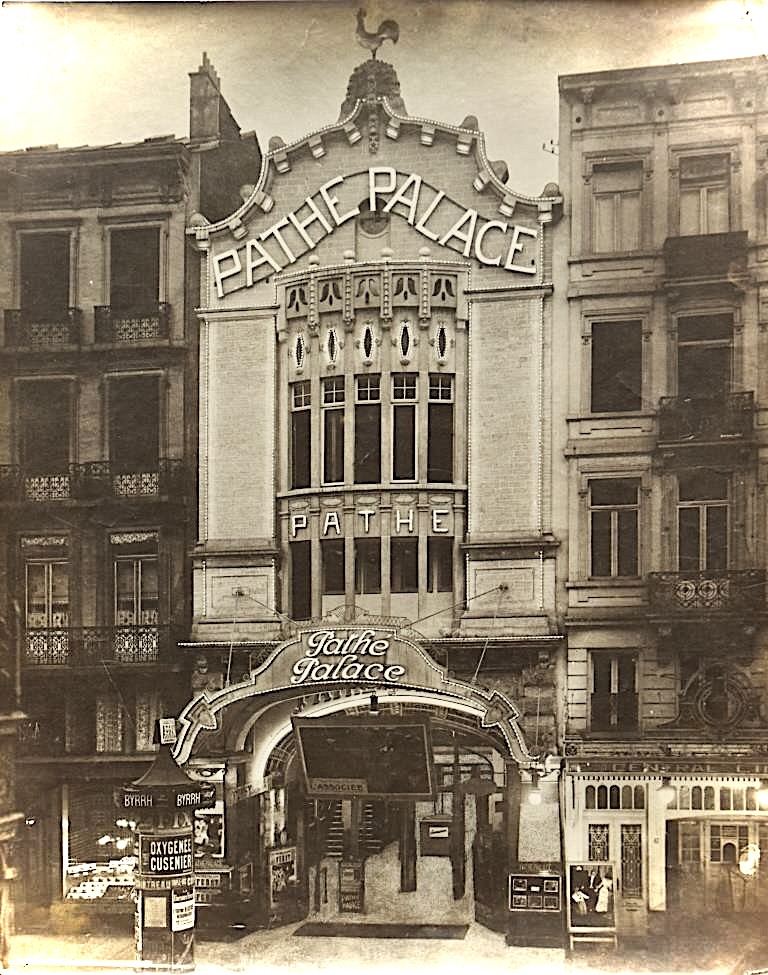
Facade of the Cinema Palace building in 1913
The transformation of the city centre had spurred the urbanisation of the suburbs, and their new inhabitants came to this new commercial zone to seek furnishings for their homes. By 1905, the sales room had been transformed into a department store selling fitted suites for bedrooms, dining rooms and salons. The architect for conversion number two, Henry Rieck, widened the entry into a flattened arch, recording the date on a stone plaque that survives today. This date confused and intrigued Alain Richard as he drew up his own conversion for a 1913 movie house: “What is magnificent about this place is that its history merges with that of cinema, with that of the roofing over of the Senne and the creation of the central boulevards, and they all feed into each other.”
Pathé Palace
By 1913, there were 90 cinemas in Brussels, according to trade journal Courrier Cinématographique, which called the city “the Eden of cinema”. The surging population in the wealthy eastern suburbs of Brussels, by now capital of a lucrative empire, had attracted the attention of French entertainment and media giant Pathé.
Pathé had already commissioned two modest cinemas from local architect Paul Hamesse (a former pupil of Paul Hankar, who co-invented Belgian Art Nouveau with Victor Horta in 1893). Hamesse had already converted a department store in Rue Neuve for the Cohn-Donnay family using the latest construction techniques. He had also transformed their 1840s home in Rue Royale, taking inspiration from the latest design trends of the Viennese Secession movement (it is now the restaurant De Ultieme Hallucinatie). In 1910, Hamesse had co-designed the neo-Louis XVI interior for the conversion of a shop into a fashionable new café (now top Brussels tourist draw À La Mort Subite).
Meanwhile, the fortunes of the old quarter of the Grande-île had risen since the devastation of the 1870s demolitions. Around its working-class core at Saint-Géry, where 17 earthy cabarets surrounded the covered market, the more polished streets on its periphery attracted deeper pockets. From 1885, the solidly middle-class Brasserie Flamande (now Beursschouwburg) on Rue Auguste Orts, with billiards, concerts, a garden and host to a score of clubs, was the anchor attraction for the northern edge of the old island quarter. By the early 20th century, it was home to artists, journalists, stockbrokers and rentiers who could enjoy the sumptuous fittings of two tavernes (code for bourgeois hospitality), the Greenwich and the Bass, in nearby Rue des Chartreux, the western fringe of the island.
By that time, many of the so-called cinemas of Brussels were just cafés with a rented projector, and when the iris-shaped plot at 85 Boulevard Anspach was freed up in 1913, all the elements were in place for Pathé to create the city’s first “palace of cinema”. They had a fashionable architect tested in store conversions large and small, experienced in modern construction and with a flair for eye-catching interiors. They had a site with capacity for both the largest screening room in the city and a multitude of extra attractions, just a few doors along from their new record shop at number 105. The competition, cafés, brasseries, taverns and theatres had delivered a moneyed crowd to Pathé’s new doorstep, and it planned to poach their custom with a very special slice of Eden.
Playtime
For conversion number three, Hamesse updated Dumont’s austere commercial entrance on Anspach with the architecture of entertainment, a festive array of features borrowed from his own playful suburban houses but on a much larger scale. A curved bow window with vertical struts open to the elements, like a section from a birdcage lent jaunty airiness. Atop the swagger of a voluted cornice sat an uncaged bird, a pert metal acroterion in the form of Pathé’s trademark cockerel. A co-branding between the film company and Hamesse’s own practice, it was this, the first and only Art Nouveau street frontage in the central section of the boulevard, that decades later would win the building’s protection from demolition.
Inside meanwhile, Hamesse wielded his spatial and decorative magic to enthral and retain the public once coaxed across the threshold. He filled the void left by the demolished store with tier upon tier of dreamlike decor hung, as in a movie sound stage, from a cat’s cradle of slim reinforced-concrete pillars and steel girders. When it opened in December 1913, Pathé Palace had capacity for 2,500 people. The cavernous auditorium in the Borgval wing seated 1,973 beneath a vast decorated cupola in stalls facing the orchestra pit and on two curved balconies lined with buvettes for refreshments. Examining the original plans, Alain Richard was struck by Hamesse’s “masterful use of the site with his superb orientation of the grande salle. There were bars everywhere, even in the basement. Cinema was silent, so it was ok to chat.”
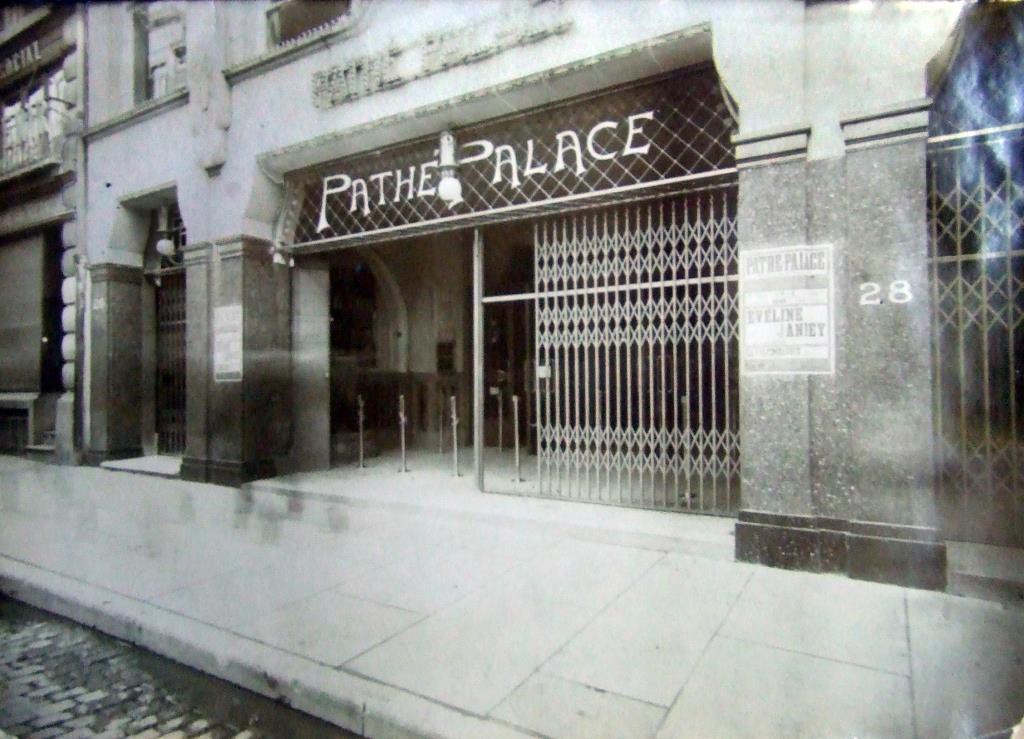
Pathé’s Palace
These days, the Palace cinema has strict rules on eating, drinking and conversation: nothing that might distract other customers from the film. In 1913, Brussels crowds accustomed to raucous music halls and the café-concert weren’t in the habit of keeping their thoughts to themselves and would talk, scoff and quaff as they wandered to and fro.
The Palace’s opening night, a Christmas-period royal charity event in the presence of the mayor of Brussels and the massed ranks of the city’s demi-monde, featured turns from various Pathé stars: an opera singer, Comédie-Française actors from Paris with a side-hustle in the movies and turns from Georges Vinter as his popular detective character Nick Winter.
During intervals, the public spilled into the array of spaces, some intimate, some grand, created by Hamesse, "singing the praises of the wonderful decor of the foyers and galleries". As well as the brasserie and fumoir, the Van Praet wing hosted a winter garden on the first floor. Bent-cane wicker furniture and pergolas familiar from guingettes and department-store rooftop tea terraces surrounded a fountain under a backlit glass roof and with a backdrop of glass walls painted with scenes of nature. From here, a passage led through the orientalist loucheness of the ‘bar mauresque’ to the galleried foyer in the Anspach wing, decorated with signature Hamesse touches from his Viennese Secession-inspired work at the Cohn-Donnay mansion. “The Palace of One Thousand and One Nights that Brussels was lacking,” was the verdict of Le Journal de Bruxelles.
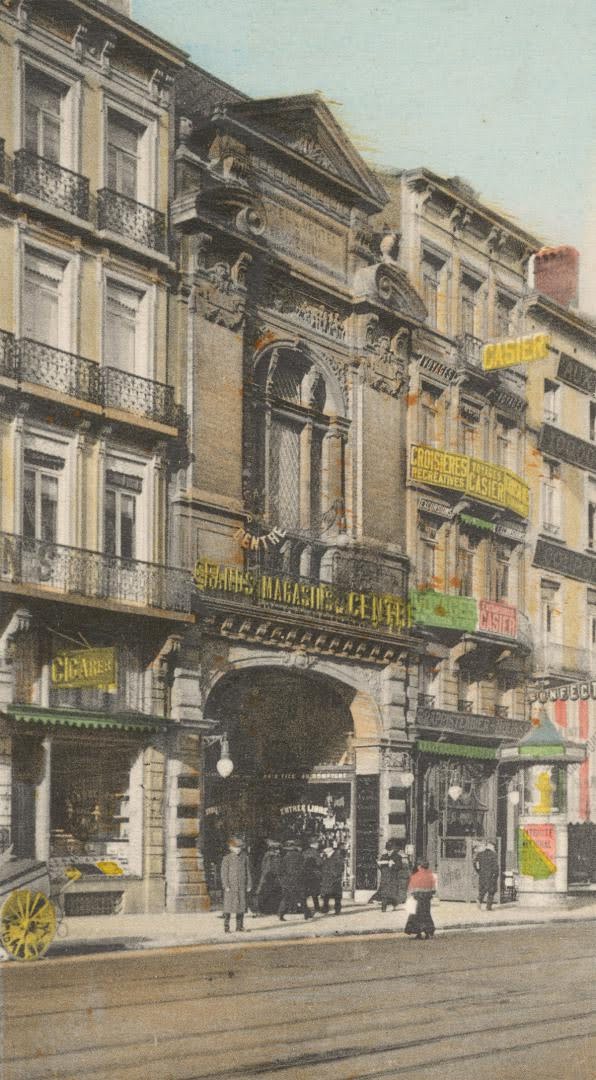
A previous iteration of the Cinema Palace when it was a department store
The Pathé Palace in this original form was a hybrid attraction, built on the cusp between two very different periods in entertainment: one where the public still played an active role, seeing and being seen on balconies that faced each other rather than the stage, moving around the room and interacting with the spectacle. The first feature film shown was Les Trois Mousquetaires, directed by Henri Pouctal and produced by a Pathé affiliate, but early silent movies were often short, crude by later standards and regarded as part of a variety bill.
Modern times
In the postwar period, filmmaking became more polished, and feature films dominated, edging out the music-hall turns. The Palace’s layout was uncomfortable for audiences craning their necks to follow complex narratives demanding their attention for upwards of an hour. The sophistication of scenery in epics such as Fritz Lang’s futuristic Metropolis of 1927 made the building’s off-screen decor look old hat, the fantasies of the previous generation. Cinema sound arrived the same year with The Jazz Singer and loudspeakers were installed at the palace as a series of mini-conversions began. The orchestra pit was replaced with additional seating trained on the screen. In the mid-1930s, Pathé adjusted the rake of seats in Hamesse’s frowsty old Palace amid competition from comfortable, modernistic feature-film-and-talkies-native venues such as Adrien Blomme’s 1932 Métropole (now Zara clothing store) and Marcel Chabot’s 1933 Eldorado (one of Brussels’ surviving Art Deco glories).
After the Second World War, cinema operators saw that putting the movie at the centre of a night out was the key to profitability. Pathé commissioned Antwerp architect Rie Haan, who specialised in breathing glamorous new modernist life into large ageing buildings, to execute a radical new conversion of the Palace.
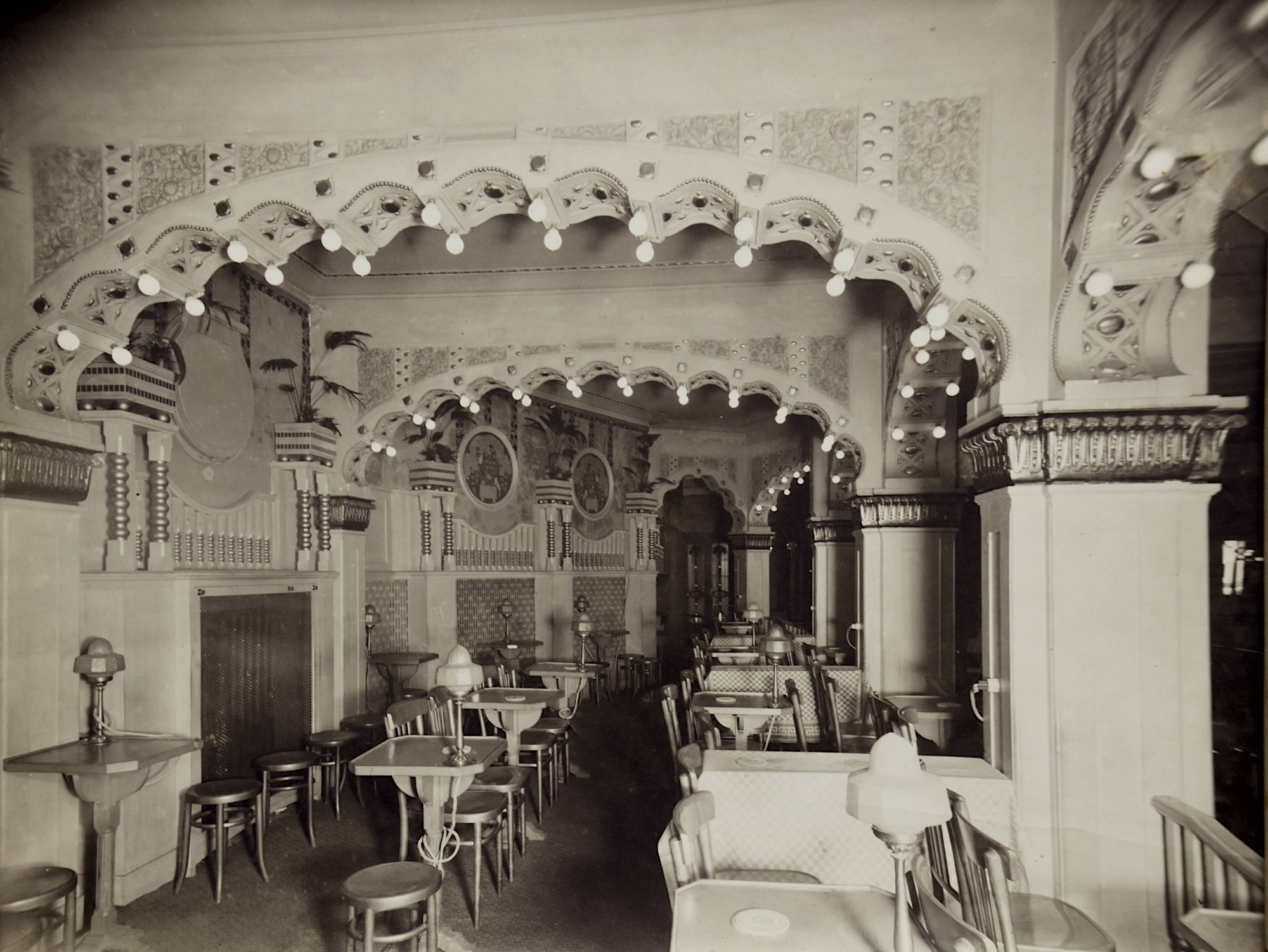
The foyer inside the Pathe cinema in 1926
For conversion number four, Haan poured new concrete to reinforce Hamesse’s slender pillars and support a vast new forward-facing balcony to replace the old ones. The noisy lateral bars were walled up along with the winter garden and the Art Nouveau foyer, and a false ceiling hid the soaring distraction of Hamesse’s original cupola. The new, streamlined design of 1950 funnelled the public in and out of the building rather than around it. This restrained, modernist decor reflected the aspirations of a new generation and hid the fantasies of its grandparents behind the sleek new acoustic shell.
The last picture show
In 1952, the historic iris-shaped plot was split up when the Van Praet wing was sold to Flemish cultural association Het Brussels Tehuis, and converted by Rie Haan into a community centre, the Hendrik Consciencehuis. A Flemish-themed café was installed on the ground floor. Above it, the cause of Belgian federalism was debated in a modern meeting room, which replaced the winter garden. Receptions for Dutch-speaking newly-weds were held in the basement.
As the postwar consumer boom progressed, TV and car ownership surged, threatening the profitability of cinemas such as the Palace and degrading its neighbourhood with noise and pollution. Fun-seekers deserted the increasingly dingy, dark and often rainswept streets around the old island quarter for brighter, cleaner spots where it was easier to park or more pleasant to walk. The young flocked to the warm, well-lit modernist interiors of the new galleries along Avenue de la Toison d’Or, arriving by the new express car tunnels instead of clanking trams. The 1950 auditorium of the Palace was denied a further upgrade to a wide screen to tempt people away from their lounges and Pathé ran the venue down, closing it for long periods. By 1973, as the effects of the oil shock were felt, it had ceased operating and Pathé itself would soon quit the Belgian market.
That same year, the complex was sold to the owners of that avatar of Brusselization and of the nadir of the downtown, Parking 58. In 1976, the Palace was leased to household appliances manufacturer Bauknecht. The Anspach wing became a showroom for white goods, mutilating the long-hidden Art-Nouveau foyer of 1913. In Haan’s grand auditorium, the seats in the stalls were ripped out and holes punched in the Borgwal facade behind the old screen to allow shoppers to park their cars below the balcony. For its fifth conversion in 63 years, the Palace had become a drive-in, literally.
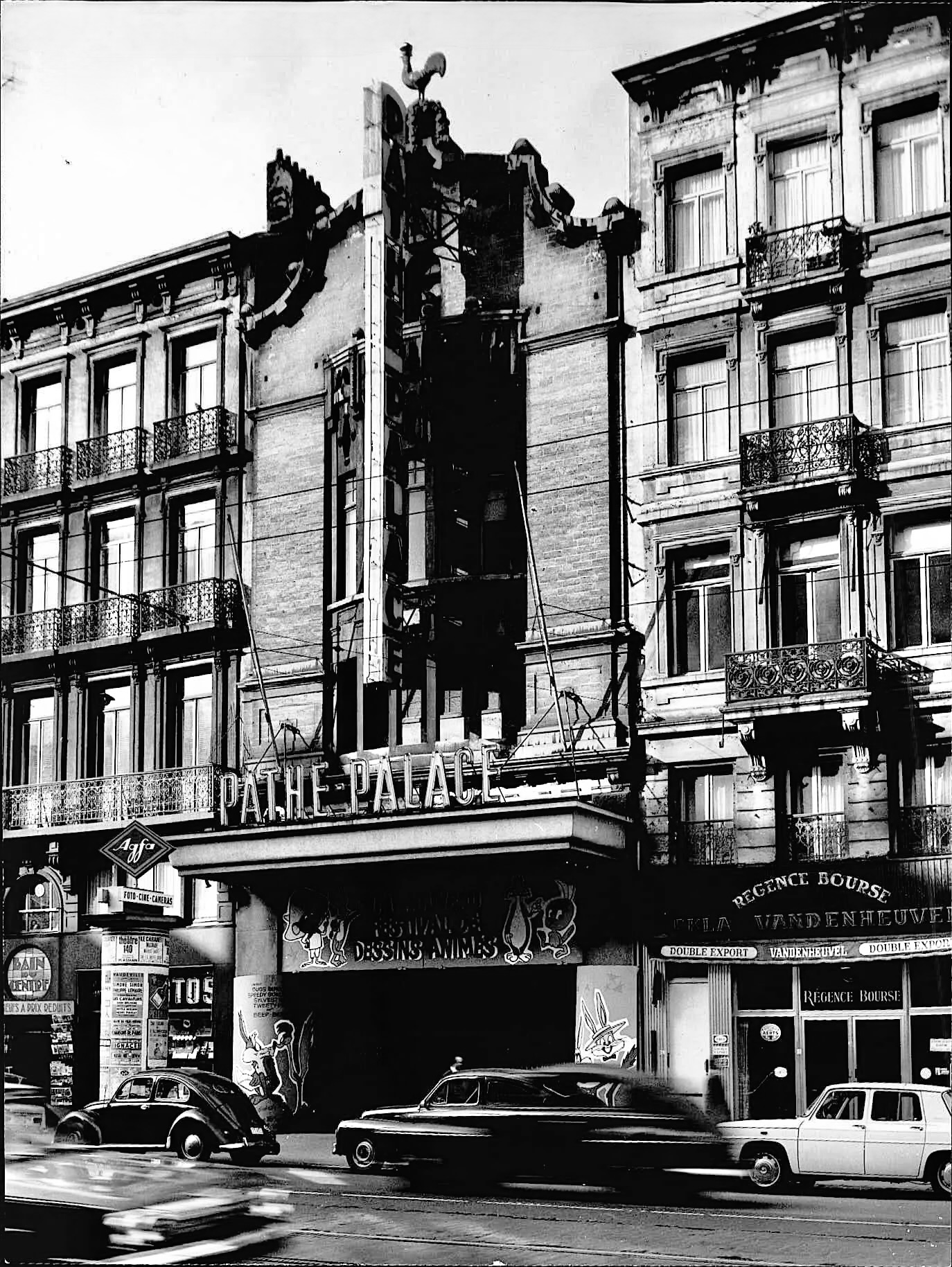
Cinema Palace in 1965
As for so many defunct Brussels cinemas hidden behind retail facades, the story might have ended there but for a sudden upturn in the fortunes of Art Nouveau heritage. In May 1993, in a first for Belgium, a developer with the connivance of a local mayor ignored the monument listing for a building and demolished it late on the Friday night of a holiday weekend with the intention of building flats and offices.
The building was a 1906 house by Paul Hamesse on Avenue de Tervuren. One of the original houses on the street, it dated from Hamesse’s Viennese Secession phase, he would soon echo at the Palace (its defenders championed it as a stylistic pendant to the nearby Palais Stoclet, erected at the same time). Like the cinema with its reinforced concrete frame beneath ornate trappings, it was an example of Hamesse’s startling modernity, with purpose-built bike storage in the basement (the avenue was built with cycle lanes from the start).
The commune had authorised the demolition knowing that the region had commenced the listing procedure. It set itself up as an authority in art history, dismissing the building as ‘Hamesseke’ (minor Hamesse). Not long in existence (it had been founded in 1989), the region decided to enforce its authority over built heritage mercilessly and the developer was eventually ordered to put the demolished facade back. This row lasted many years, but precedents were set for the planning powers of the region and for the value of Paul Hamesse’s architecture. Over the following decade, eight Hamesse buildings were awarded monument status, including the Palace in 1997. Its three street facades were protected along with the Art Nouveau entrance foyer and the original ceiling of the auditorium, both hidden for four decades and now in pitiful condition. This effectively put a heritage full metal jacket around and above the site, limiting its appeal for commercial developers.
A new hope
In 1989, the three wings of the complex were reunited under more respectful new ownership. Thanks to Frédéric Nicolay, the serial entrepreneur in the Brussels hospitality scene (creator of the Belga at Place Flagey), ‘PP’ café opened in 1994 in the Van Praet wing, a sort of Paul Hamesse theme bar assembled from fragments of the 1913 decorations and furniture retrieved from long-shuttered recesses of the building. In 1998, the upper parts of the Hamesse foyer were recreated from the surviving fragments and much decorative imagination, inspired by the architect’s designs.
The following year, conversion number six brought movies back to the building after 26 years with the inauguration of the three-screen Kladaradatsch! Palace arthouse cinema. Despite a recovery in the neighbourhood from its 1970s lows (thanks notably to a cluster of Nicolay ventures, including the Mappa Mundo and Zebra bars), the new cinema was unable to survive without public assistance. It closed in 2000, and the following year, the complex was bought for €5m by the Communauté française de Belgique (French language community – CFB), beating off competition from the Vlaamse Gemeenschap (Flemish community), which had to content itself with ownership of an old rival across the boulevard, the Ancienne Belgique, a former music hall from the period of the original Palace.
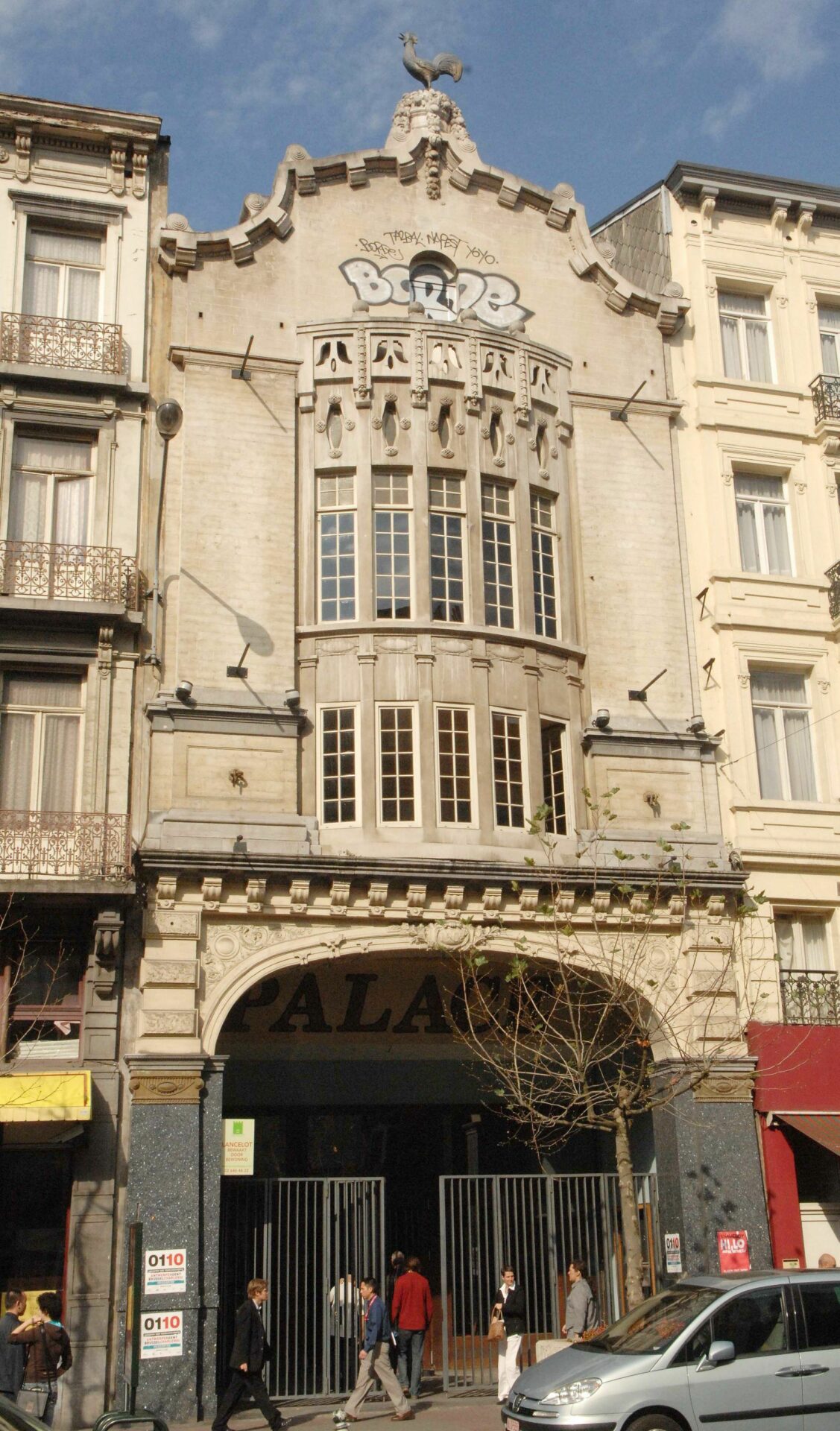
Illustration picture shows " Brussels Palace Cinema ", a building of the French Community that will be renovated as a multi-room cinema, Thursday 28 September 2006. Credit: Belga
The Palace briefly revived the thespian roots of its variety days, becoming home from 2001 until 2004 to the Théâtre national de Belgique (now Théâtre National Wallonie-Bruxelles) when the latter was evicted from the demolished Martini Tower. But the call of the silver screen was strong and in 2003, the CFB launched a tender to find an operator “to promote francophone Belgian cinema and the cinema of Europe in general”. A not-for-profit association led by Belgian filmmakers, the Dardenne brothers (ASBL Le Palace) was selected in 2004 and in 2006 Atelier d’architecture Alain Richard won the commission for a seventh major conversion with brighter prospects (CFB had decided to provide the new complex at no cost to the operator). CFB, now rebranded as Fédération Wallonie-Bruxelles, had been wise to bet on the site. By the time the new Cinéma-Palace was completed in 2018, the old quarter of the Grande-île was thriving at the heart of the new pedestrian zone.
Back to the future
In the latest conversion, the Palace revisits its own past and the past of Brussels. Alain Richard describes his architectural narrative as “creating a void”, the opposite of Rie Haan’s box within a box. Revisiting Dumont’s 1881 original, a new glass roof brings sunlight into an atrium that soars from basement to summit, proudly revealing the structures of 1913 and 1950 and the new concrete of the 2010s. The central void offers sightlines to both the new brasserie in the Van Praet wing and the stairs leading to the Hamesse foyer.
In the fourth screening room, added by Richard below the main auditorium, moviegoers share space, if not time, with the variety acts of 1913 and with 1980s shoppers parking their cars to browse white goods. Richard’s contemporary steel staircase to the brasserie’s mezzanine emerges in the location of the fountain of the old winter garden and the Flemish intellectual forum of the 1950s. In the queue for tickets, you can hold up a print of the bar mauresque against the current view, where Hamesse’s original columns still divide the tills. The Hamesse foyer, if not entirely authentic, is the most evocative spot. On the upper level behind the Art Nouveau bow window, you stand where the 1913 lavatories once were, ingeniously ventilated by that open-air design. And above your head in the largest screening room, the ceiling hides the metal frame and plaster fragments of the grand cupola.
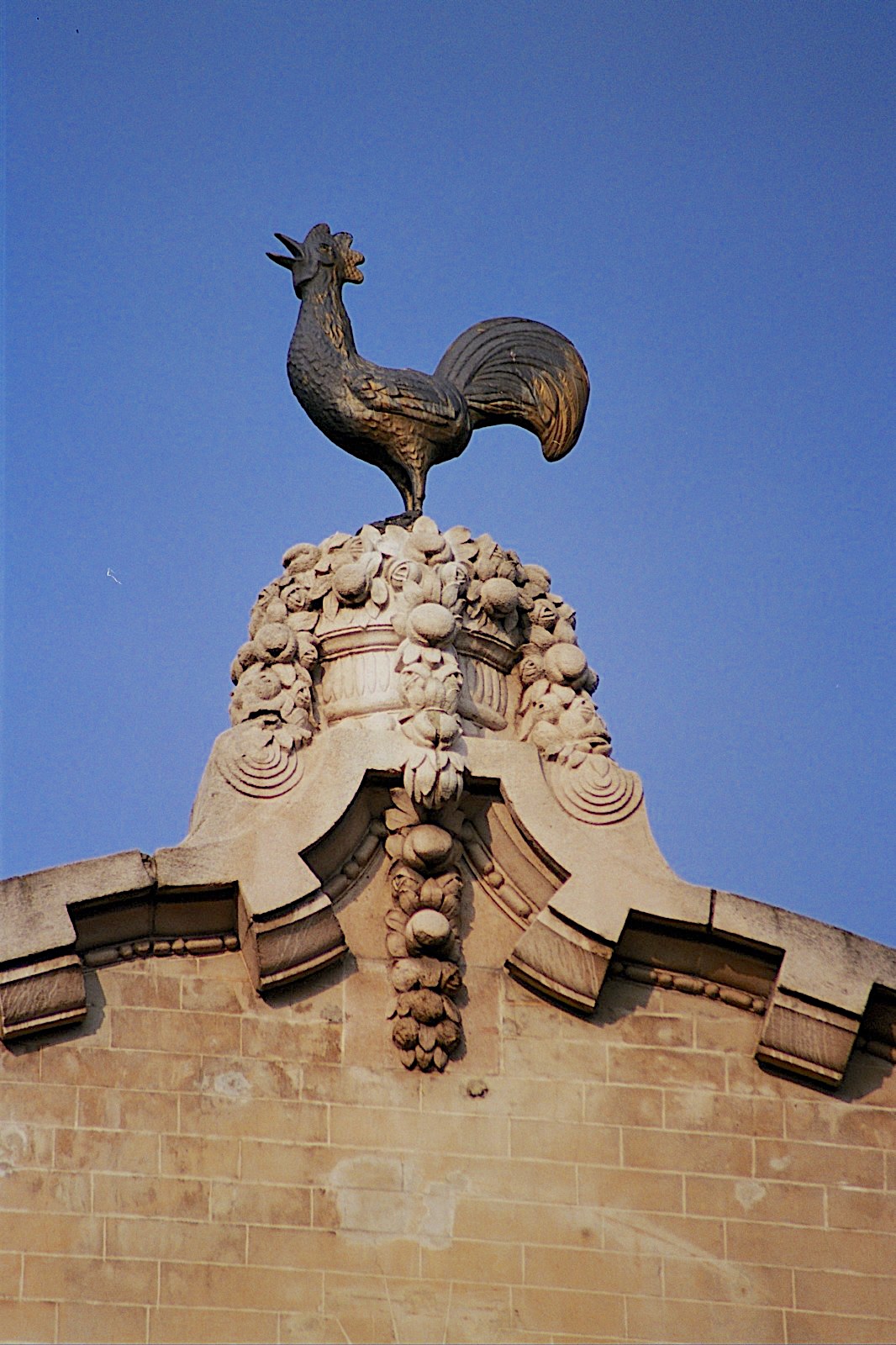
The top of the Cinema Palace, showing the old Pathe logo
In lock step with the fortunes of its neighbours and with the march of cinema technology, the Palace hasn’t stood still for long (the average duration between conversions has been 21 years). In such a site, Alain Richard doesn’t expect this seventh conversion to be the Palace’s last: “Ultimately, it’s about the creation of a neighbourhood, and we won’t be the last to change things here. Perhaps while I’m still alive, there will be a fifth screen or one fewer, who knows?"
City lights
For now, the Palace, a public asset, is thriving in the pedestrian zone. Its targets at launch in 2018 were for 125,000 moviegoers annually within three years and 80% of income generated from ticket sales. In 2025, the cinema attracted 245,000 clients, covering 88% of revenue. Its programme combines arthouse releases with mainstream fare aimed at cinephile regulars and a wider public (the Palace’s biggest-ever hit was 2019 Korean-language crossover triumph Parasite).
Meanwhile, the 2016 White Cinema on the periphery of Brussels failed to find its crowd and closed in February. Its owner blamed the Good Move regional mobility strategy and said the onetime Eden was now probably the worst region for cinema in Europe. Former rival nightspots, the galleries off tatty Avenue de la Toison d’Or, a giant surface car park trapped in redevelopment purgatory, are deserted, and their owner has filed for bankruptcy.
It is now the district centred on the old Grande-île that is leading the revival of mid-2020s downtown Brussels. Despite the underperforming Belgian Beer World attraction, the restored Bourse channels tourists in from the Grand Place. On warm nights, an audience gathers on its steps to watch the human cinema of the crowds parading along the once traffic-choked boulevard. The Ancienne Belgique has recently been restored, the newly-refurbished Metteko café reopened its doors in April, and the Saint-Géry market has gone back to its roots with the return of food stalls beneath its vaults. Next year, the vast Dome project is scheduled to open, combining flats, offices, restaurants and shopping in the converted shell of the old Grands Magasins de la Bourse department store. In Brussels, for better or for worse, the next sequel is always in production.
