
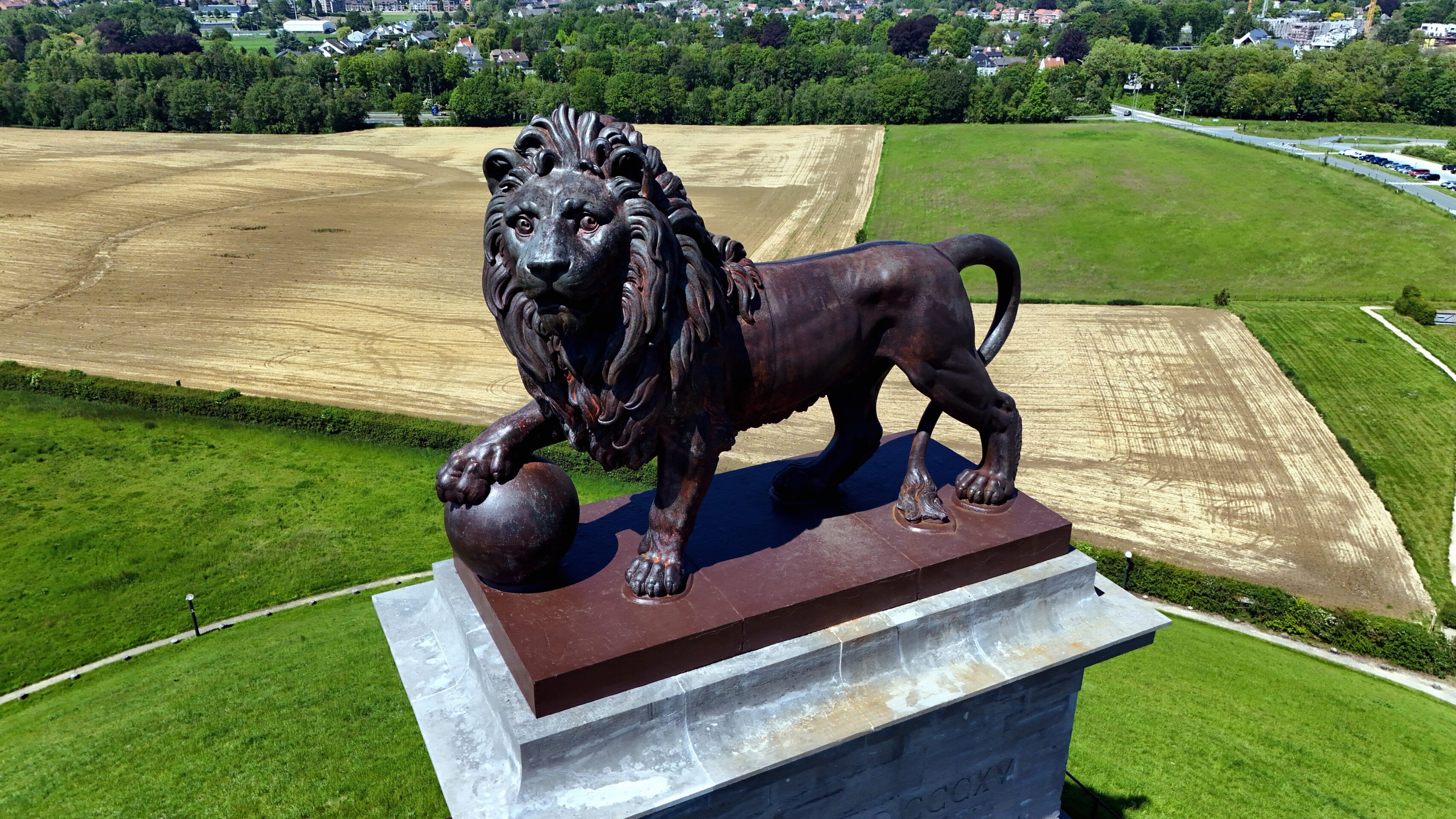
The Waterloo lion is one of the best-known sights of Belgium.He stands majestically atop his plinth overlooking the famous battlefield where Napoleon was finally vanquished and lost his empire. He is a huge source of pride for the country - even if, forgive the nit-picking, the main attraction is not entirely Belgian in origin (more of which later).
What is beyond question, however, is that the Lion Mound, as it’s known, and the surrounding battlefield are a magnet for much-needed tourist moolah.
The lion himself – astonishingly, he doesn’t seem to have a name, although he is certainly male – is looking well and more fearsome than ever after emerging from a cage of scaffolding following a five-month, well-overdue facelift.
Eagle-eyed readers might also spot that he is now also a different colour.
If you’ve visited the Lion Mound or found yourself briefly distracted by its splendour while driving past on the Brussels Ring (a gap in the trees affords an excellent view), you can’t fail to have noticed he was quite a sandy-looking lion king.
But he now has more of a brownish, bronze tint after being coated with a weather-resistant protective paint to reduce corrosion. And lest anyone gets upset about the change, he apparently bears a closer resemblance to his original state.
Indeed, his original colour possibly gave rise to the myth that the lion was made of bronze, melted down from captured French cannon. He is, in fact, made of thick cast-iron, commissioned by a Dutch king and smelted by a Brit.
But nobody’s paying too much attention to these details when your Brussels Times Magazine scribe visits.
It’s a day of celebration after the completion of the restoration.
All the partners involved are present for a ribbon-cutting ceremony, including representatives of the firm that carried out the work, the director of the battlefield site, a good number of national, regional and local politicians, as well as an exec from the Belgian national lottery. If you’ve recently scratched a lottery card, chances are you have contributed to the €665,000 cost of the project.
Thibault Danthine, director of Waterloo Battlefield site and a natural marketing man, is buzzing. “It's a total, total renovation,” he proudly tells me before the ceremony gets underway. “After 200 years, it was time to take care of the lion because he was not in very good shape. But the whole project has gone perfectly, and we now have a beautiful result.”
Belly of the beast
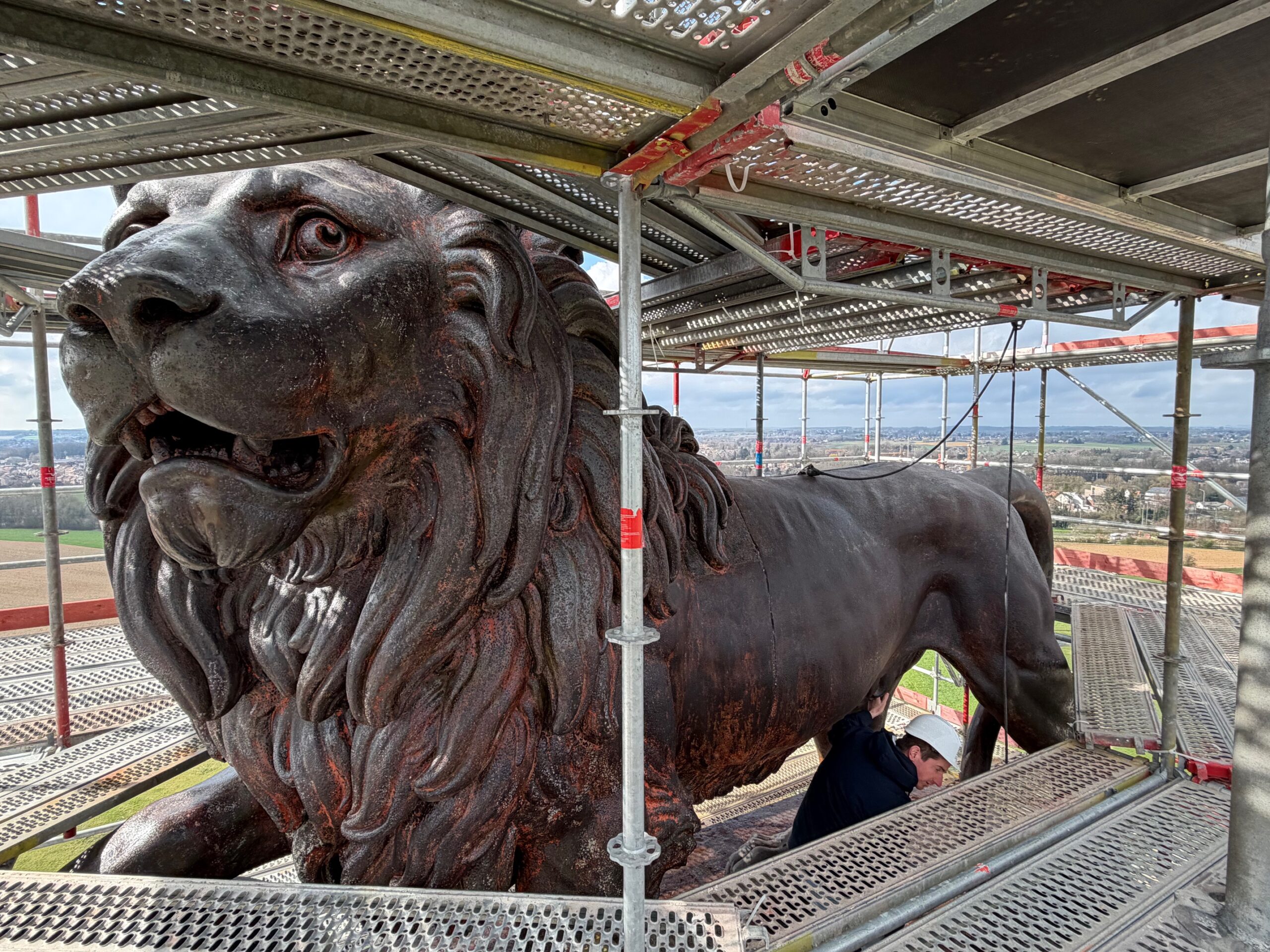
No one knew exactly what they would find when a hatch was opened under the lion’s cavernous belly last December. Considering the hollow interior had not been touched for two centuries, it could have been a lot worse. The lugs attaching the nine pieces of the lion had held up quite well, but some were broken, and there was a fair amount of rust.
Michael Vernieuwe, a project director for Socatra, the Schaerbeek-based firm which carried out the works for the Belgian Buildings Agency (La Régie des Bâtiments), is on hand to explain more.
Credit: Domaine Waterloo
“We could see the lion was very well-made, but everything had moved a little inside because of the rust,” he says. Once the scaffolding was up, they assessed the damage, took scans and made moulds so they could replace the lugs and then re-assemble the pieces of the lion back together again.
“You have to remember that the lion is a living thing. It’s metal, so it swells and contracts all that time due to changes in temperature. We've done everything we can to make sure it lasts as long as possible.”
Vanessa Matz, the Federal Minister responsible for the Buildings Agency, praises the “ingenious” Socatra team, who brought in a special lift from Germany to carry out the work safely. “The lion was caged for a few months, but it was truly worth it. He has regained all of his splendour,” she declares.
Shortly before the grand unveiling, a time capsule is placed in the belly of the beast. It contains a letter signed by Matz, Danthine and the other partners involved, a tool used on the construction site, a one-euro coin, an entry ticket to the museum and a lottery ball.
I wonder aloud if the lion will still be there in another couple of centuries. “Definitely,” says Danthine. “And when they open him back up again, they will discover all the information about the work we have done to preserve the lion.”
Parade of pride
The politicians from Wallonia are, as you’d expect, tremendously enthusiastic about the historic landmark and its pulling power.
Tanguy Stuckens, MP and President of the Provincial College in Walloon Brabant, lavishes praise on Charles Vander Straeten, the Brussels-born architect who came up with the initial plan. “We are very grateful to the person who, 200 years ago, conceived the idea of building a mound, not a stele, on such a significant site. It takes real vision to conceive of something like that,” he says.
Last year and the year before, the site attracted 180,000 paying visitors, many of them local, but also from as far afield as the US, Australia and Asia.
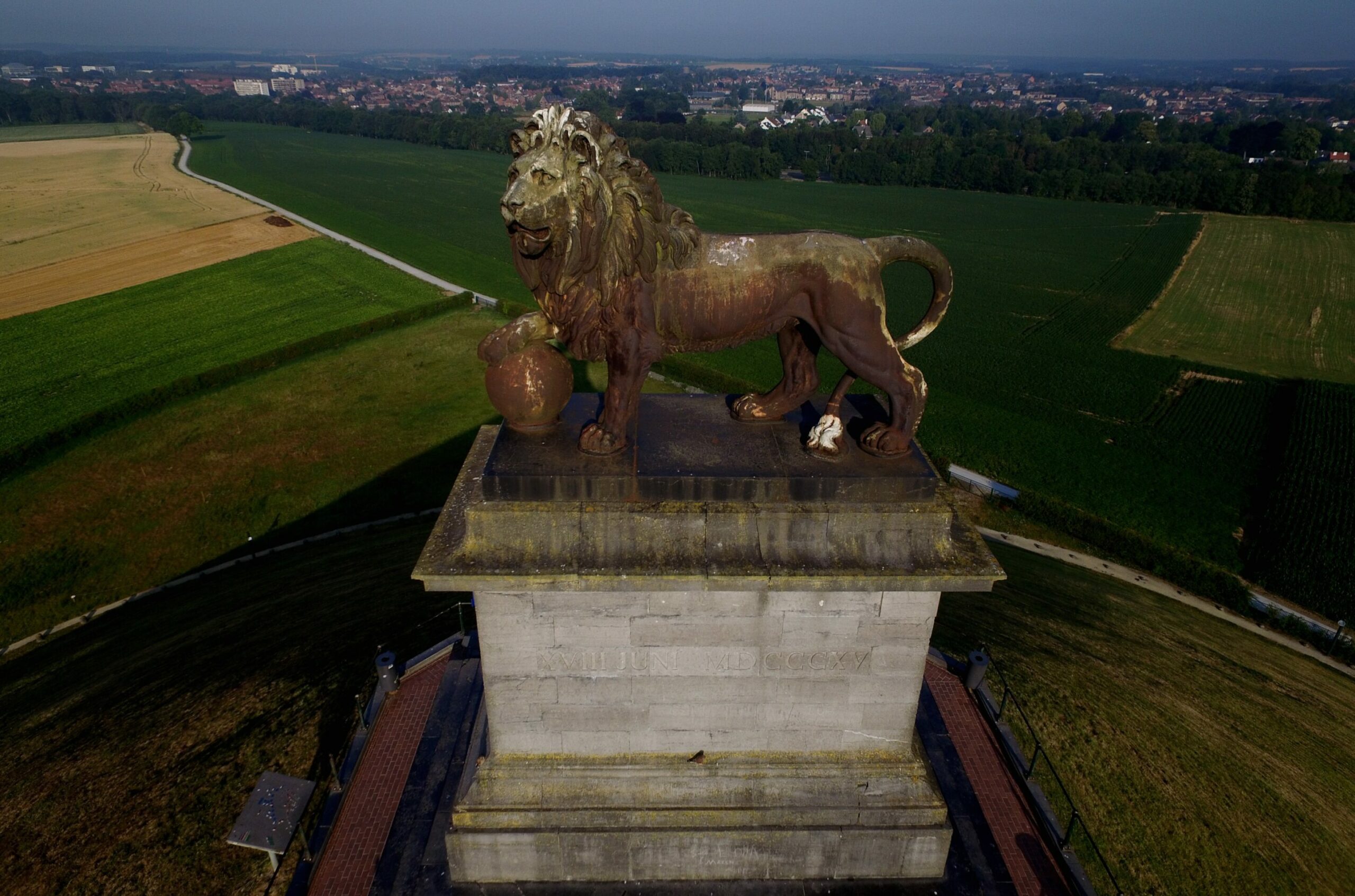
Aerial drone picture shows the Lion's Mound in Waterloo before renovation, Wednesday 17 July 2019, in Waterloo. Credit: Belga
However, the historically complex management of the site creates challenges. It is a very Belgian set-up. The federal government owns the Lion Mound and the region owns a significant area of the surrounding land, along with the province. The battlefield sprawls across four municipalities – Braine l’Alleud, Waterloo, Genappe and Lasne – which formed a single group in 1997, the Intercommunale Bataille de Waterloo, to take care of the site’s management.
Credit: Antoine Charpagne
A French private company, Kléber Rossillon, has the concession for the day-to-day running of the Memorial, which includes the Lion Mound and Panorama building, which contains a circular 110-metre canvas depicting Marshal Ney’s futile cavalry charges against Wellington’s imperturbable infantry. The Panorama was erected in 1912 ahead of the centenary of the battle and was envisaged only as a temporary exhibit, but no one got round to dismantling it.
For Valérie Lescrenier, Walloon Minister for Tourism, the memorial is not just about the past. “Visitors from all over the world come here to understand what transpired and to discover our exceptional heritage, but also to reflect on what this battle still represents for Europe,” she says. “Our duty is to keep this heritage alive without ever betraying its soul.”
If the lion could speak, he would surely agree.
Why, when and how the Lion Mound was created
Nine days before the Battle of Waterloo, European rulers gathered at the Congress of Vienna, which allowed William I of the Netherlands to expand his kingdom to include Belgium. The arrangement suited the Duke of Wellington, whose Anglo-Dutch-German army gained extra troops to face Napoleon (though many Belgians still fought for the French).
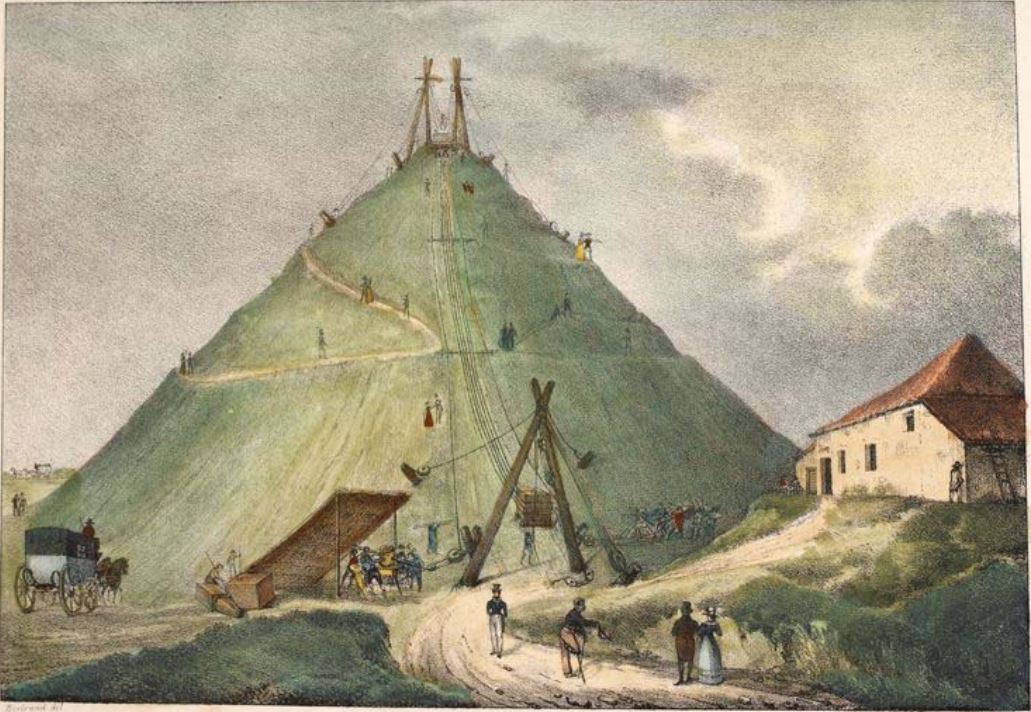
In 1820, William ordered an imposing monument to mark the spot where his eldest son, the Prince of Orange, had been wounded by a stray musket ball in the closing stages of the battle. The injury was slight, but that scarcely mattered.
After rejecting a succession of costly proposals – fountains, obelisks and pyramids among them – William accepted a design from architect Charles Vander Straeten: a vast artificial hill built from 300,000 cubic metres of earth taken from the battlefield itself.
The lion was designed by Mechelen sculptor Jean-Louis Van Geel, who based it on a marble Medici lion in Brussels’ Parc Royal, since stolen. Cast in nine sections at John Cockerill’s iron foundry in Seraing, it travelled by canal to Brussels and then by horse-drawn wagon to Waterloo for assembly.
Building the mound took nearly two years, from 1824 to 1826, and a workforce of around 1,000. Earth was hauled in hundreds of horse-drawn carts and tipped beside the growing hill. Contemporary drawings show labourers – many of them women – carrying heavy baskets of soil.
Size matters
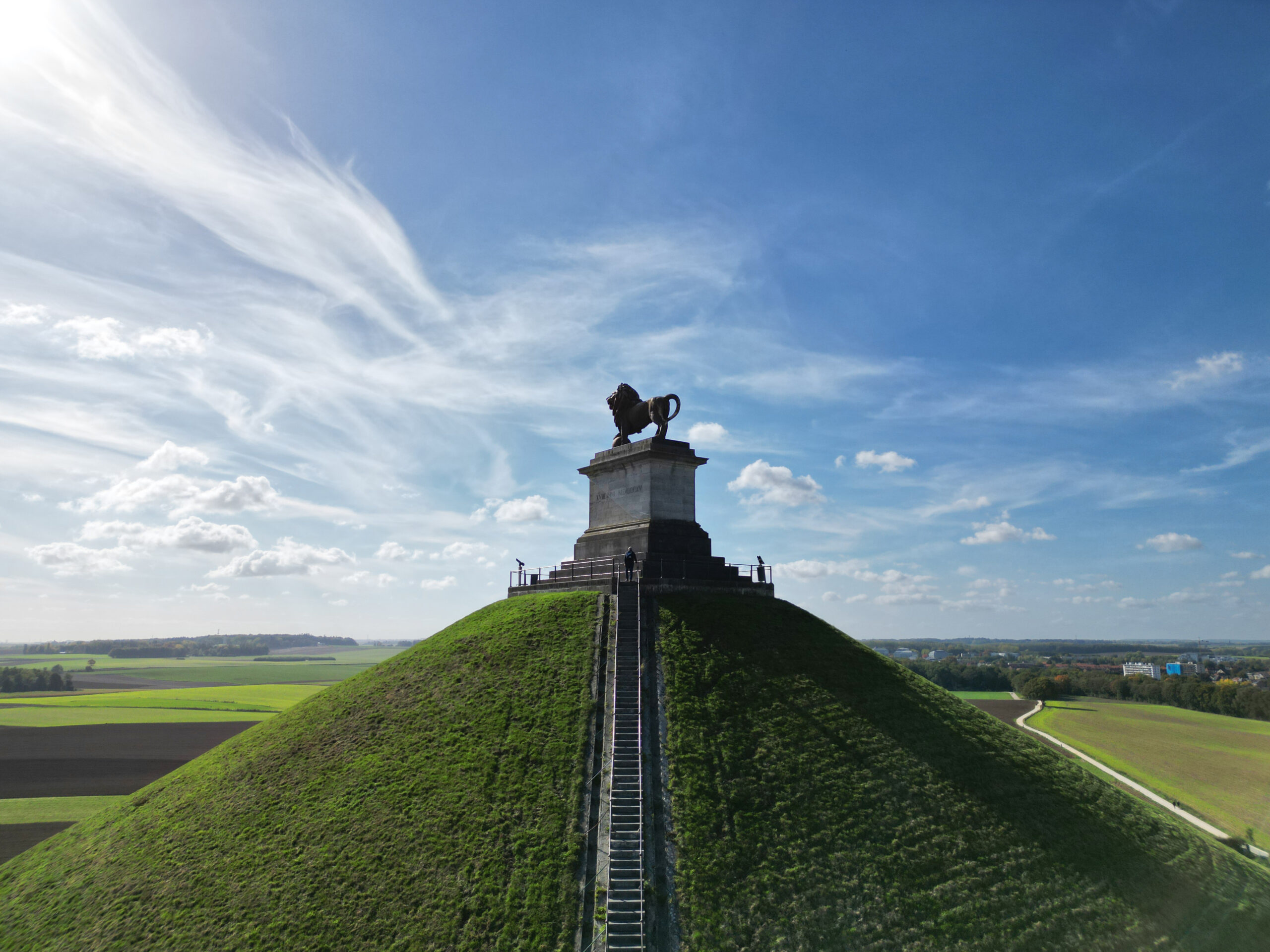
The mound is 41 metres high, with a diameter of 169 metres and circumference of 520 metres. Inside, a column of bricks supports the pedestal, which weighs 250 tonnes. It is inscribed with the date of the battle in Roman numerals: XVIII JUNI MDCCCXV (June 18, 1815). Archaeologists say the mound might also contain human remains, swept up with the earth.
The lion, weighing 28 tonnes, is 4.5 metres in length and 4.45 metres high. It was hoisted onto its plinth with winches on the evening of October 28, 1826.
He looks aggressively in the direction of France. The message is none-too-subtle. Don’t think about invading again. His right paw rests on a sphere, symbolising the victory of monarchy and return of peace in Europe. The Liberté, Égalité, Fraternité ideals of the French Revolution were firmly on the backburner.
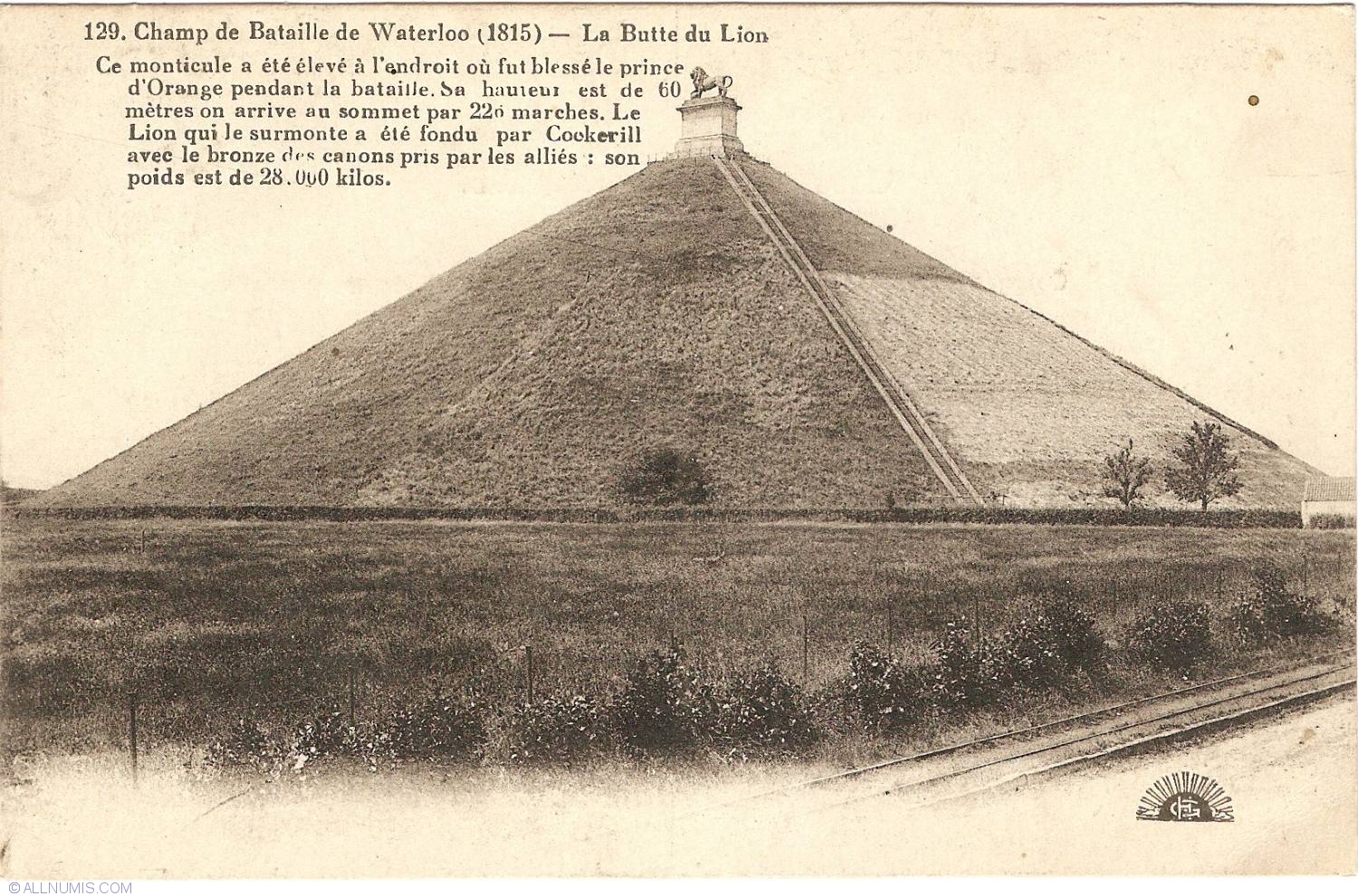
When William refused to accept Belgian independence in 1830, the new country’s government appealed to the French for support. In November 1832, the Armée du Nord returned under Marshal Étienne Gérard to lay siege to Dutch troops in Antwerp. They passed through Waterloo en route, where a few French soldiers tried to topple the lion, but only managed to break its tail.
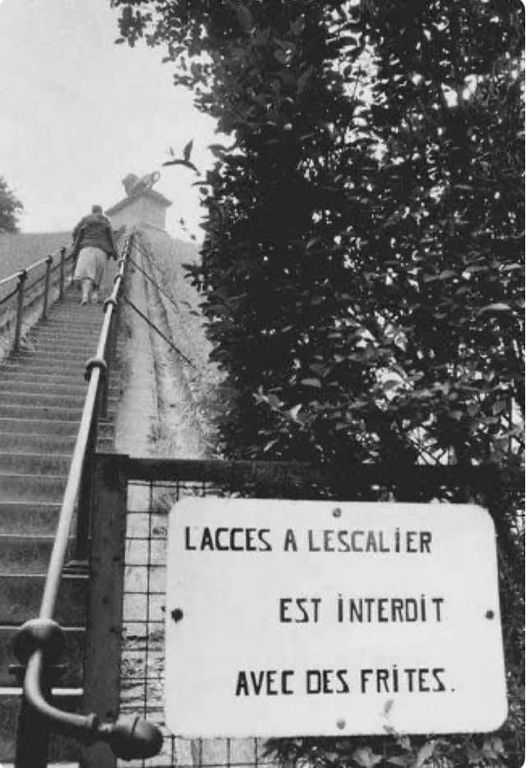
Vander Straeten did not originally envisage steps to the top of the Lion Mound because they would mean maintenance costs and he knew King William would prefer to avoid this expense. It was not until 1864-68 that the 226 steps and passageway we see today were added.
Wellington hated the Lion Mound. When he returned to the scene of his great victory some years later, he was extremely miffed. “They have altered my field of battle,” he moaned.
Victor Hugo, a fervent admirer of Napoleon, was no fan either. Describing Waterloo as “a battle of the first importance won by a commander of the second rank” and the “supreme triumph of mediocrity over genius,” the writer said he could not set foot on the “morne plain” until the lion was destroyed. However, he did stay nearby when he completed Les Misérables at the Hôtel des Colonnes in Mont-Saint-Jean in 1861, devoting 19 chapters to the “sinister history and autopsy of the catastrophe.”
 During the First World War, 95% of the country was occupied and the site was a popular destination for Germans stationed in Brussels, eager to witness the scene of Prussia’s great triumph (Wellington admitted that the arrival of his ally, Field Marshal Blücher, swung the battle decisively in his favour).
During the Second World War, the Germans returned and installed a radio jamming device and radar on the Lion Mound. The radar signals were transmitted to a bunker opposite Mont-Saint-Jean farm, the site of the Allied field hospital during the 1815 battle. The equipment was dismantled and the bunker dynamited by the Germans before they departed in September 1944.
