
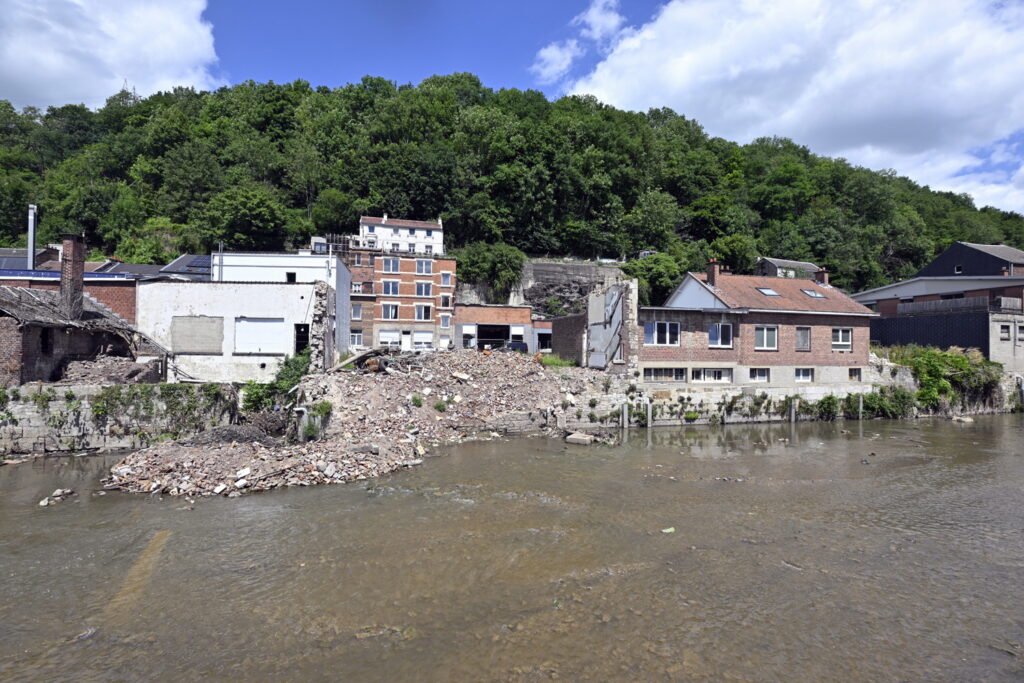
Wallonia must rethink land-use planning and river management after the deadly floods of 2021, researchers say, warning that safer valleys will require more room for water, less sealed ground and a mix of natural measures and civil engineering.
The floods in the Vesdre basin showed how vulnerable the region has become. Although the Eupen and Gileppe dams usually help regulate the river, the volume of water was so great that the infrastructure could not contain the flood peak.
“The flow speeds were far above critical levels,” geomorphologist Geoffrey Houbrechts of the University of Liège told Belga. In his view, the historic way Wallonia has engineered its rivers has reached its limits.
He said artificial structures such as retaining walls and rock armor reduce the riverbanks’ natural roughness and can increase the destructive force of the water. Tree roots, by contrast, help slow the flow.
Fixing riverbanks in place has also created a shortage of sediment, pushing rivers to erode their beds more deeply and harming aquatic life, he said.
Restoring vegetated banks, however, is not straightforward. Techniques such as planting willow cuttings can attract wildlife, including beavers, for which willow is a main food source.
Because monitoring these natural areas takes time and resources, managers often favour rock reinforcements instead. But those structures can encourage the spread of Japanese knotweed, an invasive species that damages biodiversity.
Researchers argue that rivers need to be given more space to move. Allowing them to shift and erode certain natural areas can dissipate energy, slow floodwaters and better protect built-up areas downstream.
In Wallonia, that principle clashes with long-established development in valley bottoms. Creating room for rivers is especially difficult where the RAVeL network of slow routes has been built along former towpaths directly beside the water.
“We have fixed the river in place; we can no longer allow it to move by two metres,” Houbrechts said.
That enforced immobility makes the scale of the 2021 erosion all the more striking. Analysis of old sediments containing metallurgical slag shows that Wallonia’s rivers normally move very little over time, underlining just how exceptional the flood was.
Hydrologists say the rainfall also exposed how urbanisation has weakened the land’s ability to absorb water. “The first priority is to stop sealing the land,” said Aurore Degré, professor of hydrology and soil physics at Gembloux Agro-Bio Tech, part of the University of Liège.
She warned that new building on plateaux is still degrading the land and increasing flood risk downstream.
Degré called for more de-sealing in urban areas and better management of agricultural soils. When rainfall becomes extreme, she said, soils reach their limits, making measures such as hedges, ditches and ponds particularly valuable.
Ditches and embankments dug along contour lines can redirect water towards higher ground, where it can infiltrate the soil and help reduce peak flood flows.
In rural areas, projects such as DAFoR are examining land consolidation schemes to create strips of land along rivers as grassed buffer zones, helping to reduce erosion and run-off.
Forests also offer significant scope for improvement, Degré said. Avoiding soil compaction and blocking existing drains can be highly effective because such measures work across the whole catchment, which covers nearly 700 square kilometres.
Her team’s MODREC modelling project suggests these measures can make a major difference. Targeted interventions could reduce peak flow by 30% in the Magne sub-basin and by more than 50% in some parts of the municipality of Herve.
Degré said these approaches must still be combined with conventional civil engineering to protect valley floors that have long been urbanised. “The full range of measures must be used. Setting solutions against each other is not relevant,” she said.
But she also argued that the main lesson is to stop building in hazard-prone areas. She called for a “genuine public debate” on how land should be used as the climate changes.
Across the research, the message is consistent: whether by restoring hedges on plateaus or accepting natural bank erosion in valleys, Wallonia must redefine its relationship with water.
The researchers say absolute protection through concrete is an illusion. The future of the Vesdre valley will depend on difficult compromises between public safety, land-use planning and restoring nature’s capacity to absorb water, as illustrated by the planned future Vesdre Park in Chênée.
